NOUVEL ArticleScientifique - Une équipe de scientifiques, dont @AlexLobel_ de l' @ORB_KSB vient de publier ses nouvelles connaissances sur les étoiles hypergéantes jaunes qui sont parmi les étoiles les plus massives.
https://t.co/HLy7ubZtZ2
A&A Article: https://t.co/m7BICS39NY
NIEUWE Publicatie- Een team van wetenschappers, inclusief @AlexLobel_ van @ORB_KSB publiceerde nieuwe inzichten over Gele Hyperreuzen die behoren tot de grootste en meest lichtkrachtige sterren in ons sterrenstelsel.
https://t.co/v6waxDCsjx
A&A Publicatie https://t.co/m7BICS39NY
NEW SciencePaper - A team of scientists, including @AlexLobel_ from the @ORB_KSB just published their new insights on Yellow Hypergiant stars, which are among the most massive and luminous stars in our Galaxy.
https://t.co/zYe5HXaysh
A&A SciencePaper: https://t.co/m7BICS39NY
🛰️@ESAGaia cesse ses observations fructueuses, mais la récolte scientifique continue, notamment grâce aux scientifiques de l'@ORB_KSB.
Nous attendons avec impatience les 4e et 5e catalogues de Gaia pour étendre notre connaissance de la #VoieLactée ! 🤩
💡 https://t.co/zFtfP05deC
🛰️@ESAGaia stopt ermee, maar de wetenschappelijke oogst gaat verder, met name dankzij wetenschappers van de @ORB_KSB
We kijken uit naar de 4de en 5de Gaia-catalogi om onze kennis van het #Melkwegstelsel verder uit te breiden! 🤩
💡 https://t.co/IwkCEiC0sN
The new Gaia maps are the best reconstructed views of how our Milky Way galaxy might look to an outside observer. They show us our place in the Universe like no other mission has before.
📢 Gaia delivers the best Milky Way maps to date and takes its last starlight before spacecraft retirement.
But the science is far from over.
Discover what's coming next for the mission and how you could wave @ESAGaia farewell if you own a telescope 👉 https://t.co/6uKL9U3wfc
Find the full set of our freshly brewed Milky Way visuals from this page: https://t.co/Umwjd6Y9Rz Shared under Creative Commons license to ease up their reuse: CC BY-SA 3.0 IGO.
🛰️@ESAGaia is ending its fruitful life of observations, but the scientific harvest continues, notably thanks to scientists of the @ORB_KSB
We are looking forward to the 4th and the 5th data releases to expand further our knowledge of the #MilkyWay! 🤩 https://t.co/OEVjwgfnGA
⭐ Een nieuw #ZwartGat ⚫️ werd ontdekt met data van de 🛰 @ESAGaia-satelliet🛰 . De @ORB_KSB heeft bijgedragen aan deze ontdekking met metingen van de radiële snelheden. https://t.co/Uebl8NJ5zj
⭐ Un nouveau #TrouNoir⚫️ vient d’être découvert grâce aux données du 🛰satellite @ESAGaia 🛰 . L’@ORB_KSB a contribué à cette découverte grâce aux mesures des vitesses radiales des étoiles. https://t.co/q3csizAqbm
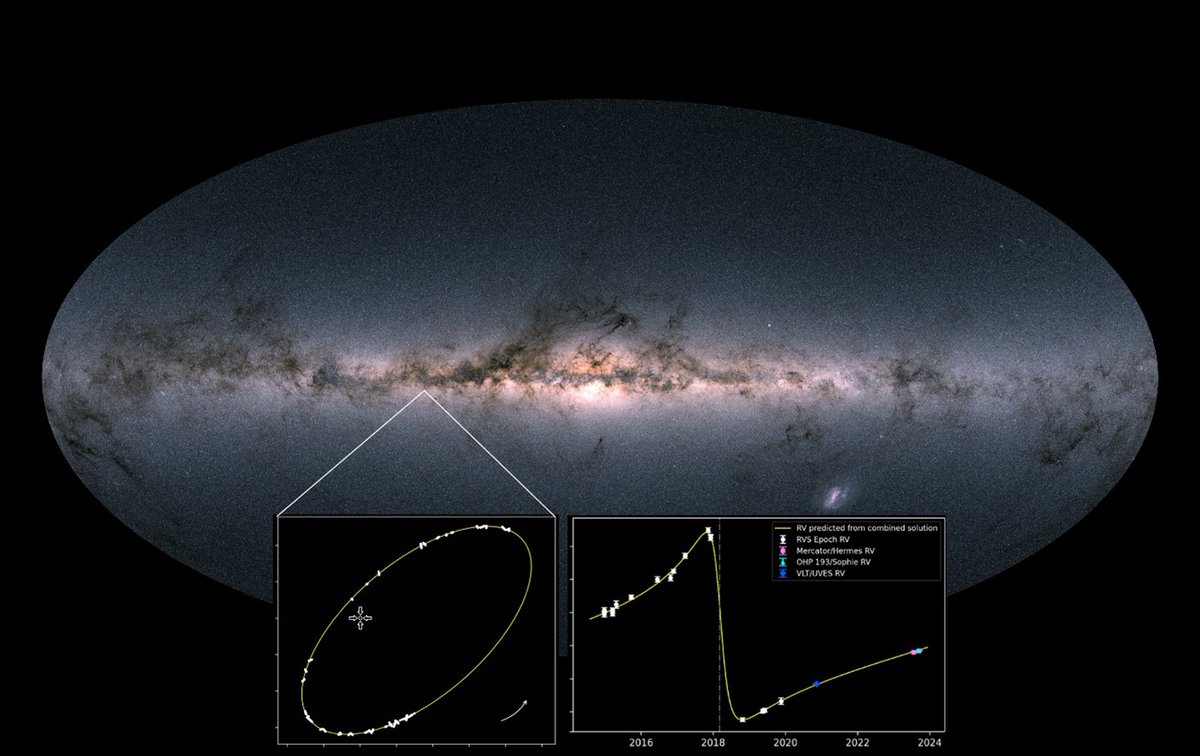
⭐ A new #BlackHole ⚫️ was discovered thanks to 🛰@ESAGaia satellite🛰 data. The @ORB_KSB contributed to this discovery thanks to the radial velocity data it helped to process. https://t.co/wdBhJr9juY
✨🔭Today, we celebrate the 10th #anniversary of @ESAGaia. Its colossal task of the mapping of the Galaxy, to which five scientists from the @ORB_KSB, have contributed, still continues.
#HappyBirthday Gaia! 🔭🧪#GaiaMission#GaiaDPAC https://t.co/kmR845oLZv
✨🛰Vandaag is de 10e verjaardag van @ESAGaia. Tot op heden blijft Gaia onze Melkweg in kaart brengen, een kolossale taak waaraan 5 wetenschappers van @ORB_KSB hebben bijgedragen.
#Gelukkigeverjaardag Gaia! 🔭🧪#GaiaMission https://t.co/ozmQlYpuq4
The @ESAGaia website recently published an image of planetary nebula HFG1. The small blue dot at the center is V664 Cassiopeiae, the two mother stars of the planetary nebula. They sparkle with a very regular pulse of light. Like a cosmic clock! https://t.co/bKj5zGmWHu
Stellar pulsations cause rhythmic brightness shifts, binary systems reshape stars into ellipsoids; and the potential mysterious dust clouds influence the luminosity of stars. The red giant star Mira is a prototype of a pulsating long period variables: https://t.co/K1MVfRnnph