For the last years, we have been working toward a new breakthrough. A ground-up rearchitecting to set new records in speed, and UX (in addition to unprecedented throughput).
Yesterday, with the same minimal technical specs, we have processed 1 Billion transactions, achieving a peak of 120k transactions/second in a LIVE community battlenet, with only 3 shards + metachain.
This is SUPERNOVA 🔥
The game has changed.
🇺🇸 EGLD Enters the US Institutional Conversation
———
State of Arizona advanced two crypto bills to a full House vote.
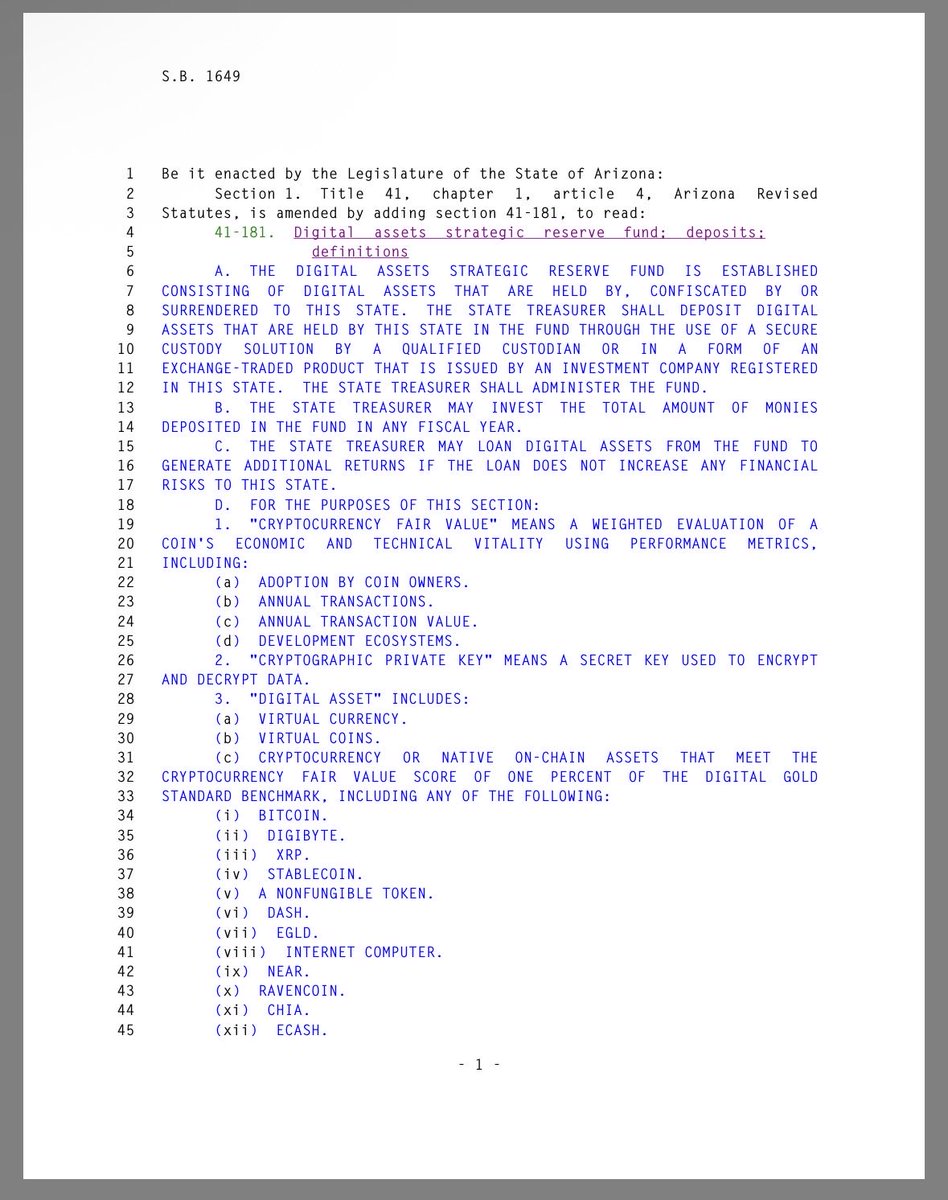
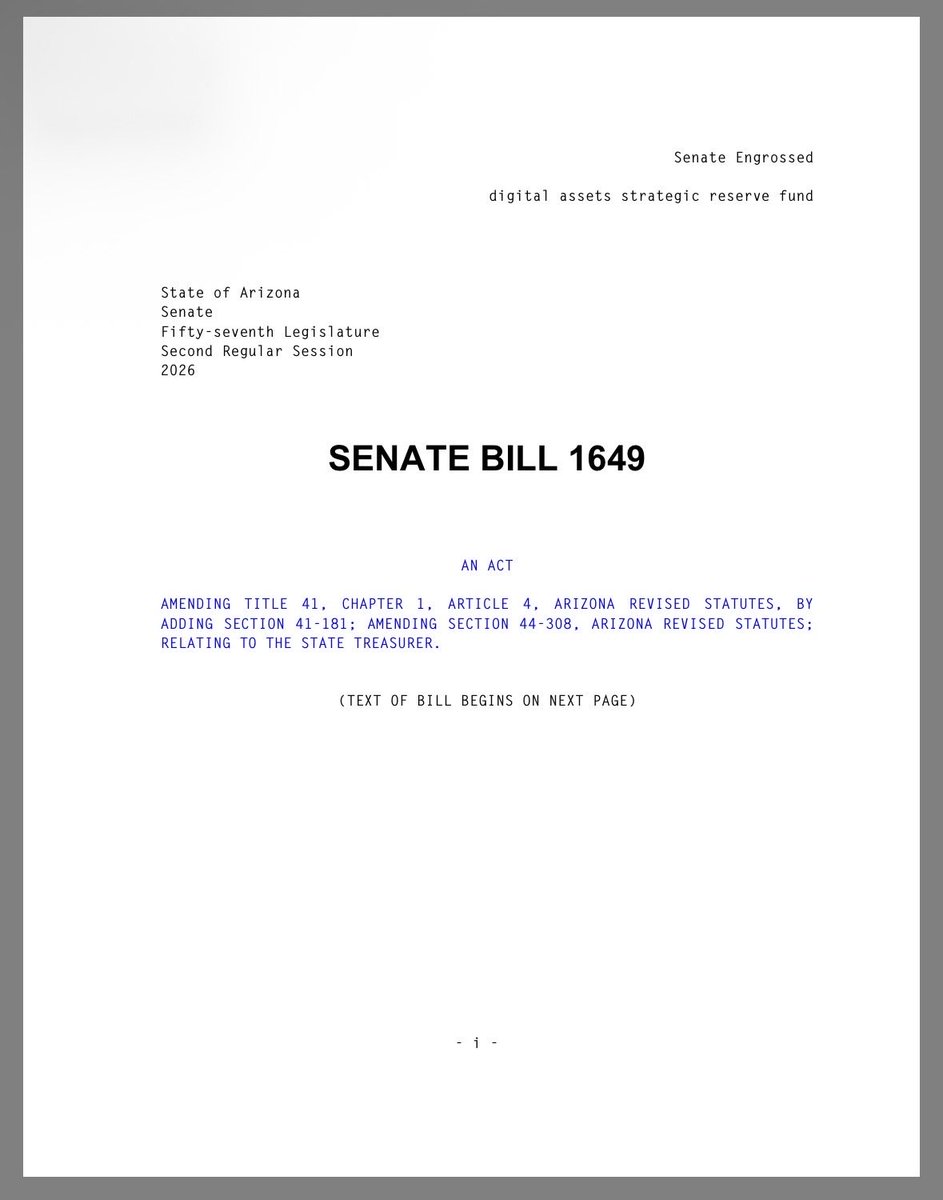
SB1042 allows 10% of state public funds into digital assets. SB1649 creates a Digital Assets Strategic Reserve Fund, first of its kind in the US.
SB1649 names 14 cryptocurrencies by name. Selection criteria: adoption, transactions, transaction value, development ecosystem.
EGLD is one of the 14.
———
If passed, Arizona creates the first US state crypto reserve. EGLD eligible from day one. The precedent opens the door for other states and bigger institutional adoption.
source: https://t.co/SC9QZCBMqU
Supernova is live on Battle Net.
Here's what changed under the hood and why it matters.
The paradigm shift nobody's talking about:
Every blockchain in the industry is measured on two metrics: block time and throughput.
Faster blocks = better chain. More TPS = better chain.
----------
Supernova breaks this framing entirely.
For the first time in the blockchain industry, block finality is faster than block slot allocation.
Let me explain what that means.
How every other blockchain works:
Traditional blockchains follow Execute → Propose → Vote. Validators must execute every transaction before proposing a block.
The block slot is the clock. Finality can never be faster than the slot, because execution is in the critical path.
Ethereum: 12.8s slot, ~12.8 minutes finality.
Solana: 400-600ms slot, 13 seconds finality.
Sui: variable, ~500 to 1000 ms for complex transactions.
In every case: finality ≥ block slot. This is treated as a law of physics.
It's not.
----------
How Supernova works:
We flipped the model to Propose/Vote → then Execute.
Consensus proceeds independently of execution. Validators agree on transaction ordering first. Execution results are notarized in subsequent block headers via inclusion proofs.
The inclusion proof is the key innovation: it allows a block to be finalized with cryptographic proof that its transactions will execute correctly, before the execution itself completes.
The virtual state tracker in the transaction pool maintains a deterministic view of account states (nonces, balances, pending transactions) so consensus can validate without waiting for full execution.
Result: the block is finalized faster than the block round itself.
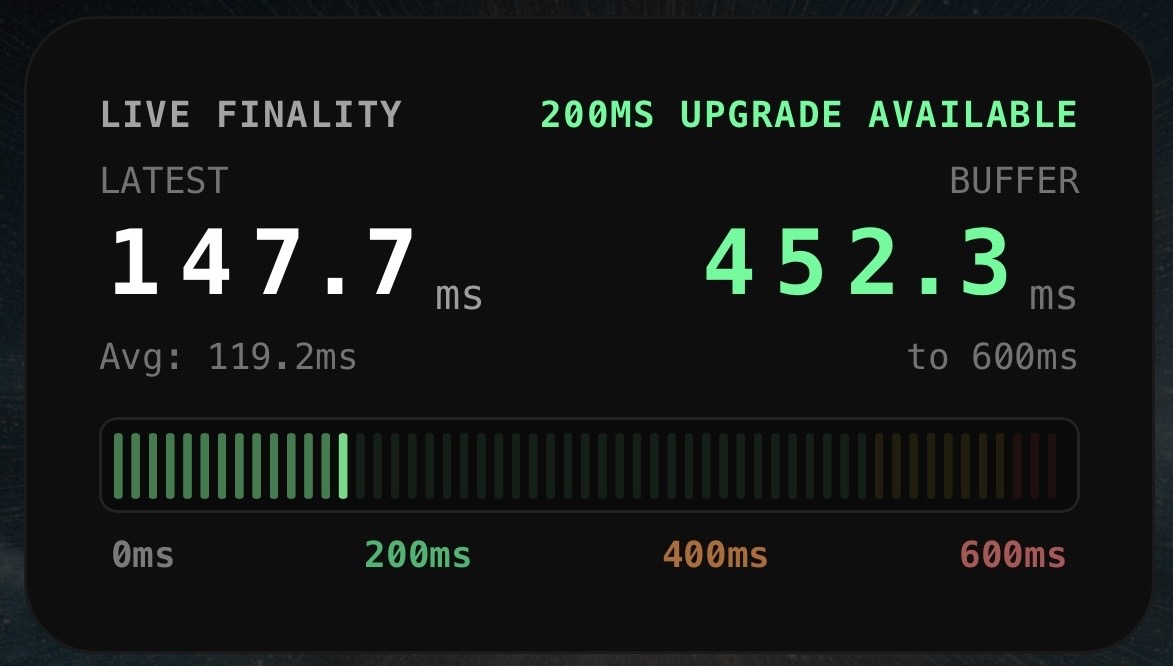
88ms finality measured in testing. Sub-200ms under real-world conditions. On 600ms block slots.
Finality < block slot. First time in the industry.
----------
The throughput story:
With the same hardware specification as pre-Supernova mainnet, the network now achieves ~120,000 transactions per second in burst mode. Same nodes. Same machines. 10x the block production cadence.
This is the same validator infrastructure running fundamentally better software.
The backpressure system (Execution-Result Inclusion Estimator) ensures this scales safely - dynamically adjusting per-block gas limits if execution lags behind proposals, so minimum-spec nodes never get overwhelmed.
What this means in context:
- Block time: 6s → 600ms (10x)
- Finality: ~88ms measured (first blockchain where finality < slot time)
- Throughput: ~120,000 TPS burst mode (same hardware)
- Architecture: consensus fully decoupled from execution
- Sharding: 3 execution shards + metachain, fully preserved
- Validators: 3,200+ nodes, no hardware upgrade required
----------
Battle of Nodes is stress-testing all of this right now. $150K in prizes to find what breaks. Validators, security researchers, builders, and guilds pushing the limits.
If Supernova survives this, it ships to mainnet.
150,000 lines of new protocol code. 20 months of engineering. The most significant upgrade since genesis.
Many are looking at how much @MultiversX / Elrond / $EGLD has dropped in price, especially percentage-wise.
Few, if any, look at where it started, the levels it reached, and where it stands today compared to competitors.
So let me help.
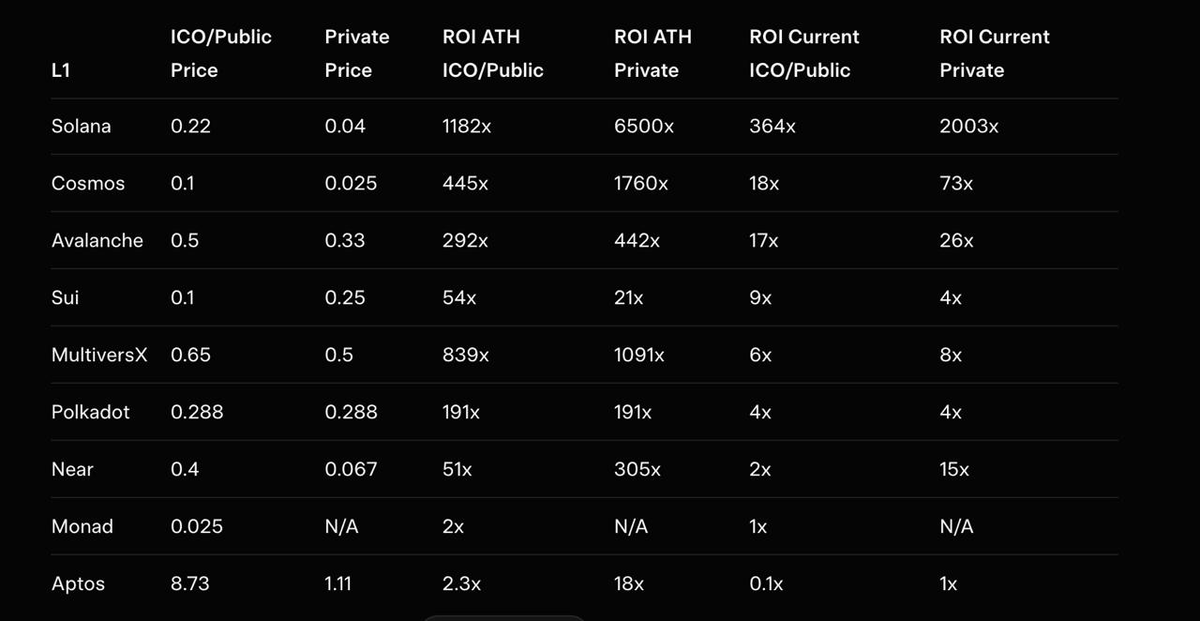
Elrond delivered 839x returns for @binance ICO users at ATH, while private investors achieved 1091x. By this metric, among L1s launched in the same period or later, only Solana ranks ahead; we come next.
Today’s ROI for public and private ICO participants puts us above Polkadot, NEAR, Monad, and Aptos, close to SUI—roughly mid-table among the top 10.
I’m not sure where you’re looking, but from our starting point and everyone else’s, we’re still in the game with all of them, ahead of most.
People call @lucianmincu (the smart one) and @beniaminmincu (the old/wise one) scammers for “only” 839x and 1091x returns, with today’s market ROI at 6x (public) and 8x (private).
Why aren’t NEAR holders calling their team scammers for a 2x ICO ROI, or Polkadot holders, or even SUI with slightly higher ROI than EGLD?
Nobody does, because they’re blinded by the market or, to be brutally honest, most other projects barely have a community that cares about price or ecosystem.
Trust me: we have a huge community of everything—haters, fans, elite minds.
What we lack are VCs and market makers; most missed the gem in 2020, and those who didn’t exited during the 1000x run.
We have a clean cycle ahead: new players will enter for the long term when the market recovers, along with people migrating from failed chains that long ago stopped delivering upgrades or real products.
Answer this: How many projects from that table own a majority stake in a full stablecoin issuer (@xMoney_com) across Europe (soon expanding), with over 50k debit cards issued directly (no third party), many Web2 merchants accepting crypto payments (I use most of them regularly), plus a multichain wallet (@xPortalApp) that frankly beats the rest?
Answer: none.
Their foundations never focused on the phase after crypto dreamers leave and regulated institutions enter.
Most will be left behind or forced to catch up in the next 5 years.
Our handicaps:
- Europe-based
- Missing US players (if you’re one and reading this, get in at this price)
- No strong market makers or liquidity
- Romanians
- Not hardcore builders; we need fewer wannabes
#Perspective
Run the @MultiversX node at lightspeed from everywhere. This is something unprecedented. No other stack has all the accumulated qualities of the MultiversX node.
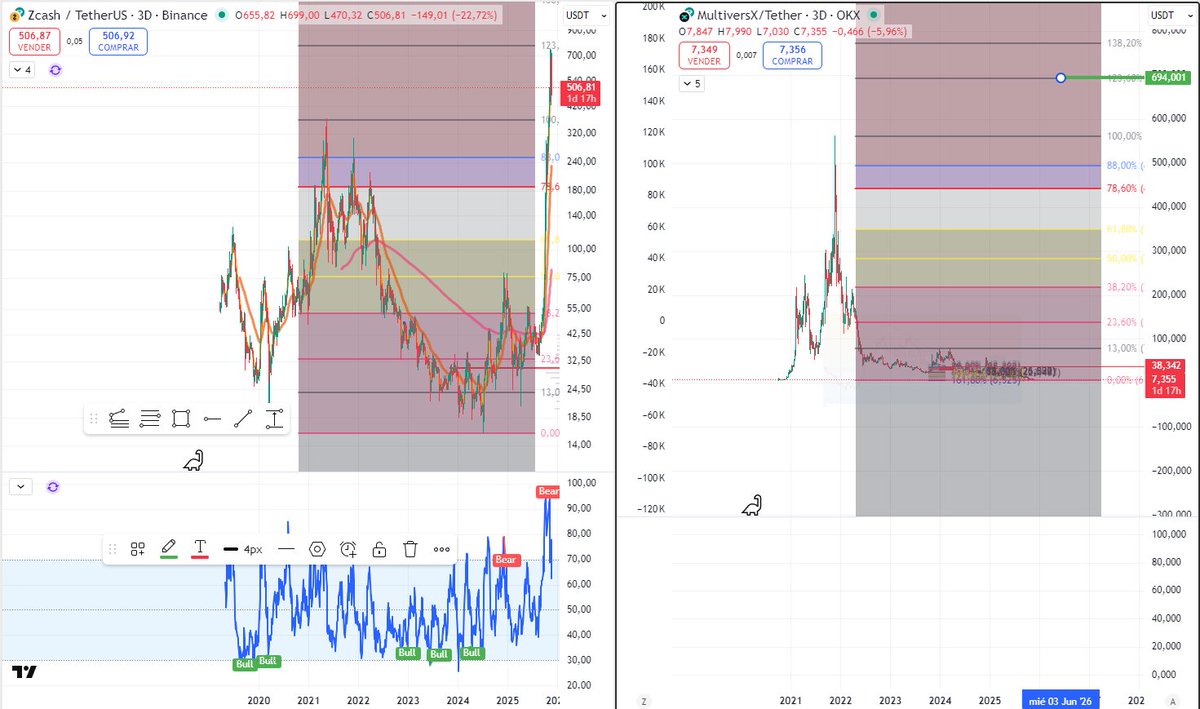
🔥 WHEN PRIVACY BECOMES SCARCITY: WHY EGLD WILL WIN ZEC $516 vs EGLD $7.31
The market is asleep. The thesis is clear. What's missing is execution.
The Narrative VCs Don't Want You to Understand Days ago, Arthur Hayes (former CEO of BitMEX) set the tone: #ZEC toward $10,000. Andreessen Horowitz published: "The demand for privacy is more urgent than ever."
@NavalRavikant made it obvious: "Transparent crypto won't survive a government crackdown." Balaji Srinivasan, Tim Ferriss, The Winklevoss Brothers, Mert Mumtaz (CEO of Helius) — all pushing #privacy.
The market reacted. ZEC exploded 1,500% in 2025. But wait. The Problem with ZEC: Theoretical Beauty, Mediocre Reality Here's what nobody says:
80% of ZEC circulates in TRANSPARENT mode.
Users optionally use "shielded" addresses, but the incentive isn't baked into the architecture. It's a feature, not a systemic necessity.
ZEC is already at @coingecko #15. Valuation: $7.8 billion. Predicting $10,000 means accepting a valuation of $151+ billion just for privacy computing power that most users already don't use.
The regulators? They're closing exchanges in the EU starting 2027. FinCEN in the USA: report every privacy transaction > $500. ZEC buys the memes. But memes aren't architecture.
Why EGLD Is the Hidden Player Today: $7.31. CoinGecko #257.
While the market was mesmerized by ZEC, Lucian Mincu and MultiversX built SILENTLY a network ready to absorb what ZEC promises but doesn't deliver: AspectZECEGLD Privacy ArchitectureOptional/OverlayNative/Integrable TPS Scalability~30~15,000 CoinGecko Position#15 ($7.8B)#257 ($236M)
Upside RatioLimited (already hyped)EXPONENTIAL VC NarrativeSaturatedDORMANT Simple math: If MultiversX implements native privacy as a core feature (not an overlay), and the market assigns it even 50% of ZEC's premium, we reach a valuation of $3.9 billion. At current supply: $694,000 per EGLD.
Is it possible? Yes. Is it conservative? Absolutely.
Naval Was Right. VCs Know It. You Know It. "Transparent crypto won't survive a crackdown." But here's the plot twist mainstream analysts miss: ZEC already has the hype, regulation is already coming, and the architecture isn't optimized to survive it. EGLD, sleeping at position #257, has:
✅ Real scalability (not aspirational)
✅ Integrable privacy (not bolted-on)
✅ Intact narrative runway
✅ Surprise factor
The Play: Lucian Mincu Is The Missing Catalyst @lucianmincu has the vision, the technical credibility, and the disposition to execute. When he announces that MultiversX pivots toward privacy as a differentiating feature: The market will compare EGLD vs ZEC EGLD's architecture will win (privacy + speed) The valuation will follow This isn't prediction. It's recognition of potential. The Moment Is Now ZEC made its move. A16z, Hayes, Naval got their pump. But EGLD is still asleep.
In #Bitcoin parlance: "HODLers become millionaires." In this case, EGLD accumulators become holders of the next narrative. Privacy isn't luxury. It's survival. EGLD isn't #257. It's #15 waiting for execution.
When Mincu does it, remember this. 🚀
Congrats @MultiversX on the @WalletConnect Challenger Finale win 🔥
It was an honor to battle in the final alongside you.
For us at #Radix, reaching 2nd place out of 72 contenders - and beating giants like $SOL, Tezos, Hyperliquid, Vechain & more on the way - already proved the strength of our community 💪
The #Radix ecosystem is still early, but with fair rewards (1B $XRD incentives), uncompromising security, and a grassroots community that never gives up, we’re building something meant to last 🚀
Respect to @MultiversX, thanks to @WalletConnect 🙏, and the biggest thanks to the #Radix community ❤️ - you carried us all the way here.