The quantum future is full of possibility.
Our goal is to bring that future forward.
We turn quantum's hard problems into challenges open to the world.
Our network rewards the people who solve them.
It also connects us with potential customers and pilot partners, helping turn research into tools people actually use.
This promises a clearer path from solving quantum software problems to implementing the solutions in industry.
Let’s get to work ψ
Building useful software takes testing and feedback.
CO.LAB Q connects us with quantum hardware and technical experts to benchmark our tools across platforms, refine them and tackle real-world requirements.
This month Superquantum, the team behind Qubitcoin, has joined CO.LAB Q’s inaugural cohort in Chattanooga.
Here’s why we're delighted to be part of it:
The more you look into @qubitcoinx, the more you’ll realize that the company and team behind it are as legitimate as they come.
Superquantum built qubitcoin-2:native because they conceived of it as being the most efficient and practical means for improving quantum computing’s fundamental algorithms. No other reason.
Superquantum’s real world traction proves they have what it takes to get those algorithms into the hands of non-crypto orgs that will use them.
Few understand what’s coming.
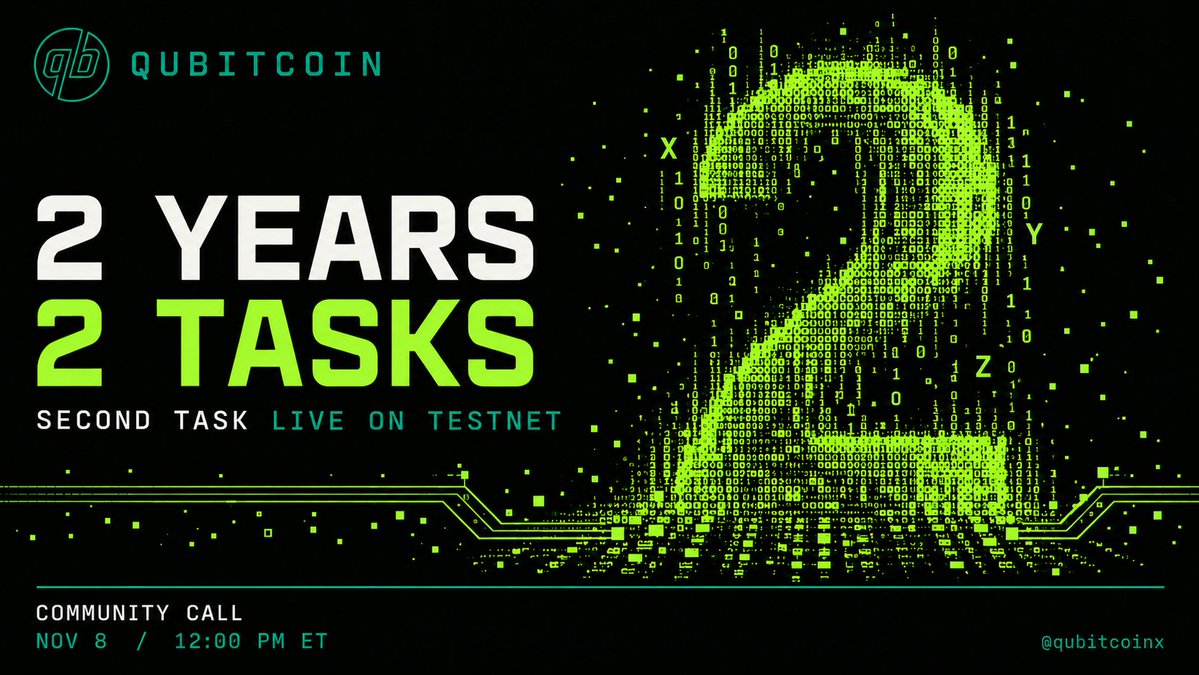
Two years of Qubitcoin! 🎉
Our second computational task, decoding random stabilizer codes, is now live on testnet. A new milestone for Superdense Consensus!
Join our community call: Sunday, Nov 8, 12 PM ET.
Thank you for two years of support!
Some highly interesting developments around the team behind Qubitcoin $QTC
Members of the Superquantum team, which created and actively manages Qubitcoin via the Foundation, recently won Lockheed Martin’s quantum-computing challenge at Vanderbilt’s inaugural 2026 Dry Dock event.
Lockheed Martin’s quantum challenge was straightforward to understand but difficult to solve and the challenge was to use quantum computing to find the one thing that doesn’t belong.
Examples included identifying a self-driving car amongst human-driven traffic or detecting a vehicle constructed from an unusual mixture of materials - essentially a high-powered anomaly-detection / pattern-recognition problem using quantum tools.
The winner was Superquantum's/Qubitcoin's team - David Nizovsky, Daniil Shatokhin, Dmitrii Khitrin (Qubitcoin's Director), and, much to the community's surprise, a new face appeared among the ranks - Carter Steinberg.
The attached clip is an excerpt from the winning speech conducted by Carter, who appears to be playing an increasingly visible business-facing role.
He graduated in Economics from Vanderbilt and now works at Morgan Stanley . His background adds something rather different to a group otherwise dominated by quantum physics, engineering and computer science.
Though not entirely relevant here, it is worth noting that Carter comes from good pedigree. His father is the esteemed David A Steinberg - founder of Zeta Group (AI market and intelligenc), co-founded in 2007 with former Apple CEO, John Sculley.
Carter’s presentation (approx 4 months ago) also sets out what appears to be Superquantum’s target $1.5m pre-seed raise, designed to fund approximately 18 months.
Note: Qubitcoin was fair launched at MIT in 2024 in a classroom of approximately 35 students. No pre-mine occurred and any QTC the team has was fairly mined.
The presentation set out three key milestones:
• Production-grade FTQC resource optimiser
• Independent Shor / ECC-256 / RSA-2048 benchmarks
• First paid hardware-OEM pilot
What interested me most, though, was Superquantum’s “six layers of moat” slide.
The strategy appears to comprise:
1 — Optimisation IP
Building and protecting proprietary quantum-circuit optimisation/compression technology.
2 — Scheduler IP
Developing architecture-aware scheduling and resource optimisation for fault-tolerant quantum computing.
3 — Hardware abstraction
Creating a vendor-neutral layer capable of working across different quantum-hardware manufacturers rather than betting the company on one QPU architecture.
4 — Benchmark corpus
Building an accumulating body of reproducible performance data that can compare quantum architectures and optimisation approaches.
5 — Validation workflows
Providing reproducible evidence which hardware companies and customers can use when evaluating performance and future roadmaps.
6 — Qubitcoin's compute explicitly mentioned
Perhaps the most interesting part for $QTC holders is Superquantum explicitly identifies Qubitcoin compute as part of its moat, with the network potentially generating circuit-optimisation data that can help improve future quantum compilers.
That last point potentially gives Qubitcoin a much clearer place inside the wider Superquantum business moderl than simply being “a quantum cryptocurrency”. Qubitcoin is the only decentralized L1 network focusing on building real world quantum infrastructure and software, not another project trying to solve PQC on-chain.
For transparency, as far as the community is aware none of this means those commercial moats or OEM relationships have already been achieved, but who knows. What is clear is that this is a fundraising/business plan and a clear call for investment.
It is encouraging to see the technology being framed around a route from research → optimisation IP → independent benchmarks → hardware integration → paying OEM customer, with Qubitcoin itself appearing inside that strategy.
I got more👇
Want a clearer view of the QTC Bubble Map?
Try the 50,000 QTC filter, then “Fit to View” to explore a smaller set of addresses.
Addresses below the threshold are hidden, not gone.
Screenshot: 18 Oct.
https://t.co/ybZHSwY4ta
#Qubitcoin
I asked the @QuantusNetwork team on Telegram why they adopted qubitcoin-2:native after @qubitcoinx was already using it publicly. I told them their replies and mine would be shared on X. 𝗝𝗮𝗻𝗴𝗹𝗲 𝗰𝗼𝗻𝗳𝗶𝗿𝗺𝗲𝗱 𝗺𝘆 𝘁𝗶𝗺𝗲𝗹𝗶𝗻𝗲, but the key question remains unanswered.
GM Friends,
$ZEC traded near the bottom for years. Around $15, barely any volume, barely any hype, barely anyone talking about it.
Today it’s above $1,600.
That’s roughly 100x from the low and up around 3,000% in the last 12 months.
But the lesson isn’t “buy ZEC now.”
After a move like this, the risk/reward is a completely different game.
The interesting part is where these moves usually start: long, boring bases.
Volume dries up. People lose interest. Holders leave. The timeline moves on.
That’s why I like watching charts nobody is talking about yet.
One on my watchlist again and again: $QTC (Qubitcoin).
Proof-of-work, but instead of pure hash puzzles, it uses GPUs to simulate quantum circuits.
Interesting narrative and its already approximately down ~96% from ATH.
Just a chart I’m watching before it skyrockets again.
NFA. DYOR.
The Future of Bitcoin is QuBitcoin.
$QTC is the most asymmetric bet in crypto since ETH went live.
The Quantum Computing narrative is where the AI narrative was in 2022.
DYOR like your life depends on it.
Bitcoin = 1 puzzle type.
$QTC SDC = up to 256 independent puzzle types that can run concurrently, with free miner choice and independent difficulty, all feeding one chain.
That is a meaningful architectural difference from classic single-puzzle PoW.
@qubitcoinx
Two weeks ago, on the 632nm podcast, we released an interview with @QuantumQM co-founder and CTO Yonatan Cohen.
We discussed the future of quantum computing and the classical compute infrastructure needed to orchestrate quantum gates, enable fast system calibration, and perform real-time quantum error correction.
The emerging vision is clear: quantum computers will be tightly integrated with CPUs, GPUs, FPGAs, ASICs.
At Qubitcoin, we are working toward a big goal of building a useful blockchain that enables and incentivizes useful quantum computing.
Watch the podcast with Yonatan now (link below 👇):
Rmsynth just got updated.
This is Qubitcoin’s quantum circuit optimizer — the tool that drastically reduces the cost of running quantum algorithms.
It’s a core piece of the second mining task.
If this works at scale, miners won’t just secure a chain… they’ll advance REAL Quantum Research.
The re-pricing will be merciless.
Still not too late... $QTC
https://t.co/5lZDNdRpOm
@whalenumber588@qubitcoinx Unique? Qubitcoin turns mining hashpower into real scientific value for quantum research instead of burning energy for nothing. That's real utility, not just marketing
🔬 Qubitcoin’s qPoW: miners simulate real 16-qubit circuits instead of wasting hashes — verified in <1ms on a GPU.
Mining competition = better quantum simulators over time.
Tiny mcap (~$1M), room to grow. $QTC #QuantumComputing@qubitcoinx