@great_martis if one does basic research - one fins out that agentic AI doesn't work, 95% corporate projects fail because of LLM in-built flaws, just google research it. they are pumping and shilling a flawed product
@KobeissiLetter JUST IN: 🇮🇷 Iran offers US deal via DocuSign. Axios reports
So, next is Trump claiming deal is signed with someone from Iran, who doesn't matter they don't know who's in charge there. (Ah, it was Shah Reza who signed)
who cares that with 2 month Hormuz closure now, the world oil and gas reserves and on-water stuff has ran out and used up. Who cares shortages are getting real and no reserves left. Who cares factories are getting closed and there's no fertilizer and there'll be 1/3 less crops next year. Who cares. They have no cards. Or maybe he wanted all this to happen all along?
Great news, No talks. No chance of them at all. But now "the market" can be pumped one more week "on expectations of talking about possibility of talks" it brought it +17% already, it can pump another +20%. The longer the expectations lasts the higher "the market". Closed Hormuz? - who cares. Sarcastic of course, but tires of all this sh
NEW: An urgent phone call from Saudi Crown Prince MBS changed Trump’s decision at the last minute:
President Trump had intended to declare a complete ceasefire and end the fighting against Iran in exchange for the immediate opening of the Strait of Hormuz.
However, a tense phone call with Saudi Crown Prince Mohammed bin Salman dramatically changed the plan.
According to White House sources, bin Salman begged Trump not to stop the war:
“This is a historic opportunity – we must finish the job and weaken the Iranian regime once and for all.”
In exchange for continuing the fighting, Saudi Arabia offered an unprecedented package of economic and strategic incentives.
Key points in the offer:
• $100 billion transferred directly to finance American war costs
• Full and immediate normalization with Israel after the fall of the regime
• Direct oil pipeline from Saudi Arabia to the port of Ashdod, turning Israel into a major energy hub
• Investment of approximately $1 trillion in the U.S. economy + purchase of $500 billion in American weapons
• Establishment of a new regional defense alliance, including Israel, Saudi Arabia, and other moderate countries under an American umbrella
• Joint naval force to control the Strait of Hormuz and Bab el-Mandeb
• Funding of strategic U.S. bases in Israel
• Joint reconstruction fund for a post-regime “secular and moderate” Iran
In the end, Trump announced a temporary ceasefire, not an end to the war as was expected.
Senior diplomatic sources describe the move as “a historic turning point” marking the beginning of a new regional order.
@great_martis Trump pumps the market another +5% on absolutely fake news, oil -10%, Hormuz closed, shortages, stagflation rampant. But markets rally rip up melt up on Trump's hourly tweets ??
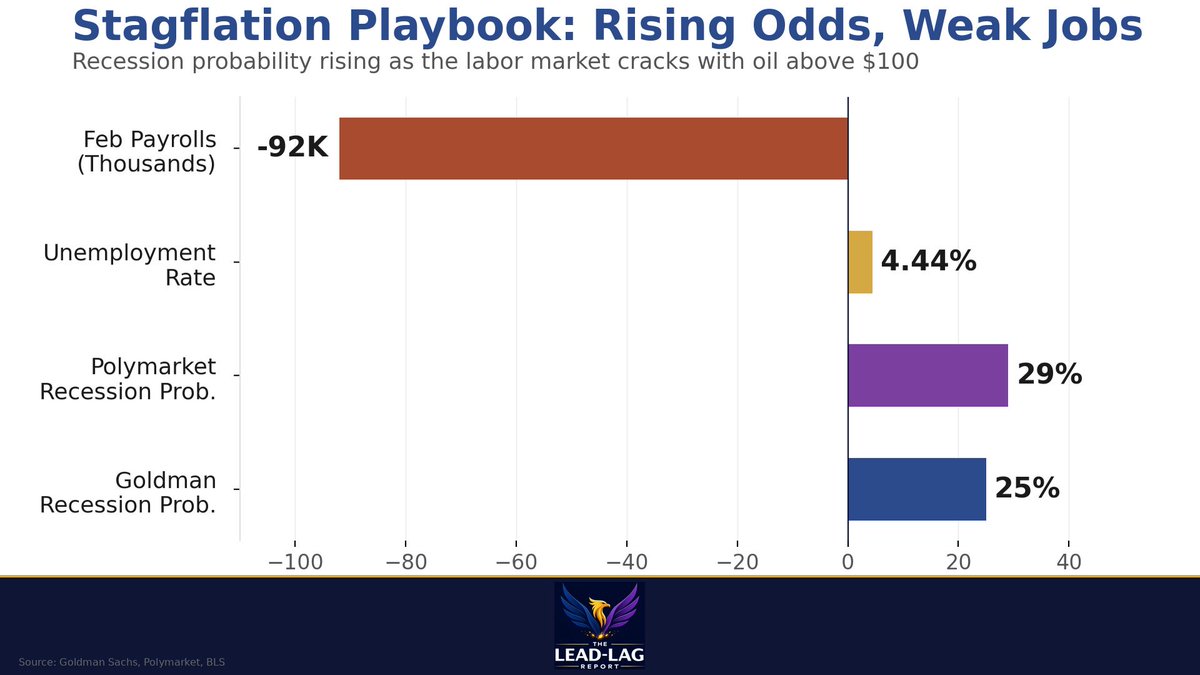
Goldman: 25% recession probability. Polymarket: 29%.
February payrolls went negative. Unemployment at 4.44%.
The labor market is cracking and oil is at $100+. This is the stagflation playbook.
The US government needs to refinance $28 trillion in debt over the next four years. Most of it was borrowed at 2%. Being rolled over at 5%.
That 3 percentage point difference on $28 trillion equals $840 billion in additional annual interest costs. On top of the $1.1 trillion they're already paying.
By 2028, annual interest on the national debt could exceed $2 trillion. That's more than Social Security. More than Medicare. More than the entire military budget. Just interest. On money already spent.
In 2025 alone, $9.2 trillion matured and needed refinancing. Another $9 trillion matures in 2026. The Treasury front-loaded the 2025 refinancing into short-term T-bills, 13-week, 26-week, 52-week paper, because it's easier to sell in uncertain markets. But that just kicks the problem into next year. Rolling short-term debt with more short-term debt means the refinancing wall never gets smaller. It just keeps showing up.
The Deloitte Economics team projects US GDP growth slowing to 1.4% in 2026. Growth slowing while interest costs are accelerating is the exact combination that breaks fiscal sustainability. You can survive high debt if you're growing fast. You can survive slow growth if your debt is cheap. You cannot survive both simultaneously.
Four buyers traditionally absorb US Treasury supply. Foreign governments. The Federal Reserve. Domestic banks. Private investors. Every single one is pulling back.
China held $1.3 trillion in Treasuries in 2013. Today it's $800 billion and falling. Japan, the largest foreign holder at $1.1 trillion, has been net selling to defend the yen. The Fed went from buying $120 billion/month during COVID to actively reducing its holdings through quantitative tightening. Domestic banks are sitting on $600+ billion in unrealized bond losses from the 2022 rate hikes and aren't eager to add more duration risk.
btw who buys $10+ trillion in new Treasury issuance when every major buyer is stepping back?
The buyers will appear. But only at higher yields. Which means higher interest rates for everything. Mortgages. Car loans. Business loans. Credit cards. The government's borrowing binge is crowding out the private sector.
Specific positioning.
BIL (SPDR Bloomberg 1-3 Month T-Bill ETF). Park cash here, not in long-duration bonds. You earn 4.5-5% with zero duration risk. When the Treasury eventually has to offer 6-7% to attract buyers for long-term paper, your short-term holdings won't lose a penny of principal. This is where Buffett is parking $334 billion.
TIPS (Treasury Inflation-Protected Securities). TIP ETF or individual TIPS through https://t.co/pB8kdcEaZ7. These adjust upward with inflation. If Congress prints money to manage the refinancing wall (the most likely outcome), TIPS are designed to protect you against that exact scenario. You're buying government insurance against the government's own likely behavior.
The Buffett playbook. Cash allocation of 20-30%. Not because cash is a great investment. Because cash is ammunition. When the refinancing cliff eventually rattles markets, you need dry powder to buy quality assets at crisis prices. Buffett raised cash to $334 billion for exactly this scenario. The man with the most experience reading these cycles is sitting on the biggest cash position of his career.
Gold and miners. Every debt ceiling crisis, every bond auction that goes poorly, every headline about the $38 trillion debt sends money into gold. Gold is trading above $5,100 right now. Central banks are buying at these levels. They see the same refinancing math you just read. Physical gold + mining stocks in a Roth IRA = the asymmetric position.
Dividend aristocrats with pricing power. Companies like Procter & Gamble (PG), Johnson & Johnson (JNJ), Coca-Cola (KO) that have increased dividends for 25+ consecutive years. When the government is crowding out borrowers and inflation is running, you want companies that can raise prices and pass costs through. These businesses survived the 1970s stagflation, the 2008 crash, and COVID.
Avoid: long-duration Treasury bonds (TLT is down significantly since 2020 and will keep bleeding if yields rise), speculative growth stocks with no cash flow (rising rates kill unprofitable companies first), and holding excess cash in a savings account (the real rate after inflation is negative, which means your savings are shrinking while you think they're growing).
i track treasury auction results, bid-to-cover ratios, foreign buyer participation, and institutional positioning through tradevision. the bid-to-cover ratio on the last 30-year auction was the weakest since 2019. fewer buyers showing up for the same amount of debt. that ratio tells you where rates are going before the Fed announces anything.
(the US borrowed $28 trillion when money was free. now they have to refinance it when money costs 5%. the math doesn't work. either rates come down (print money), spending gets cut (political suicide), or taxes go up (also political suicide). which one do you think they'll pick. own assets that benefit from the answer.)
🚨 BREAKING: Researchers at UW Allen School and Stanford just ran the largest study ever on AI creative diversity.
70+ AI models were given the same open-ended questions. They all gave the same answers.
They asked over 70 different LLMs the exact same open-ended questions.
"Write a poem about time." "Suggest startup ideas." "Give me life advice."
Questions where there is no single right answer. Questions where 10 different humans would give you 10 completely different responses.
Instead, 70+ models from every major AI company converged on almost identical outputs. Different architectures. Different training data. Different companies. Same ideas. Same structures. Same metaphors.
They named this phenomenon the "Artificial Hivemind." And the paper won the NeurIPS 2025 Best Paper Award, which is the highest recognition in AI research, handed to a small number of papers out of thousands of submissions.
This is not a blog post or a hot take. This is award-winning, peer-reviewed science confirming something massive is broken.
The team built a dataset called Infinity-Chat with 26,000 real-world, open-ended queries and over 31,000 human preference annotations. Not toy benchmarks. Not math problems.
Real questions people actually ask chatbots every single day, organized into 6 categories and 17 subcategories covering creative writing, brainstorming, speculative scenarios, and more.
They ran all of these across 70+ open and closed-source models and measured the diversity of what came back. Two findings hit hard.
First, intra-model repetition. Ask the same model the same open-ended question five times and you get almost the same answer five times.
The "creativity" you think you're getting is the same output wearing a slightly different outfit. You ask ChatGPT, Claude, or Gemini to write you a poem about time and you keep getting the same river metaphor, the same hourglass imagery, the same reflection on mortality.
Over and over. The model isn't thinking. It's defaulting to whatever scored highest during alignment training.
Second, and this is the one that should really alarm you, inter-model homogeneity. Ask GPT, Claude, Gemini, DeepSeek, Qwen, Llama, and dozens of other models the same creative question, and they all converge on strikingly similar responses.
These are models built by completely different companies with different architectures and different training pipelines.
They should be producing wildly different outputs. They're not. 70+ models all thinking inside the same invisible box, producing the same safe, consensus-approved content that blends together into one indistinguishable voice.
So why is this happening? The researchers point directly at RLHF and current alignment techniques. The process we use to make AI "helpful and harmless" is also making it generic and boring.
When every model gets trained to optimize for human preference scores, and those preference datasets converge on a narrow definition of what "good" looks like, every model learns to produce the same safe, agreeable output. The weird answers get penalized.
The original takes get shaved off. The genuinely creative responses get killed during training because they didn't match what the average annotator rated highly. And it gets even worse.
The study found that reward models and LLM-as-judge systems are actively miscalibrated when evaluating diverse outputs. When a response is genuinely different from the mainstream but still high quality, these automated systems rate it LOWER. The very tools we built to evaluate AI quality are punishing originality and rewarding sameness.
Think about what this means if you use AI for brainstorming, content creation, business strategy, or literally any task where you need multiple perspectives. You're getting the illusion of diversity, not the real thing.
You ask for 10 startup ideas and you get 10 variations of the same 3 ideas the model learned were "safe" during training. You ask for creative writing and you get the same therapeutic, perfectly balanced, utterly forgettable tone that every other model gives.
The researchers flagged direct implications for AI in science, medicine, education, and decision support, all domains where diverse reasoning is not a nice-to-have but a requirement.
Correlated errors across models means if one AI gets something wrong, they might ALL get it wrong the same way. Shared blind spots at massive scale.
And the long-term risk is even scarier. If billions of people interact with AI systems that all think identically, and those interactions shape how people write, brainstorm, and make decisions every day, we risk a slow, invisible homogenization of human thought itself. Not because AI replaced creativity.
Because it quietly narrowed what we were exposed to until we all started thinking the same way too.
Here's what you can actually do about it right now:
→ Stop accepting first-draft AI output as creative or diverse. If you need 10 ideas, generate 30 and throw away the obvious ones
→ Use temperature and sampling parameters aggressively to push models out of their comfort zone
→ Cross-reference multiple models AND multiple prompting strategies, because same model with different prompts often beats different models with the same prompt
→ Add constraints that force novelty like "give me ideas that a traditional investor would hate" instead of "give me creative ideas"
→ Use structured prompting techniques like Verbalized Sampling to force the model to explore low-probability outputs instead of defaulting to consensus
→ Layer your own taste and judgment on top of everything AI gives you. The model gets you raw material. Your weirdness and experience make it original
This paper puts hard data behind something a lot of us have been feeling for a while. AI is getting more capable and more homogeneous at the same time.
The models are smarter, but they're all smart in the exact same way. The Artificial Hivemind is not a bug in one model. It's a systemic feature of how the entire industry builds, aligns, and evaluates language models right now.
The fix requires rethinking alignment itself, moving toward what the researchers call "pluralistic alignment" where models get rewarded for producing diverse distributions of valid answers instead of collapsing to a single consensus mode.
Until that happens, your best defense is awareness and better prompting.
◾️Trump Administration Manipulation of Oil Prices: Remember the crying Wolf Stroy!
◾️Can Russia, Kazakhstan, and Brazil Offset the Hormuz Crisis Impact?
◾️Has China Swapped Venezuelan Oil for Canadian Crude?
◾️Why Trump's Sanctions Waiver Fails to Help India
◾️Asia's LNG Squeeze: More Carriers Routing via Panama Canal?
◾️US SPR: Surrounded by Misinformation
◾️IEA and SPR: It's Really All About the US
◾️Hormuz Crisis Side Effects: Escalating Hourly and Crushing Even Crop-Based Fuels and Beyond
Daily Energy Report https://t.co/MLRTSr0ulH