I’m glad to announce that our paper “Firm Heterogeneity, Capital Misallocation and
Optimal Monetary Policy” has been conditionally accepted at @JPolEcon
Here is a short thread
https://t.co/odh1UdHYDK
Sometimes, when I want to lift my spirits, as this week after brooding about the state of much of academia, I want to read a great paper I have already read dozens of times. Those are the papers that inspired me as a younger scholar and that, even today, make me slightly jealous.
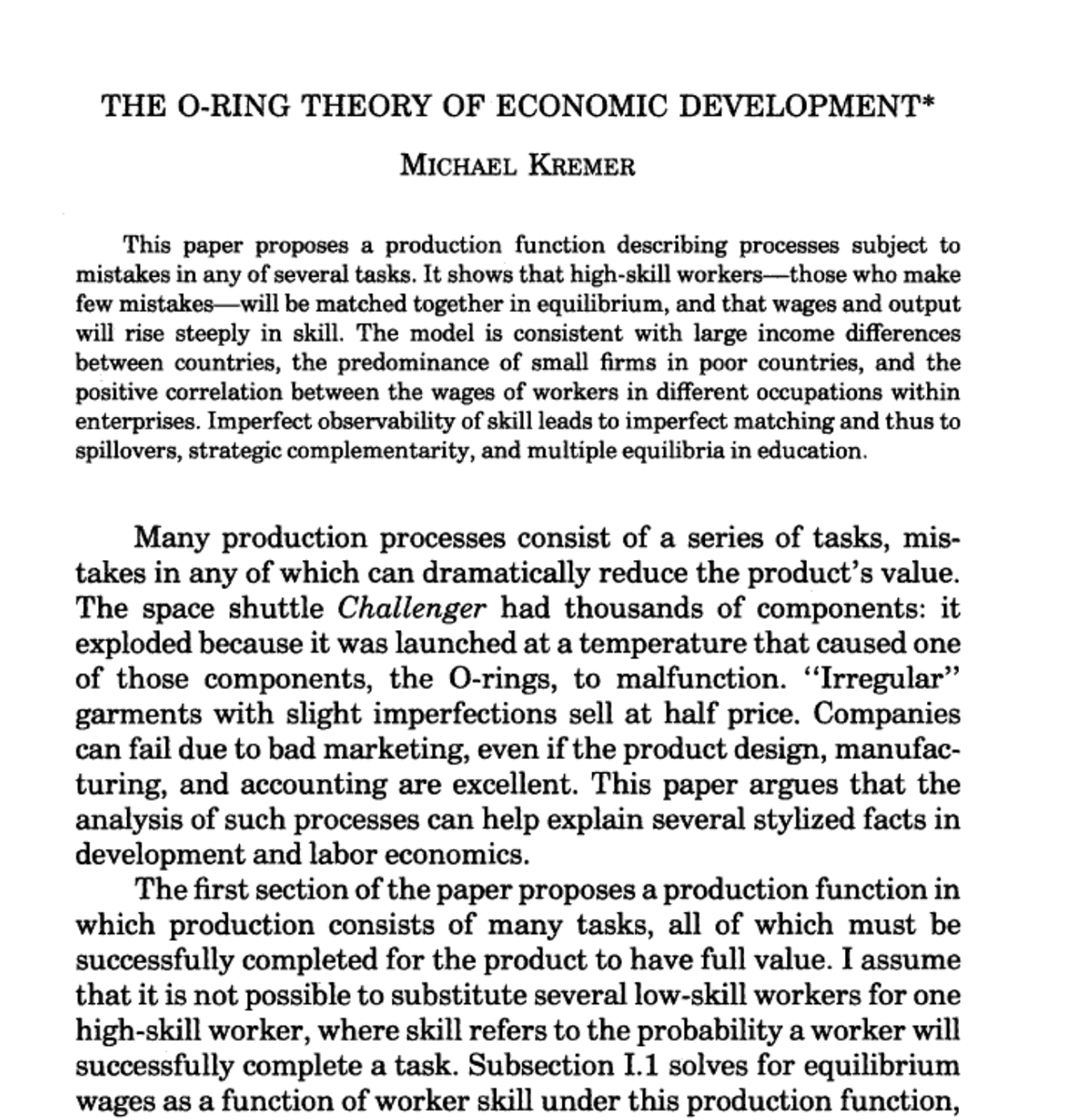
One of my favorite go-tos is “The O-Ring Theory of Economic Development,” by the inimitable Michael Kremer, at UChicago Econ.
The idea is that producing output requires many tasks, and failure in just one of them drastically lowers the value of the final output. My favorite examples are the British cars of the 1950s and early 1960s. Think of the Jaguars or the Austin-Healeys. Was anything ever more gorgeous than an XK120 in British Racing Green? And yet, that Moss gearbox with no synchro on first! Go for a Porsche 356 if you have the money, because the Jaguar will eventually break your heart.
But the paper is gorgeous because Kremer takes this simple observation and builds a whole theory of differences in output across countries around it. He lets the quality of each task multiply rather than add up, as in standard models. A good worker is worth more next to other good workers, so the best end up working with the best and wages fan out. And a small difference in the chance of a mistake, compounded over dozens of tasks, becomes a huge difference in output per worker across countries, plus a large set of predictions about the distribution of firms, wage correlations, matching, and more.
Here, back in 2014:
https://t.co/XexEUaKVNq
I used that model to think about some of Spain’s economic problems (an automatic translator will give you a very good English version).
It is such a wonderful and deft piece of economic craftsmanship. Read it. I just did.
Why do many economists like markets? Because most markets, although not all, work well. There is bread in bakeries, cars at car dealers, and books in bookstores because the price system provides economic agents with incentives to ensure these outcomes. Of course, markets are never perfect outside economics textbooks. More often than not, we face inefficiencies such as limited competition or externalities.
The intelligent case for markets has never been that they are flawless, a proposition so obviously untrue that it is not even worth discussing (unless you are writing for the Stanford Encyclopedia of Philosophy). The case for markets is that they usually work better than feasible alternatives.
Note that I used three words: “usually,” “better,” and “feasible.” The word “usually” tells us that, sometimes, markets fail. A market for national defense is unlikely to work because it is impossible for a private air force to defend my house but not my neighbor’s, who refuses to buy the service.
The word “better” reminds us that, even when markets do not work well, the alternatives may be worse. Flying with American Airlines is a ticket to an unpleasant experience. But those of us who have flown in government-run airlines understand that service can be considerably worse.
The final word, “feasible,” emphasizes that one should not judge market behavior against an idealized public service staffed by angels. Alternatives to market systems are run by humans, with their strengths and shortcomings, and, in particular, without the incentives provided by the profit motive.
You might disagree with my case for markets. But, at the very least, you need to understand what I am claiming. Otherwise, this is not an intellectual discussion; it is a brawl at a bar.
Ya lo siento, pero este dato no está bien hecho. Lo que hace es comparar 27k de STOCK TOTAL de pisos turísticos con 3k de OFERTAS ACTIVAS de alquiler de largo plazo. La comparación correcta sería con stock total de pisos en alquiler de largo plazo.
Que son alrededor de 140k.
Falso. A y B son proposiciones con contenido valorativo. Hablar de "tan bien"/"tan mal" sin unidad de medida/referencia las convierte en opiniones/ juicios de valor.
En C no hay ningún juicio de valor.
No ver la diferencia es grave para un economista, con cabreo o sin él.
🔷ENTREVISTA🔷
🗣️ @Jongonzlz : «El debate público está dominado por la narrativa, no por datos y evidencia reales»
ABC entrevista al divulgador que ha dinamitado el debate fiscal al demostrar, a partir de fuentes oficiales, que la rentas bajas pagan más IRPF ahora que en 2019
✍️@bpvazquez
https://t.co/mDHrP4oLEU
Beware the Jevons effect on effort.
Installing Claude Code in your PC and letting it into your life (files) is a bit like having a baby-- it rewires your brain . Suddenly you go from wondering what to do with it to having 100 ideas and wanting to do them all.
Do it. It is fun.
But we need to be careful about the burn out. Suddenly all seems possible and necessary to do immediately. Instead of economizing in effort you (well I!) want to be working all the time and forget about life (hence Jevons, but for work). The sense from the outside that the world is changing very rapidly intensifies the sense of urgency. We need to be able to slow down, smell the flowers, pay attention to family and friends, etc.
I say this to myself, mostly. But hopefully it helps some of you.
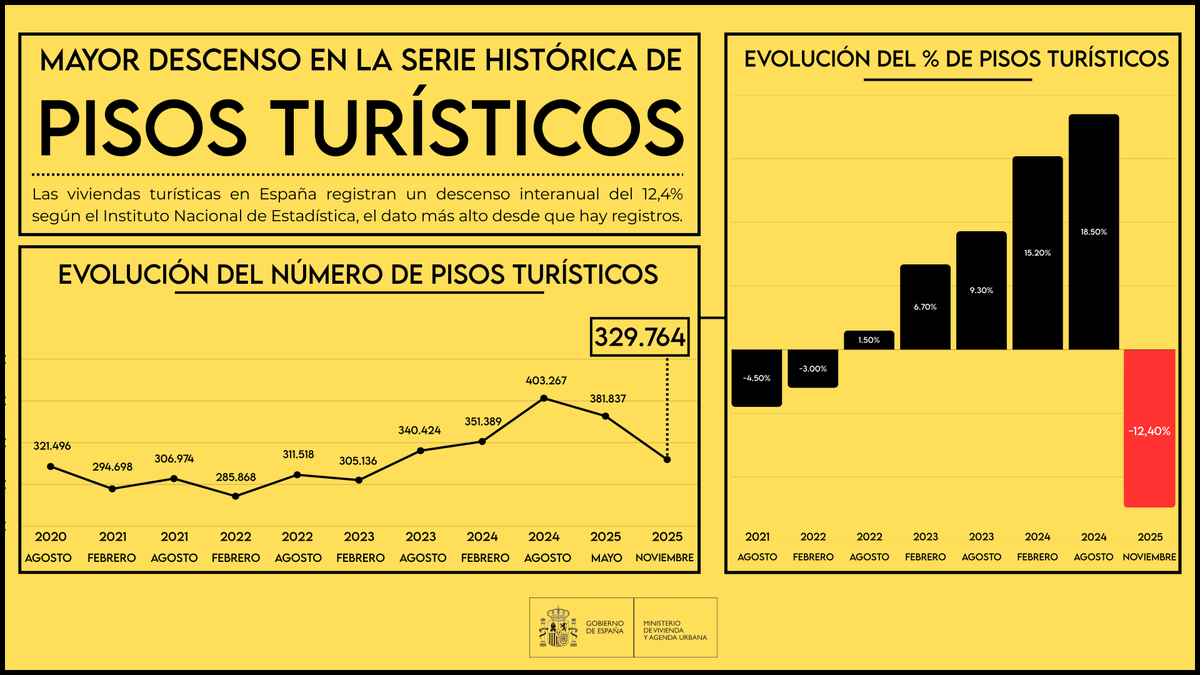
📊 El número de viviendas turísticas registra su mayor caída de la serie histórica:
🔸Descenso interanual del 12,4%, el dato más alto desde que hay registros.
🔸Las viviendas comercializadas en plataformas se redujeron entre mayo y noviembre de 2025 en más de 52.000 unidades.
Hoy escribo en @nadaesgratis
Analizamos con @javirodriecon el impacto del cheque bebé en la natalidad en España:
¿hubo más hijos o simplemente hijos antes?
🔗 https://t.co/vndtq4I4kp
AI tools at end of 2025:
1) Gemini much better multimodal, e.g., image output & image/video input. And cheap/fast. But too sycophantic.
2) GPT 5.2 Pro easily best in hard logic/math/code.
3) Claude is elegant, writes well, style/design-wise has "good taste", less sycophantic. 1/3
este tuit es el ejemplo perfecto de por qué en españa no se puede tener un debate serio sobre pensiones. en cuanto uno pone sobre la mesa que nuestro sistema es demasiado generoso con las cohortes actuales de jubilados a costa de las generaciones que vienen detrás, aparecen las tergiversaciones absurdas: "queréis dejar sin pensión a la gente mayor". nadie está proponiendo eso! (nadie serio, al menos)
cualquier persona con una noción mínima de justicia distributiva y una lectura honesta de los datos llega a la misma conclusión: estamos transfiriendo recursos masivamente hacia un grupo que, en agregado, ya está comparativamente protegido, mientras que los jóvenes de hoy llegan a la edad adulta con menos renta, menos patrimonio y la carga añadida de financiar unas prestaciones a las que no van a acceder en las mismas condiciones (https://t.co/KzDI4yK5HI).
la tasa de riesgo de pobreza en españa para la población entre 25 y 49 años es del 25,6%, la segunda más alta de la UE después de bulgaria (!). la de los mayores de 65 es del 19,5%, en línea con la media europea y la más baja de todos los grandes grupos de edad en españa (fuente: https://t.co/AnGcZ4yvNq). ¿quién está desprotegido aquí exactamente?
si a ti te parece "fascista" pedir un sistema que sea sostenible y equitativo entre generaciones, el problema es que tienes el cerebro hecho papilla y estás usando "fascista" como comodín para cancelar cualquier debate incómodo.
no contesto a este tuit porque crea que se pueda razonar con esta gente. contesto por si alguien más lo lee y le sirve saber que sí hay otro camino: se puede defender un estado del bienestar que no sea injusto con los que vienen detrás, que proteja de verdad a quien lo necesita y que no convierta cualquier crítica en un delito moral.
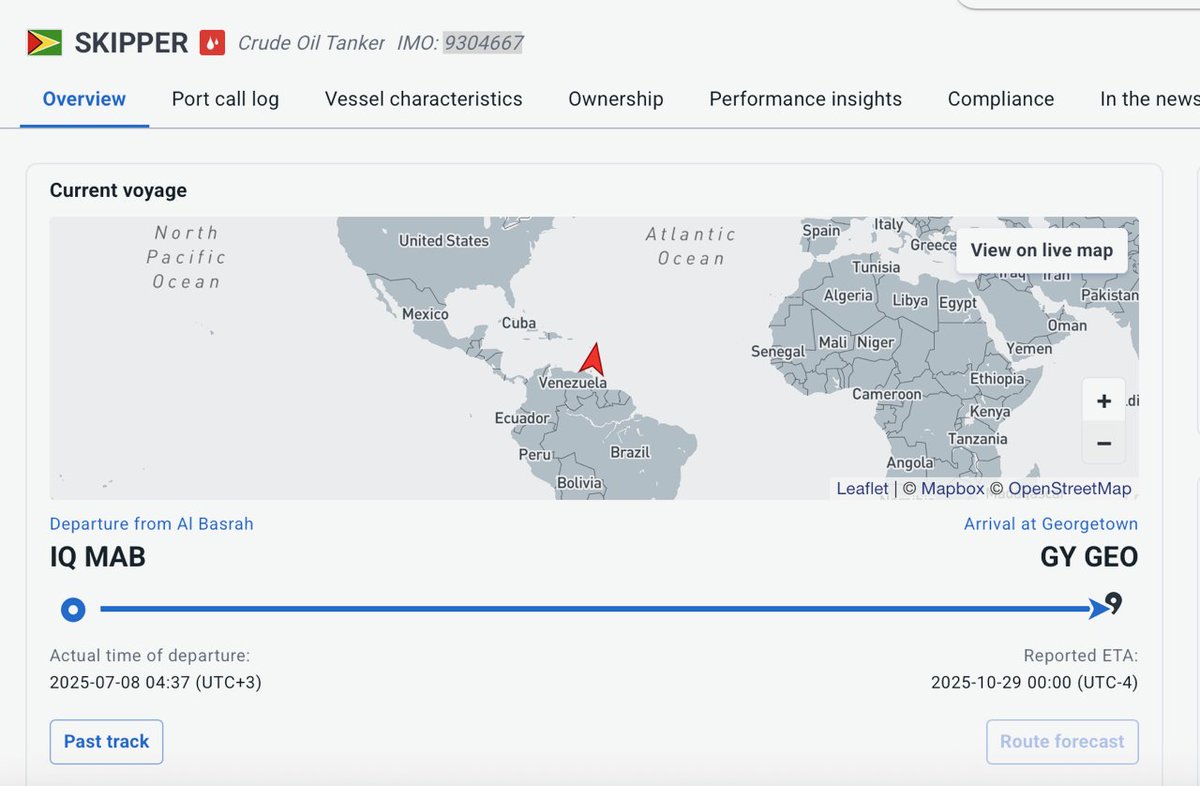
Yesterday, the U.S. seized the oil tanker Skipper off the coast of Venezuela (included pic). This seizure highlights the key role that the dark fleet plays in the global oil market.
Together with @YiliangLi_, Le Xu, and @FZanettiOxford, I have spent much of the last year thinking about this market:
https://t.co/vJiiUSdLxm
While I have posted about this work before, given the recent discussion on X about modern economics, data, and artificial intelligence, I want to revisit it, as I believe it is also a perfect example of the marvelous findings that can be documented using machine learning in economics and how the future of economics goes, to a large extent, through artificial intelligence.
Our punchline is that we designed a novel, powerful machine learning algorithm to show that dark oil tankers transported an estimated 9.3 million metric tons of crude oil per month between 2017 and 2023 (right now, before sending the paper back to the journal, we are extending the database to 2025).
Let that sink in: nearly 10 million tons of crude every month off the books, outside official trade flows.
And the economic impact? Surprisingly large for output and inflation in the U.S., the EU, and China.
Let’s start today with how we gather the data.
When oil sanctions hit, exporters don’t stop. They go dark:
— Disable AIS transponders
— Transfer oil ship-to-ship in open waters
— Reflag vessels under shady jurisdictions
— Use forged paperwork to mask identities
And here’s the twist:
Many of these tactics are quietly tolerated (sometimes even facilitated) by countries that don’t want to see tight energy markets or higher inflation. Nobody wants to rock the boat.
So, we built the most comprehensive dataset to track this:
✅ Over 2,150 oil tankers, essentially the entire global crude fleet.
✅ Trips tracked from 2017 to 2023.
✅ Satellite AIS data + metadata (vessel age, flag, etc.).
✅ ~330 million observations.
We then trained a machine learning model that detects sanction-busting trips with very high accuracy:
— Patterns in AIS gaps.
— Origins and destinations.
— Temporal clues like navigation anomalies.
— Vessel profiles.
This isn’t sample data — it’s population-level tracking.
We audited and validated the model using satellite images and independent checks.
For instance, the oil tanker Roma (IMO: 9182291) was classified as “dark” by the algorithm, and sure enough, we found imagery of Roma loading oil at Kharg Island (Iran) on August 20, 2022 (see second included pic).
You can’t argue with a photo.
This process gives us confidence in the entire classification and enables us to identify every trip that violates sanctions.
So what do we do with all these dark voyages?
We construct time series of:
📈 Oil exports that violate sanctions.
📉 Oil imports that violate sanctions.
🌐 Their origin and destination.
See the third and fourth included pics.
Tomorrow, I will discuss these results and how we use them in what I think is a rather creative econometric exercise.
P.d. By the way. Have you seen any “heterodox economist” doing anything like that? Of course not. The “heterodoxs” sit down and talk about the ontology of the oil markets, or what Sraffa would have said about the oil market, or even better, that mainstream economists do not look at the data (and write a whole book about that). Can you be any more empirical than this paper, where we actually look at every single oil tanker in the planet in real-time?
Let’s be honest: “heterodox economics” is just an excuse to be a low performer and not having to face your own shortcomings as as a researcher.
Extracting helium-3 from the moon, bringing it back and using it to make quantum computers might be close to profitable... The speed and the scope of tech progress is scary.
🚨 Job Market Paper
❓ Dispersion in firms’ capital intensity has widened. Why, and does it matter?
⚙️ Firms unevenly update the capital-intensity of their technology as capital goods get cheaper.
📊 This helps explain major US trends.
Paper: https://t.co/gqNc7uJ4FX
1/14
Hopenhayn (1992) is the workhorse model of firm dynamics. However, quantitative implementation of the original model remains scarce. I attempt to do the exercise here (Julia code + slides): https://t.co/jXsDcYlj3Q
The resulting FSD is a remarkable baseline to match the data!
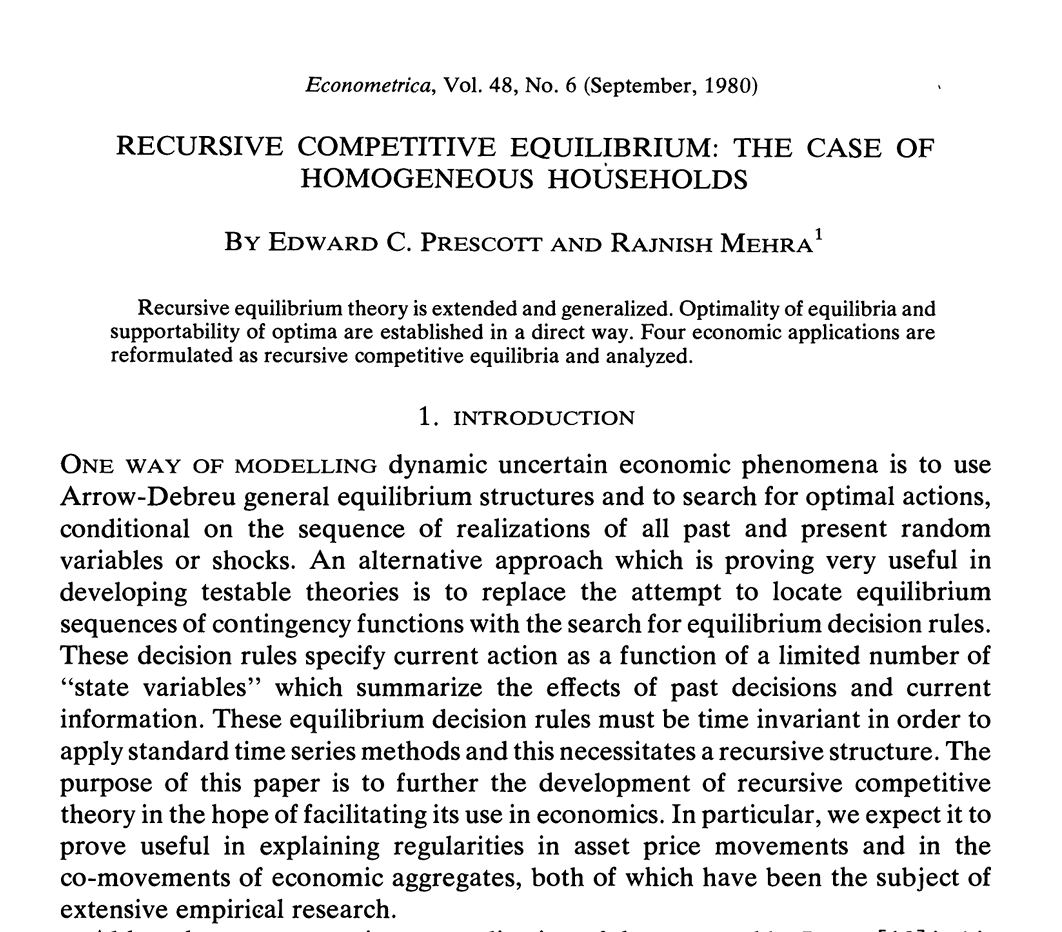
A guide for students of economics: Ten statements that demonstrate that someone does not understand modern economics or what an equilibrium is, and that you can safely ignore everything else they say.
1. “Equilibrium means the economy is stable or at rest.”
Many assume that an equilibrium is a peaceful state with no forces at play. Instead, an equilibrium is just an arrangement of actions and expectations over time that are mutually consistent. It can be locally unstable, explosive, or fragile. Nothing in the definition of equilibrium implies stability.
2. “Equilibrium implies optimality or social efficiency.”
Equilibrium is often conflated with efficiency, but equilibrium merely reflects decentralized consistency, not welfare maximization. Market power, externalities, incomplete markets, nominal rigidities, and frictions routinely produce inefficient equilibria. I often teach a first-year macro graduate course, and not a single one of the equilibria I define is efficient.
3. “Equilibrium is a unique outcome.”
Many often expect models to have one equilibrium. In reality, multiple equilibria arise naturally in dynamic, strategic, and incomplete-market environments. Models of coordination failures, self-fulfilling expectations, bubbles, overlapping generations, and liquidity traps all hinge on the existence of equilibrium multiplicity.
4. “Equilibrium requires perfect foresight or perfect information.”
Equilibrium does not assume agents know the future. In fact, equilibria are often stochastic. The definition of equilibrium only requires that beliefs are consistent with the (perceived) stochastic laws of motion implied by the model. Bayesian learning, noisy signals, ambiguity, and subjective uncertainty all fit well within an equilibrium framework, provided beliefs converge to an internally consistent (but possibly incorrect) distribution.
Bonus point: equilibria are compatible with agents having diverging beliefs that never converge to a single Dirac distribution.
5. “Real economies are rarely in equilibrium, so the concept is unrealistic.”
Equilibrium is not meant to describe the daily state of the world. It is a conceptual device used to understand the outcome of our models under the assumptions we make. Also, see point 1 above.
6. “Equilibrium requires agents to be fully rational in a psychological sense.”
Equilibrium only assumes internal consistency: agents optimize given preferences and constraints. It does not assume realism about human cognition. We can and do define equilibria in models with behavioral biases, bounded rationality, inattention, or rule-of-thumb behavior. We only need to ensure that the resulting actions and beliefs are mutually compatible.
7. “Equilibrium eliminates dynamics or learning.”
Equilibrium is sometimes misinterpreted as a static state in which nothing evolves. In fact, many equilibria are sequences of probability distributions over states driven by shocks, policy rules, and endogenous responses. Learning dynamics (Bayesian updating, adaptive rules, experience-based expectations) can occur within equilibrium if the evolution of beliefs is self-consistent.
8. “Equilibrium renders expectations unimportant.”
A common misconception is that equilibrium mechanically determines outcomes. In reality, expectations are often central: they determine investment, consumption, asset prices, and policy responses. Many equilibria differ only in their expectations. This is why communication, credibility, and forward guidance matter even in fully rational models.
9. “Equilibrium excludes policy intervention.”
Some interpret equilibrium as a laissez-faire concept. In fact, equilibrium analysis is the foundation of modern policy evaluation. Fiscal, monetary, and regulatory interventions work through equilibrium responses (prices, wages, interest rates, quantities) and must satisfy equilibrium conditions to be credible. Equilibrium is a tool for policy design, not a barrier to it.
10. “Equilibriums…”
Aequilibrium is a Latin neuter noun of the second declension, which forms a nominative plural in “a”. It is composed of aequus (equal; the same root as equality or equity) and libra (balance or scales or the name of several currencies over history).
A final thought: “equilibrium” is a term of art. Its meaning in economics differs from its use in the natural sciences or in everyday language. Terms of art are ubiquitous across academic disciplines, and the first act of intellectual diligence when one starts studying a discipline is to learn what they mean.