Crypto Analyst | Clear takes on #DeFi#Blockchain#Tokens#Onchain
I write to help you understand, not just believe |
For those who prefer clarity over guessing
Crypto isn’t weak because sentiment broke.
It’s weak because dollars became scarce.
When SOFR trades above IORB, it’s not a chart anomaly it’s a balance sheet problem.
Banks cut risk, leverage unwinds, and the most liquid assets get sold first.
This isn’t a crypto story.
It’s a liquidity regime shift.
⬇️ Full breakdown here: https://t.co/6Q7WqcqHcP
Every single time retail piles in on the hype from the “guy in the suit”, gets rekt on the way down or liquidated, and then loses faith in crypto altogether.
This isn’t just bad analysis anymore — it’s consistently damaging to newcomers.
When (if ever) do you think characters like Tom Lee, PlanB and the rest of the perma-bull “prophets” will finally burn through all their credibility with the community?
Or will they just keep resetting the hype cycle every 2–3 years forever?
@slezisatoshi Self-custody = lower counterparty risk, agreed.
Withdrawals act as a stress test, but they don’t guarantee a supply shock — price effects can go either way.
Most 2026 crypto forecasts focus on prices.
Institutional reports focus on something else:
market structure, execution, and infrastructure.
That difference matters more than any target.
In 2026, I’m focusing on one thing.
Helping people navigate crypto through context and structure.
I’ll keep filtering noise, translating complex ideas into clear frameworks,
focusing on liquidity, risk, and market regimes - not hype or predictions.
No calls. No promises.
Just clarity for those who prefer thinking over guessing.
@BeamFDN Great vision, thanks for sharing.
Tokenomics: when can we expect updated details?
Value capture: how will revenue flow back to the Beam token?
Timeline: when is implementation planned?
4/ This isn’t a price prediction.
It’s a regime framework.
As long as global liquidity trends higher, BTC remains structurally bullish.
Timing the exit matters more than timing the entry.
Liquidity drives cycles - not narratives.
Bitcoin and alts don’t top on excitement or price levels.
They top when global liquidity rolls over.
Volatility ≠ cycle end.
As long as liquidity expands, risk assets remain structurally supported.
Watch it:
https://t.co/xBbxKw4NX2
3/ Volatility doesn’t mean the cycle is broken.
Corrections are part of every expansion phase.
The final, irrational phase only comes after liquidity peaks - not during its rise.
Every risk-on cycle lives in the grey zone.
Not bans. Not approvals.
Just delay, expectations, and uncertainty.
Once rules are finalized, markets mature — and speculation gives way to structure.
#CryptoMarkets#RiskOn#MarketStructure#Liquidity#Macro
Senate punts crypto market structure bill to next year https://t.co/JTpjL05t7n via @coindesk
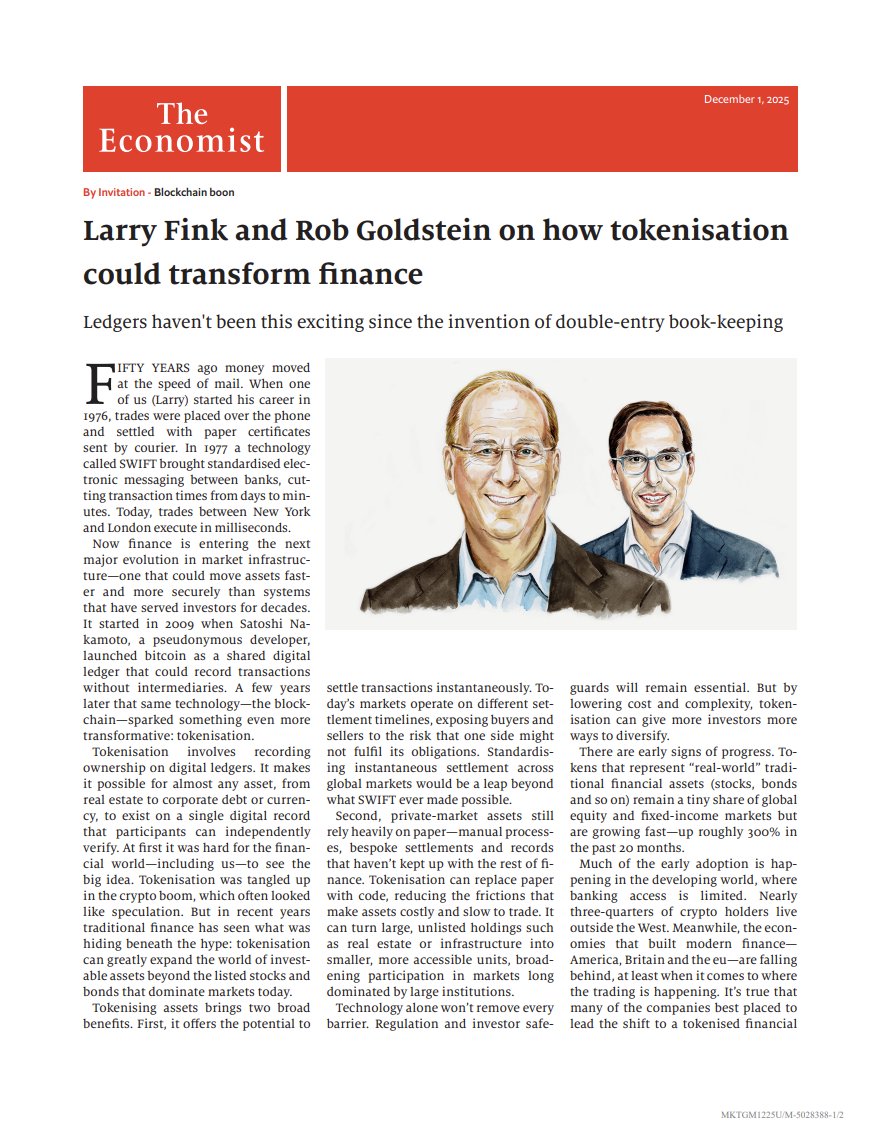
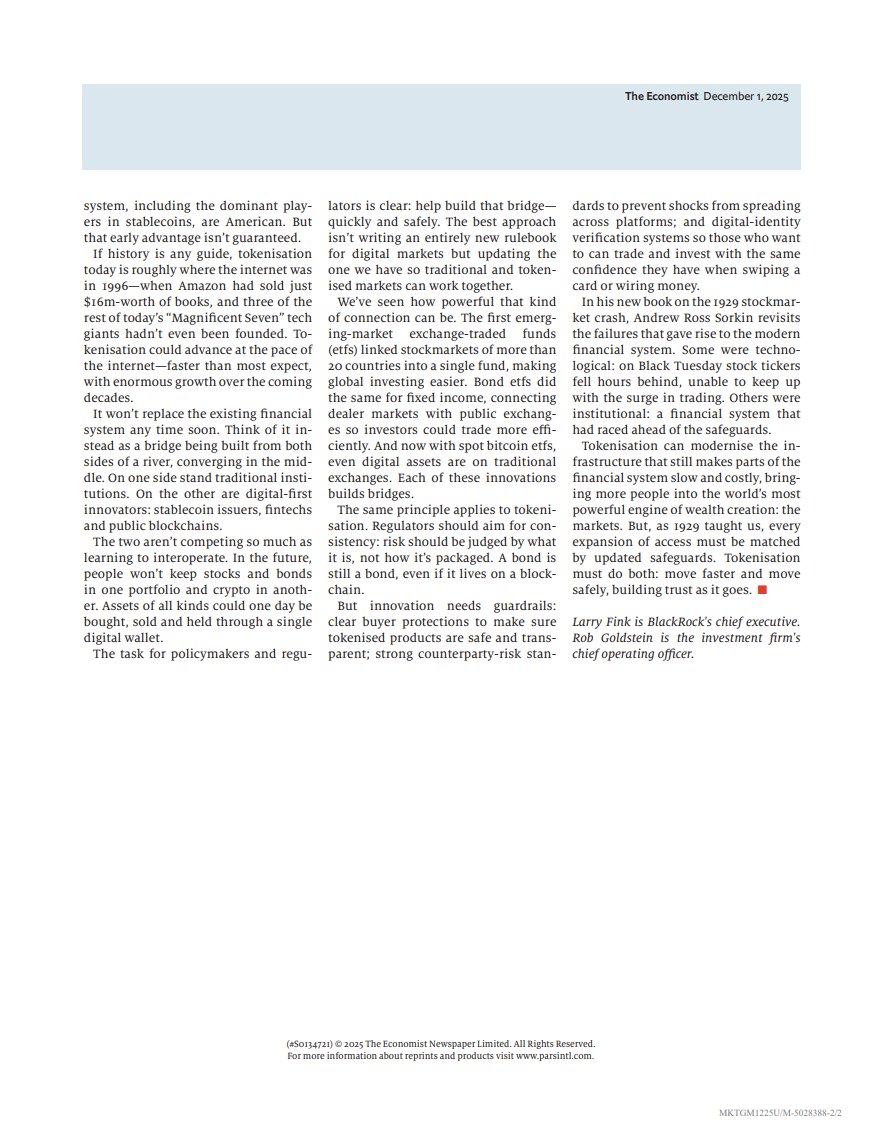
The mainstream isn’t debating crypto anymore they’re already rebuilding financial infrastructure on blockchain.
At that scale, “altseason” talk is trivial. Tokenization is the bridge from TradFi to Web3, and those who build the rails will win.
Fink is clear: all assets go digital.
Tokenization is shaping the next evolution of global markets. In @TheEconomist, Larry Fink and Rob Goldstein discuss how tokenization can modernize market infrastructure, enhancing efficiency, transparency, and access by connecting traditional and digital finance. Read more:
Ethereum ships Fusaka a bundle of upgrades that make L1 faster, cheaper, harder to attack, and better for L2s.
Here’s Fusaka in a compact format.
Six updates that define how
Ethereum changes from this point forward.
Ethereum’s next major upgrade, “Fusaka”, goes live in less than 48 hours.
I read all 13 EIPs being included so you don’t have to.
So, here are 13 tweets (with diagrams) to explain the 13 upgrades in simple terms: 🧵
5/ Security hardening
• Caps max gas per single transaction (stops spam tx that fill entire blocks)
• Limits block size (prevents oversized DoS blocks)
• Fixes MOD_EXP input sizes + corrects its gas pricing
Stronger base layer, fewer DoS vectors.