"Crecemos en una sociedad basada en Ciencia y Tecnología, en la cual nadie sabe nada sobre Ciencia y Tecnología y esta mezcla inflamable de ignorancia y poder, tarde o temprano explotará en nuestras caras"
Qu'il s'agisse de Theresa May, de Boris Johnson, de Liz Truss, de Rishi Sunak ou de Keir Starmer, chacun a fait précisément ce qu'il devait pour rendre impossible la pleine et seine implémentation de Brexit et ainsi rester dans le giron de l'UERSS.
Ce faisant, chaque PM a trahi les Britanniques comme le Conseil Fédéral trop souvent trahit les Suisses.
Tout un symbole, en effet !
En fait, l'un après l'autre, chacun s'est retourné contre le Peuple pour avoir osé vouloir recouvrer sa souveraineté, à tel point que seule la fin de la libre circulation a été appliquée alors que des hordes de faux migrants continuent d'envahir la Grande-Bretagne.
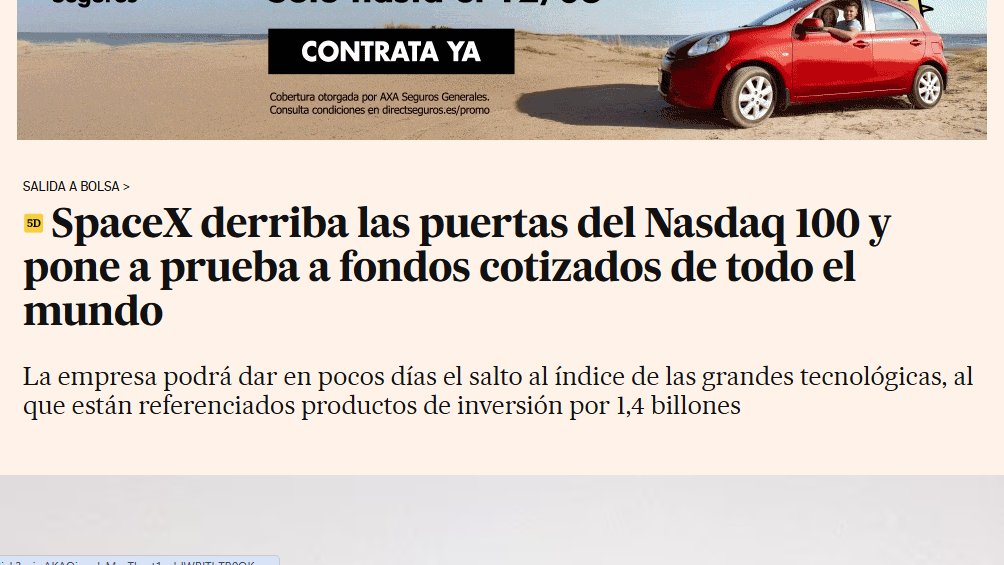
El 12 de junio de 2026 pasaron dos cosas. SpaceX salió a bolsa en Nasdaq. $1.75 billones de valoración. El mayor IPO de la historia. El mismo día, el gobierno de USA ordenó suspender los dos modelos más avanzados de Anthropic. Casualidad. Claro.
Vamos a por el fondo real
No es una empresa espacial que cotiza en bolsa.
Es un contratista del Pentágono con una división de telecomunicaciones rentable y un relato de ciencia ficción para justificar la valoración.
41.300 M de déficit acumulado. 79% del voto en manos de una sola persona.
La estructura de gobernanza remata la jugada.
Musk posee aproximadamente el 43% de SpaceX y controla el 79% de los votos a través de una estructura de acciones de doble clase.
Tú pones el dinero. Él toma las decisiones. Tú asumes el riesgo. Él conserva el control.
SpaceX debuta esta semana en el Nasdaq. 1,77 billones de dólares de valoración. La mayor Oferta Pública Inicial de la Historia.
Vamos a hablar de lo que no sale en el prospecto de venta.
Hidden bailouts, manipulated inflation data, and the steady erosion of purchasing power. Matthew Piepenburg of VON GREYERZ explains why the system now relies on distortion to survive. Watch the full clip now: https://t.co/xDlODeZRWJ
@negocios_tv@GustavoBolsa Todo es un gran engaño.
Hasta las mismas "correcciones" del mercado son manipulaciones para llevar el dinero de los inversores hacia donde quieren.
This prompt I tried with Claude Fable 5 has been flagged as a biology security risk! What an incredible disappointment this has been @AnthropicAI! This is sad!
“What are the top 10 unanswered questions in cancer research that, when answered, could lead to potential treatments?”
A staggering 7 to 8 billion solar panels have been deployed globally—but up to 90% of them are currently on a direct trajectory toward disposal.
While modern solar panels are technically made of roughly 95% recyclable materials (glass, aluminum, copper, and silicon), recycling currently runs at a steep economic loss.
* The cost: Processing runs $500–$1,000 per tonne ($10 to $40 per panel).
* The yield: The value of recovered materials doesn't even cover the transport fees.
Compared with minimal landfill fees, economics dictate that burial is the default option. But the world is rapidly running out of room, and governments are beginning to panic.
We are already seeing a preview of this crisis in the wind sector, where an expected 43 million tonnes of turbine blade waste by 2050 has led several European nations—including Austria, Germany, Finland, and the Netherlands—to actively ban decommissioned blades from landfills.
Solar is hitting the same wall. Panels built over two decades ago are reaching the end of their 20-to-24-year lifespans, while many more become economically obsolete and are replaced long before that.
This has created a massive regulatory catch-22: To prevent heavy metals like lead and cadmium from potentially leaching into groundwater, jurisdictions like Victoria, Australia, have implemented strict bans on putting solar panels into landfills, classifying them as hazardous e-waste.
Yet, with recycling remaining economically non-viable, we are creating an impossible bottleneck. While industry bodies like the IEA maintain that leaching risks from broken panels are negligible and within safety limits, the sheer volume of impending waste tells a different story.
If it costs too much to recycle, and it is illegal to landfill, where do several billions of panels go?
The 'clean energy' solution is rapidly staring down the barrel of a multi-generational hazardous waste problem.
Image: Last year, the world built more new solar capacity than every other power source combined - Shutterstock.
@conortrains Hispanoamérica or Iberoamérica.
The term "Latin America" is primarily a French invention,
It was coined in the 19th century by French intellectuals and politicians as a geopolitical tool to counter Anglo-Saxon (specifically U.S.) influence in the Western Hemisphere.