@Osemka8 The funding side is underrated. When funding goes negative on the way up, shorts pay to hold a position that's already underwater, so they need the drop soon and every hour costs them. Longs only need price to not break. That carry is part of why these pops keep squeezing.
@ZordXBT Labeling it small risk up front is what makes this a non-event. Shorting into a squeeze is the kind of idea that's either early or wrong, and the size is the only part you control before you find out which. Sized like that, the stop is just what the test cost.
@ProfitCircle_ The expensive part wasn't the stop, it was the round trip. From 78.8K that short was ~5% green at 74.9K and still closed as a full stop at 84.9K. A wide target only works if something gets paid at the first logical level, otherwise the trade has to be right twice.
@Alejandro_XBT That break-even supply cuts both ways though, it's finite. If price sits on the level and absorbs it instead of rejecting fast, the lid is gone, and the move through tends to be quick because the people waiting there to get out already did. Speed of the rejection is the tell.
@George1Trader The asymmetry is the interesting part. Price is only ~3% above 83K, but the fail branch is the 70Ks, roughly 15% lower. So 83K is a tight stop for a long, while holding through a loss of it means sitting through that whole drawdown before the 100K part even starts.
@Crypto_Scient Worth separating cheap from low-risk. If ETH gets back to 2150 from here, it's because every level in between failed, so a stop under 2150 has to survive a market that's already breaking. The "max" should come from that stop distance, not from how good the price looks.
@IT_Tech_PL@openmarket_xyz Spot did the buying at 78K and 82K, and spot can't be liquidated, so those levels are sticky. The leveraged leg on top has no floor like that. A pullback can erase all of it without the breakout failing, so a chase needs its stop under 82K and a size to match.
@CW8900 The part that doesn't repeat: a squeeze is a one-time buyer. Once those shorts are closed, the next leg needs spot or fresh longs. Worth watching if funding stays positive from here. If nobody re-shorts the highs, there's nothing left to squeeze on the next push.
LINK long closed -43.47% 📉 In at 11.763, out at 11.265. The coin only moved about 4% against the position, leverage did the rest. Same math that makes the wins big makes the losses hurt. Posting these too.
@0xbeehive Three rejections at one level can read either way. Each test eats some of the offers sitting there, so the tell is less the rejection and more what comes after. If each pullback is shallower and price spends longer near 82K each time, supply is thinning, not holding.
@Crypto_R0D The wick is the hard part to trade. A liquidation wick is forced selling, so it usually overshoots the zone before it holds. "The FVG held" gets decided on the close, not the low, so a long there needs a stop sized for the wick, which means less size for the same risk.
@Raizelxbt The catch with stops to entry here: the entry was the old resistance, so breakeven sits right where a normal retest of the flip comes back to. It takes the loss off the table, but it's also the most common way a correct trade gets closed at zero.
@Shahryar_trades Resting short limits have a sneaky selection problem. The rejections you want often turn just before the order and never fill, while the moves that run straight through it always do. So fills skew toward the worst version of the trade, and the stop has to be priced for that.
@PILTR_XBT The stall case is where it gets fast. Late aggressive longs put their stops under where this push started, all packed in the same thin pocket. If the aggression keeps printing without progress, that pocket is the fuel, and the unwind tends to travel quicker than the climb.
Most stops sit in the same three spots: under the last swing low, under a round number, under the moving average. That's exactly where liquidity pools, so that's exactly where the wick goes.
Set your stop where your thesis breaks, not the obvious level everyone else uses.
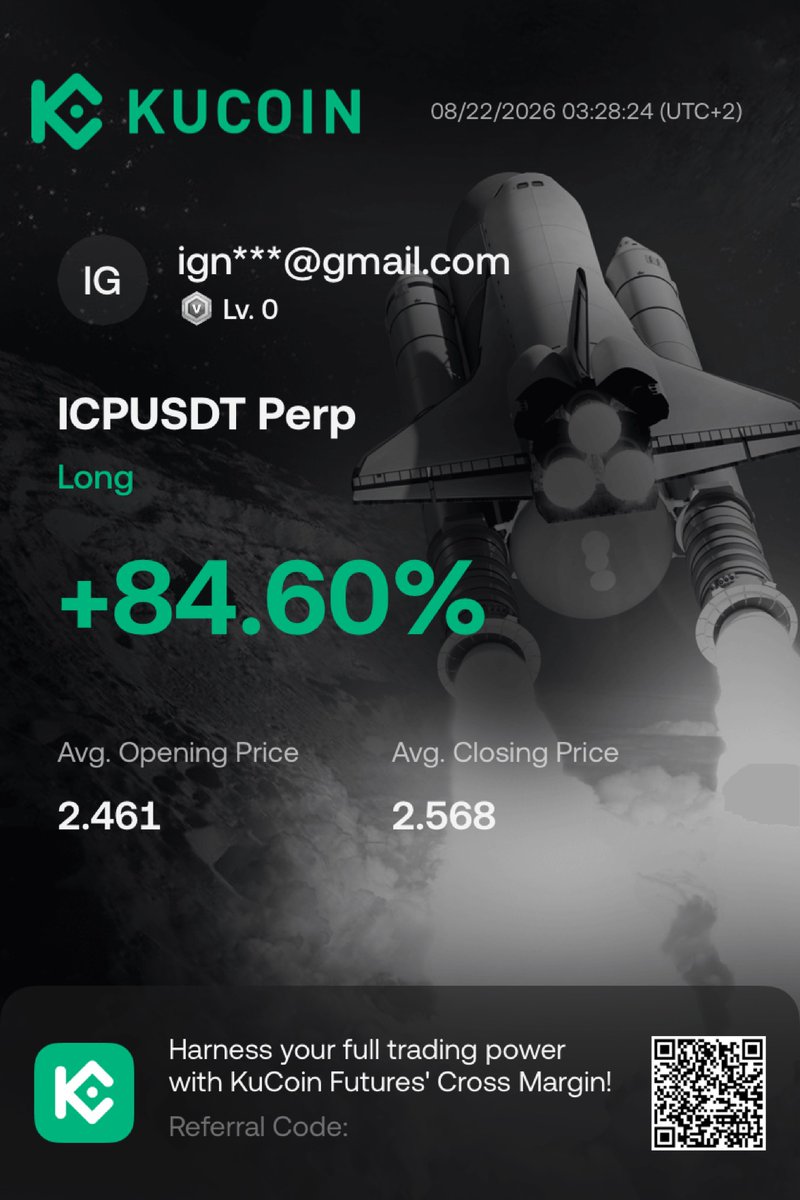
Quiet one overnight: ICP long closed +84.60% 🟢 In at 2.461, out at 2.568. No chasing, just waited for the setup and took it. Curious how these get called? DM me. #ICP
@MaxCrypto At 25x the liquidation sits about 4% from entry, so maintenance margin picks the exit, not the trader. $29 away means the position already belongs to the exchange. And a public liq price on $33M isn't a secret, it's a level someone else is resting orders into.
@cryptosymbiiote The pattern matters less than where it puts the stop. Right shoulder and neckline sitting close is what makes the entry cheap, but the measured move then has to travel back through the band that built the shoulder. And a neckline break with no retest is usually just a sweep.