@bitcoinjack@F1 Fully agree with you! Drivers skills are minimized with these "power units". It is all read on Verstappen face. No more "pedal to the metal". Boring overtakes on strait line... Brrr...
This is the direct piece DeepSeek founder wrote in the legendary Jim Simons book, The Man Who Solved the Market:
Liang Wenfeng
Founder of High-Flyer Quant
“James Simons is a titan in the field of quantitative investing. For a long time, the outside world knew little about Simons and the Renaissance Technologies he founded. Yet this has not stopped countless young people, inspired by Simons’ story, from entering this mysterious industry.
Like many new technologies, quantitative investing was initially an object of ridicule when it first emerged; no one believed computers could invest like humans. But Simons keenly foresaw that with the development of computer technology, the “impossible” would one day become reality. In the early days, Simons made many attempts, most of which were not very successful, but he did not give up. He believed time was on his side.
Simons was fortunate to have encountered the right era. By the late 1980s, the development of computer hardware and software had reached a tipping point. People began building truly practical models and achieved initial success in certain niche areas of investing. When Simons established the Medallion Fund in 1988, he was already 50 years old and had experienced over a decade of setbacks in investing. But this time, he seized the opportunity and boarded the train to a new era. Today, the rise of many quantitative giants on Wall Street can be traced back to this period. Simons and other pioneers, using what now seem like relatively simple techniques, quickly picked the lowest-hanging fruit in the market and accumulated their first bucket of capital. This was just the beginning. Over the next 30-plus years, computer technology continued to advance, and quantitative investing gradually evolved into a new darling of the capital markets. New models were continuously developed, more “impossibilities” became reality, ultimately making quantitative investing an inevitable trend in the financial sector in the 21st century. Throughout this process, Renaissance Technologies, under Simons’ leadership, consistently stood at the forefront of the times, becoming a benchmark for the industry.
The glorious 30-plus years of Renaissance Technologies also coincided with a period of increasingly strict and transparent financial market regulation. In the early days, fund managers could obtain more information from company management, giving them a trading advantage. However, such unfair practices were gradually resolved over the past 30-plus years. In the information age, financial markets are fair and transparent, placing human fund managers and computer models on the same starting line. This further cleared the path for the widespread success of quantitative investing. Why did finance become fair and transparent precisely during these 30-plus years? To some extent, this is also thanks to the development of computer technology.
As Simons approaches retirement, the publication of this book unveils many previously unanswered mysteries and offers a wealth of experience for us to learn from. While foreign models may not be directly applicable to China, reading this book can provide us with much food for thought and inspiration. What traits and opportunities made Simons a fortunate figure in history? How does one manage an excellent team to remain undefeated for over 30 years? Why does technology bring about such profound changes in financial markets? Readers can find answers to these questions in this book.
As a member of the younger generation, I am deeply honored to write the preface for the Chinese edition of Simons’ biography. Whenever I encounter difficulties in my work, I recall Simons’ words: “There must be a way to model the price.””
This is an example that I highly suggest you to study because it will improve your overall trading comprehension (and profitability).
At the beginning of September I was tracking the chart of COPPER and noticed something extremely interesting.
The price experienced a very aggressive selloff.
From an AMT perspective, this was a liquidation event and not a bearish auction because there was no real price discovery taking place, only forced selling and stop-driven participation.
Because value cannot be established during imbalance, I had no interest in chasing that move lower.
Instead, I focused on where the auction would eventually find excess on the downside.
Once price stopped extending lower, I began to see signs of strong buying as the selloff lost momentum and continuation to the downside failed.
That told me the selling auction was complete.
From there, the most important phase began.
Price started to build a range.
This is where most people lose patience, but from an AMT standpoint this is where the real information is produced and what we can call "Fair Value building".
Why?
Because time was spent, which is a key factor in order to build value as both buyers and sellers transacted in that area.
That told me the auction was now in balance, and balance is what allows me to build directional scenarios with defined risk.
Inside this range, I paid close attention to the POC and fair value.
These references tell me where the market agrees on price and where participation is fair.
Once those areas are established, the edges of the range become actionable, not because I am predicting direction, but because I understand how auctions behave around value.
At this point, two scenarios became very clear to me.
- If price were to accept above the range, that would signal initiative buying and a shift in value. In that case, I would expect price to seek higher prices and fill the inefficiencies left behind by the liquidation, with area in the 5$ acting as natural target.
- On the other hand, if price failed to accept above value, that would indicate the auction still needed more work.
In that scenario, continuation of balance or a deeper test of lower levels would have been completely natural, aka not bearish but simply what we can call unfinished business.
Price instead exited from the 1st fair value zone seeking for another area where 60 days were spent and another fair value was established before expanding more.
Result? Massive impulse that gave me an overall +30%
This entire sequence is a textbook example of how markets actually move:
imbalance → excess → balance → acceptance.
If you train your eye to recognize these phases instead of reacting to each candle, your trading stops being reactive and starts becoming context-driven.
Which I believe is the key for obtaining consistent results.
The streets won't forget the psyops at the top. Shameless theft. And it wasn't just this. As always, there's been promises of ETH guaranteed to run to $10,000
The delusion, the echo-chamber confidence, the entire herd hypnotized by their own hopium.
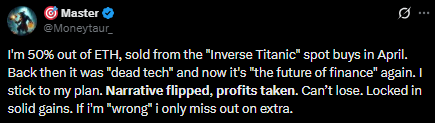
On the same day, i was selling half of my bags, completely against the herd's blind conviction.
These 'indicators' never fail.
You should stop trading if you can't open a blank chart and instantly feel comfortable with it.
Have a step-by-step system to analyze a blank chart:
1. Mark the annual, monthly, and weekly support/resistance.
2. Identify the zone: accumulation, distribution, or another phase.
3. Determine the trend using an EMA (e.g., 4-hour 200 EMA or 50-day EMA).
4. Assess if the volume indicates accumulation or indifference.
@game_for_one Thank you for the Post, Sir. As for me, unfortunately it is bad trades with big loses that forces me for big efforts to become a better trader. Without pain - no gain.
Things you should have noticed if you’re in this space for a bunch of years:
• Communities are just geese being fattened up while waiting to become foie grais
• It’s full of narcissistic, egocentric and toxic people always looking to flame each other in the most creative ways trying to dethrone their “opponents” for imaginary glory
• Life changing tech is truly life-changing for those who sell it as such, it’s all a useless vaporwave that saw no real improvements during the last 10 years
• 95% of accounts are here just to sell dreams scamming as much as they can showing no mercy
• The cults around certain projects are more toxic than the air in Chernobyl in 1986
• Narratives shift overnight, and what was “the future” yesterday becomes a laughingstock today until it gets rebranded and fed to the next generation of suckers
• Every cycle, the same promises are repackaged, the same scams run, and the same insiders walk away richer while the true believers are left holding the bag
• Decentralization? Just a marketing gimmick. Power always centralizes in the hands of those who control the money, the narratives, and the backroom deals. The only thing truly decentralized is accountability, because when things go south, suddenly, nobody’s responsible.
• Regulation is always “right around the corner,” but somehow, the worst actors thrive while the few honest builders get crushed under bureaucracy or priced out by VCs looking for the next pump-and-dump cycle.
• Partnerships, roadmaps, and whitepapers are just theater designed to keep the dream alive long enough for the right people to exit. Nobody actually expects these projects to deliver; the goal is to make it look like they could for just long enough.
• Media? Bought and paid for. Every “independent” journalist or influencer is just another cog in the machine, shilling whatever pays the most while pretending to be objective. The few who dare to expose the truth either get blacklisted or quietly disappear.
• Security is a joke. Billions vanish overnight due to “unexpected exploits,” yet somehow, the same teams and auditors keep getting hired. Everyone acts shocked for a week, then moves on like nothing happened because deep down, they know it’s part of the game.
• “Transparency” is just a buzzword until someone gets called out. In reality, the industry is built on trust that’s been eroded so many times it’s hard to believe anything anymore. Full disclosure is reserved for those who have nothing left to hide.