Убитой и запытанной в плену журналистке Виктории Рощиной россияне сломали затылочную кость, когда ее удерживали в СИЗО в Таганроге.
Я напомню что при передаче тела у девушки оказалось что отсутствовали внутренние органы, головной мозг, глазные яблоки, часть трахеи.
Очередное напоминание всему миру с кем воюет Украина. Это не люди.
@PeeterKo Sa pead silmas vist seda ainsat saadet, mida ma Eesti kanalitel korra aastas vaatan?
Hea intekas oli. Tegime abikaasaga lausa mulli lahti selle peale ❤️💪
Uudne vaade madalale sündimusele üle gloobuse. Probleemiks on kodude kättesaamatua (meie puhul vanad head planeeringud) ning Instagram ja TikTok. Neid küsimusi suuremate peretoetustega ei lahenda. Why birth rates are falling everywhere all at once https://t.co/i7pR2fS5UE
> Europe’s youngest billionaire didn’t come from Silicon Valley 🤯
> Meet Markus Villig.
> Born in Estonia. A country of just 1.3 million people.
> Grew up watching Skype get built in his tiny home country.
> Dreamed of building a tech company since he was 12.
> Graduated high school in 2013. Skipped university after one semester.
> Had zero experience. Zero connections. Zero investors.
> Borrowed €5,000 from his parents money they'd saved for his studies.
> Went on the streets of Tallinn. Talked to taxi drivers one by one. Alone.
> Built a ride-hailing app called Taxify.
> Uber had billions. He had €5,000 and a laptop.
> Didn't fight Uber directly. Went where Uber wasn't.
> Quietly dominated Eastern Europe and Africa while Uber fought in the West.
> Uber burned $19.8 billion before going public.
> Bolt reached $10 million in revenue on almost nothing. 💀
> COVID hit. Wiped out 85% of their revenue overnight.
> Instead of mass layoffs — entire team took pay cuts. Founders went to zero salary.
> Pivoted to food delivery. Survived.
> Built to 200 million customers. 600+ cities. 50+ countries.
> Valued at $8.4 billion.
> Became Europe's youngest self-made billionaire at 27. 🚀
> Said "You don't need Silicon Valley. You don't need billions. You just need to start."
> €5,000 vs $19 billion. He still won. Absolute legend. 🔥
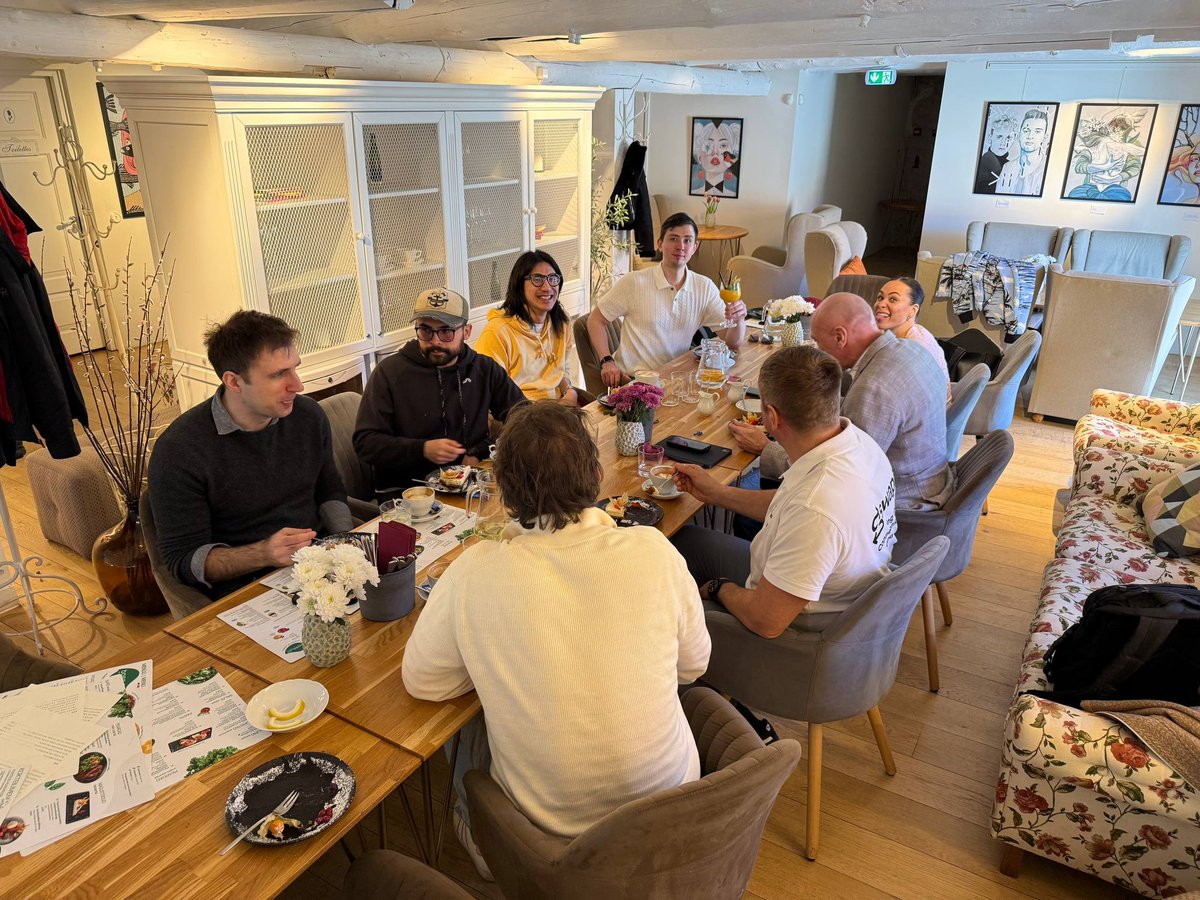
Today’s 30th Web3 Community Brunch welcomed some new faces, and together we got the latest updates about everyone’s ventures at Basiilik.
These community brunches generally take place on the 2nd Friday of each month in 2026.
So proud to see this launch, @sandergansen! The physical book renaissance is real, but scaling it online requires exactly this kind of innovation. Bridging the sensory gap with AI to build buyer confidence is a game-changer. Keep pushing the boundaries with #Raamatuhai!
You can't smell a book through a screen. Or can you?
Today, we're launching BookScent™ on Raamatuhai. Our AI now analyzes microscopic patterns of paper oxidation in seller photos to verify the exact age and condition of pre-loved books.
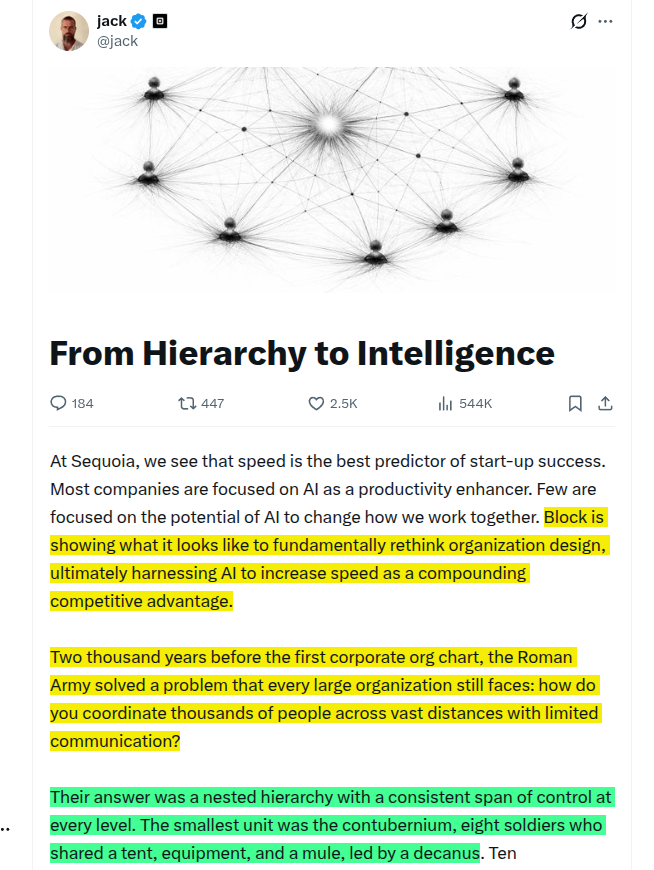
🤯 Jack Dorsey's Block just laid out a plan to replace much of corporate hierarchy with AI coordination.
Middle management exists to coordinate work, but AI can now handle that instantly. There is no longer a need to move information up and down layers. Block is replacing hierarchy with AI systems, so decisions come from real-time data instead of meetings.
The old org chart exists because people are slow, narrow-band routers of context, so companies add managers to pass information up and down.
Block’s claim is that a company world model can track work continuously, while a customer world model built from transaction data can track what people and merchants actually need.
A sufficiently good company model can take over much of that routing function. In a remote-first firm where work already leaves digital traces, AI can, at least in principle, maintain a live picture of projects, bottlenecks, resources, and outcomes.
That lets an intelligence layer assemble financial capabilities like lending, payments, cards, and payroll into custom solutions at the moment demand appears, instead of waiting for a product roadmap.
The human job shifts from relaying status to building capabilities, owning cross-team problems as DRIs, and acting as player-coaches who improve craft and judgment.
The real bottleneck in big companies is not effort but coordination, and Block is aiming at coordination itself.
Money is behavior with fewer illusions attached. If you can see how customers and merchants actually spend, borrow, save, and repay, you are no longer guessing from survey answers or product roadmaps.
From that view, products become less central than capabilities. Payments, lending, payroll, or card issuance are modular parts, and intelligence is the layer that composes them when the model detects a real customer need.