The cure for most cases of type 2 diabetes (T2DM) requires fat loss. This thread will discuss research showing restoration of carbohydrate tolerance in those with T2DM through addressing the underlying pathology (ectopic fat) rather than just focusing on symptom management.
This is obviously false and mostly confined to being a man's wet dream. Polygyny is incredibly rare and most women simply aren't interested in it.
In developed nations like the UK, 81% of women are against polygynous relationships and only 5% are for them (first image) (PMID: 38030825).
Moreover, when rated on a scale ranging from −3 (not appealing at all) to +3 (very appealing), women put monogamy at around +2.5 and polygyny around -2 (second image).
Women's (lack of) interest in polygyny was unrelated to their age, education, prestige, or mate value.
These findings are observed in the YouGov survey of Americans too, with 73% of women "definitely not" interested in polyamory and 14% "probably not" — 87% total being not interested (third image).
And yes, women's behavior matches what they say. In the US, only about 4% of relationships are polyamorous (which includes polygyny, but also open relationships for both partners) (PMID: 29696552).
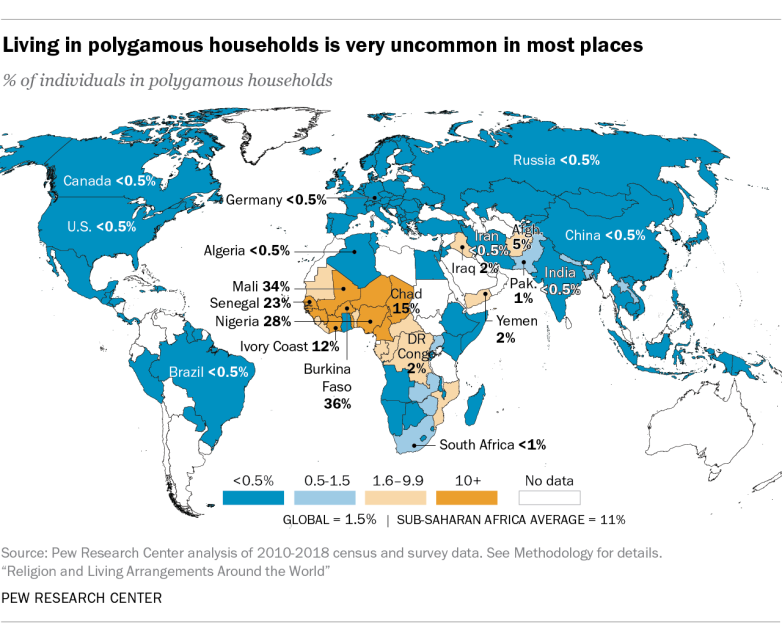
In another study, researchers estimated that just 0.1% of American marriages are polygamous (DOI: 10.1017/ssh.2021.23). PEW survey data put the value at less than 0.5% (fourth image).
Given a choice between part of a high-value man and all of an average one, women will share the Alpha.
Monogamy is the stated ideal. Hypergamy's revealed preference is quality, even when quality comes with competition. Five minutes of Alpha trumps five years of Beta.
What has been replicated is that men are much more likely to agree to a one-night stand when asked by a women compared to women asked by a man.
But your data point is cherry-picked, and subsequent replication research using larger sample sizes has found only 28–38% of men agree.
Also, replication work analyzed the data by relationship status and found that the "yes" answers for men were driven primarily by single men (53–59%) compared to those in relationships (8–18%).
None of this contradicts my prior point that men aren't as polygamous as you seem to think. These were zero-effort opportunities of the woman inviting the man to go have sex, and not only did 82–92% who were already in relationships say no, but so did 41–47% of those who were single.
Most men simply don't care about maximizing their lifetime number of sexual partners. That's a myth propagated by boys who have not yet stepped into their masculinity.
And considering how susceptible men are to perceived sexual norms (as demonstrated by the very study you responded to), continuing to perpetuate this myth will just cause many to chase a manufactured ideal at the expense of developing the very relationships that would bring them the greatest fullfillment.
** All studies involved college-aged adults on or around university campuses. Seminal work was at the University of Florida; replication studies done in Denmark (2010), Germany (2015), and Austria (2025).
@Alexleaf And yet, 75%+ of college-age men answered 'yes' when asked by an attractive woman, "Would you go to bed with me tonight?" (Clarke & Hatfield, 79, 82, & 89) in one of the most reliably replicable studies in psychology.
@RationalMale My post was talking about variety in sexual partners, not variety in sexual stimulation, so this pornhub analysis is irrelevant.
If you have a proposition you want to put forth from this data, I'm happy to discuss.
The desire for sexual variety is relatively low among men, even if larger than women (I've never disputed that a sex difference exists; only that it is exaggerated by the manosphere).
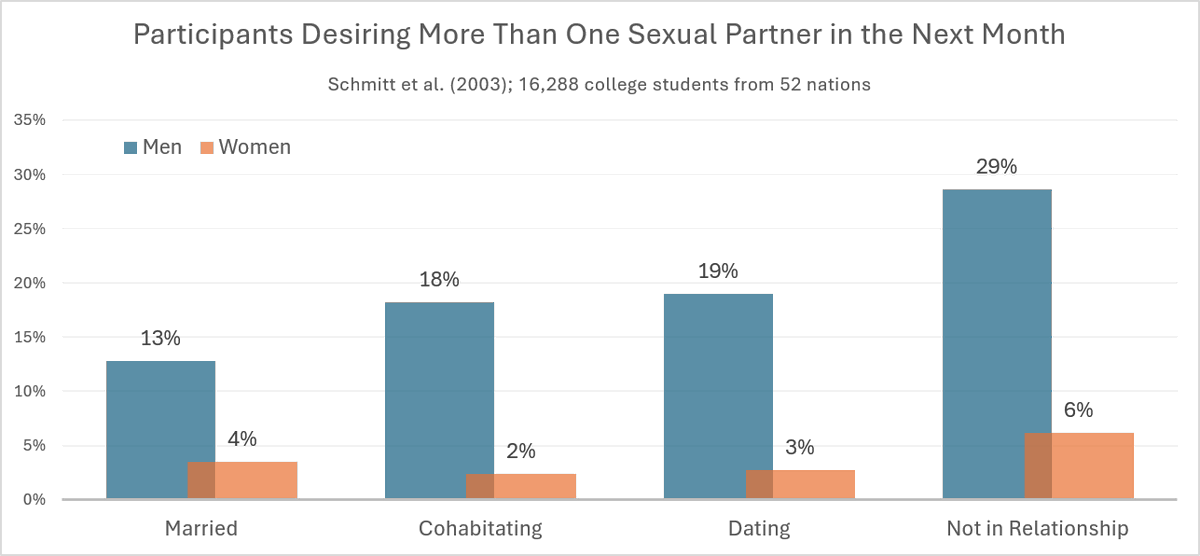
A cross-sectional survey of over 16,000 college students across 52 countries found that even among single men, 71.4% did not want multiple sexual partners in the next month (DOI: 10.1037/0022-3514.85.1.85).
This reported desire fell further to 18–19% for non-married men in relationships, and further still to 12.8% among married men.
This study also found that men reported wanting an average of just 6.6 sexual partners over the next 30 years, compared with 2.5 for women.
But as we saw with my prior post (link in follow-up comment), these averages are heavily skewed by the tail of highly promiscuous men, and most men aren't interested in maximizing their sexual variety.
@Alexleaf Also, these studies test compliance with a stranger, not desire. Where desire is measured directly (52 nations, 16,288 people), men report wanting more sexual variety. That's an average, not 'most men maximize,' but it makes 'manufactured' a stretch.
https://t.co/9VNOnP4Ekm
@UNOVERSE00 You started attacking a straw man and never to ask what my position was because you aren't really interested in having a good faith conversation.
@UNOVERSE00 I won't tolerate accusations that I'm manipulating data, especially when I'm literally sharing the data points of studies themselves. You can disagree with my interpretations, but I won't engage with bad faith tactics.
Those who lack optionality always assume the grass is greener. A self-directed man chooses what he wants from the options at some point. He doesn’t keep wandering aimlessly like a lost boy.
@PMauricard Sex differences were never a disputed point, so continuing to bring them up is irrelevant. My focus is on the tendencies of men alone, not men compared to women.
@UNOVERSE00 No, it's 40–45%, which I stated in my post. And it rises to 50–60% when the men are prompted with information that makes such a thing seem more normal and common.
@UNOVERSE00 Both this study and the other one also asked about sexual partners over the next 30 years, 1 in 3 wanted more than one partner isn't most men, and that was restricted to single men.
@UNOVERSE00 As explained in my post, this study largely supports what I've been saying all along, where the desires of men are exaggerated in manosphere circles. Sex differences have never been disputed.