David Friedberg just said what a lot of people in tech are thinking but won't say out loud and the evidence backs him up (Save this).
@friedberg argument is that the people who talk loudest about inequality, fairness, and protecting the working class are the same people building the most sophisticated machinery of economic control this country has ever seen and disguising it as virtue.
He calls it the Great American Politburo.
The Politburo, for context, was the small committee that ran the Soviet Union controlling the economy, education, media and what citizens could and couldn't do, while insulating its own members from the rules they imposed on everyone else.
Freeberg's case is that Elizabeth Warren, Bernie Sanders, and Ro Khanna are doing the exact same thing, American edition.
And here is the evidence.
Congressional members outperformed the S&P 500 again in 2024 , Democratic representatives averaged 31% returns while Republicans averaged 26%, compared to a 24.9% gain for the S&P itself.
Nancy Pelosi's Nvidia positions have returned 586% since 2021 while she simultaneously sat on committees regulating the semiconductor industry.
Elizabeth Warren publicly calls for soaking the rich while financial disclosures reveal she has made millions on Wall Street investments, the same markets she campaigns against.
A nonpartisan tracker of congressional wealth found that roughly half of all 540 members of Congress match or beat the S&P 500 on an annualized basis.
These are people with access to intelligence briefings, regulatory decision-making, and committee hearings held months before public disclosure and they're trading the whole time.
The AI angle is where this becomes directly relevant to every reader of this newsletter.
In February 2026, Sanders and Khanna held a town hall at Stanford specifically calling for slowing down AI development warning of profound dangers from AI controlled by billionaires like Musk, Zuckerberg, and Thiel.
They called for keeping humans in the loop," broad AI regulation, a federal AI regulatory agency, and ensuring productivity gains are shared with workers.
On the surface, that sounds reasonable. Who could be against sharing gains with workers?
But look at what that agenda actually means in practice, a federal AI regulatory agency means political appointees deciding which companies can and cannot deploy AI, which models can and cannot be released, and which applications are approved or denied with no market mechanism and no accountability to the people actually building the technology.
That is the Politburo structure Freeberg is describing, translated into tech policy.
I still have no idea what Kevin Warsh thinks about monetary policy. Maybe we need a task force for that!
Saying you will deliver on price stability without explaining how you might do it is empty words.
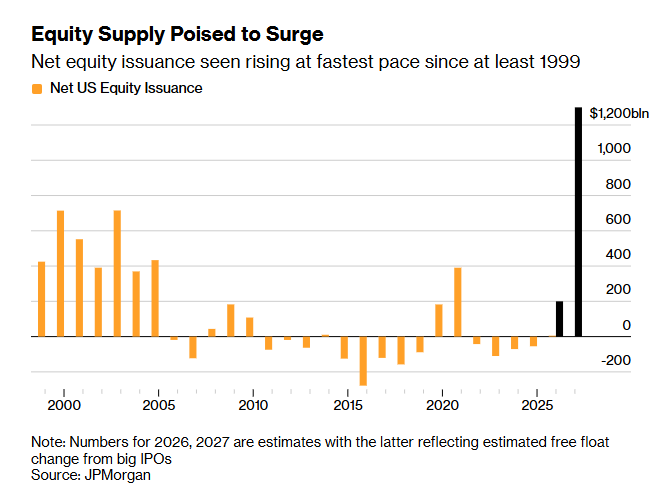
SpaceX and OpenAI Are Ending Wall Street’s Era of Stock Scarcity
For the better part of two decades, a defining feature of the US stock market has been scarcity. Year after year, shares disappeared from public hands, with buybacks by S&P 500 companies alone erasing nearly $12 trillion worth.
Now, investors are about to discover what happens when the supply suddenly comes rushing back.
According to JPMorgan Chase & Co., IPOs, secondary offerings and other share sales are poised to add roughly $1.5 trillion of stock to the US equity market over the next two years, even after accounting for buybacks. If realized, it would mark the strongest period of net equity issuance since at least the late 1990s. (Bloomberg)
This AI just exposed the BIGGEST legal insider trading operation in America.
A platform called GovGreed built a seven-layer machine learning system that cross-references every stock trade disclosed by every sitting politician against the bills their committees control, the campaign donations they receive, and the companies their votes directly impact.
It scored all 540 politicians currently in Congress. And the numbers are crazy:
56% of every stock purchase made by Congress in the last 16 months was on a stock directly affected by a bill the buyer later voted on. That is 6,170 out of 11,016 total purchases.
More than HALF of all congressional stock buys are on companies whose fate that same politician is about to decide.
343 of 540 Congress members actively trade stocks while holding access to nonpublic legislative information.
That is 63.8% of the entire legislature making market bets with an informational edge that would put any hedge fund manager in prison.
The AI identified 752 active "Triple Signals" in the current Congress. A Triple Signal fires when three conditions line up at once:
The politician sits on the committee controlling a bill, they traded stock in a company affected by that bill, AND they received campaign contributions from that same industry.
Bills carrying these insider indicators pass at 5.4 TIMES the normal rate.
Now look at the individual leaderboard:
- Nancy Pelosi's estimated portfolio sits at $194 million with a Greediness score of 98.1 out of 100
- Ro Khanna made 13,231 trades across 800+ different tickers
- Michael McCaul made 32,302 trades and filed 6,670 of them late
- Thomas Suozzi filed 86.4% of his trades late with an average delay of 396 days, meaning his disclosures landed over a YEAR after he made the trade
And then there is Lisa McClain, the fourth-ranking Republican in the House. She has made 1,443 trades in three years, more than 98% of all politicians tracked.
She violated the STOCK Act twice in a single year, disclosing up to $900,000 in trades months after the legal deadline. Her husband bought up to $250,000 in Elon Musk's xAI, which quietly converted into SpaceX equity before last Friday's $2 trillion IPO.
The penalty for all of this? A $200 fine.
The number of Congress members ever prosecuted under the STOCK Act since it passed in 2012? Zero.
And the cruelest part is this:
A bill to ban congressional stock trading was introduced in January 2026. It has bipartisan support. Over 80% of American voters want it passed.
But Congress is sitting on it, because the people who would have to vote yes are the same people making millions from the system staying exactly the way it is.
They write the insider trading laws, they exempt themselves from enforcement, they trade on the information those laws generate, and when they get caught, they pay a fine that is basically nothing.
The AI didn't discover anything Congress was hiding. It just organized what was already public into a pattern so obvious that nobody can pretend it isn't there anymore.
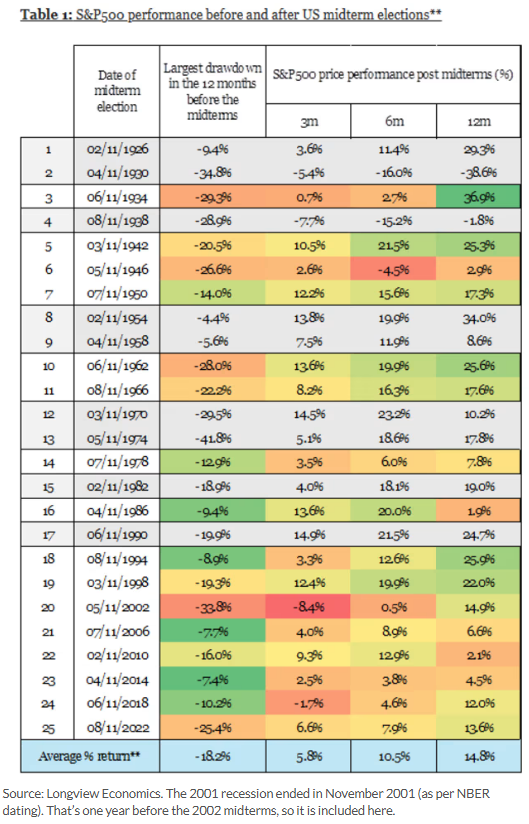
2026 Warning 🚨: Going back to 1926, the S&P 500 has seen an average drawdown of 18.2% in the 12 months before midterm elections 📉 Going back 60 years, the smallest drawdown has been 7.4% while the largest was 41.8% 🤯 After the midterms, all is well, but before? 🤔👀
This is a must-read from @HodlMaryland. 🫡
Long piece but absolutely worth your time.
We both identified an emerging monetary system with Bitcoin + private stablecoins at its core months ago.
In this article he breaks down why Strategy and its financial instruments
are becoming central to this new monetary system taking shape under the Trump administration.
A system that shifts money creation away from the Fed & banks
and into a decentralized network of stablecoin issuers.
A lot of Bitcoin OGs are still grouping MicroStrategy with the old guard…
They’re missing how fundamentally different this is from anything JP Morgan or Wall Street has built.
Strategy isn’t trying to recreate the old system;
it’s positioned to play a transitional role in moving monetary power out of the centralized banking sector
into a decentralized stablecoin- and Bitcoin-native framework.
Maryland and I have been tracking the emerging Trump vs. Banker conflict for months.
We challenge each other and push deeper into understanding what’s happening.
The conclusion is clear: we’re living through monetary reform in real time.
And the monetary war is entering a new phase.
Understanding this monetary shift is our edge.
What helps us win long-term is:
• Self-custody BTC
• Staying informed
• Staying patient
Enjoy the read. 👇
MARK YOUR CALENDAR!
Europe at a Crossroads: Wealth, Politics & the Future of the Continent 🇪🇺 featuring Alex Pezzoli 1-on-1 with Keith McCullough https://t.co/Pn8U32I44E via @Alexpezzoli and @KeithMcCullough
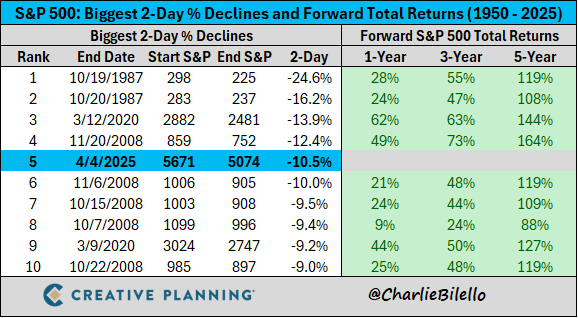
The S&P 500 fell 10.5% over the last 2 trading days which was the 5th biggest 2-day decline since 1950.
What has happened in the past following the biggest 2-day declines?
Stocks were substantially higher over the next 1, 3, 5 years every time.
https://t.co/l5IYmkeySJ
Why did "liberation day" blow up the stock market?
We collectively misunderstood that this was more than tariffs.
It's an attempt to realign the global economy that comes around a few times a century.
---
Scott Bessent, Manhattan Institute 6/6/2024
"We're also at a unique moment geopolitically, and I could see in the next few years that we are going to have to have some kind of a grand global economic reordering, something on the equivalent of a new Bretton Woods or if you want to go back like something back to the steel agreements or the Treaty of Versailles, there's a very good chance that we are going to have to have that over the next four years and I'd like to be a part of it."
---
Why? Because the status quo has become untenable. We cannot continue to allow foreign countries to endlessly fund our debt and deficits.
So, if you don't like this radical policy, propose another radical policy.
The answer cannot be to get back on the path of the red line below.
The S&P 500 has dropped 10% in 2 days, one of the most rapid descents.
What happened in previous sharp declines? (Parabolic drops).
These were the last 4 parabolic declines
Bill Ackman's Pershing Square released an investor update that covered commentary on markets and Pershing's holdings.
Here are 8 interesting slides:
1) The 10 largest companies in the S&P 500 index trade at 27x earnings, compared to 20x for the other 490 companies
WOW. This would be historic:
Both Elon Musk and Coinbase's CEO have now proposed putting ALL US spending on blockchain.
This means $6.9 TRILLION of US spending PER YEAR would be placed on a decentralized ledger.
What does this mean? Let us explain.
(a thread)
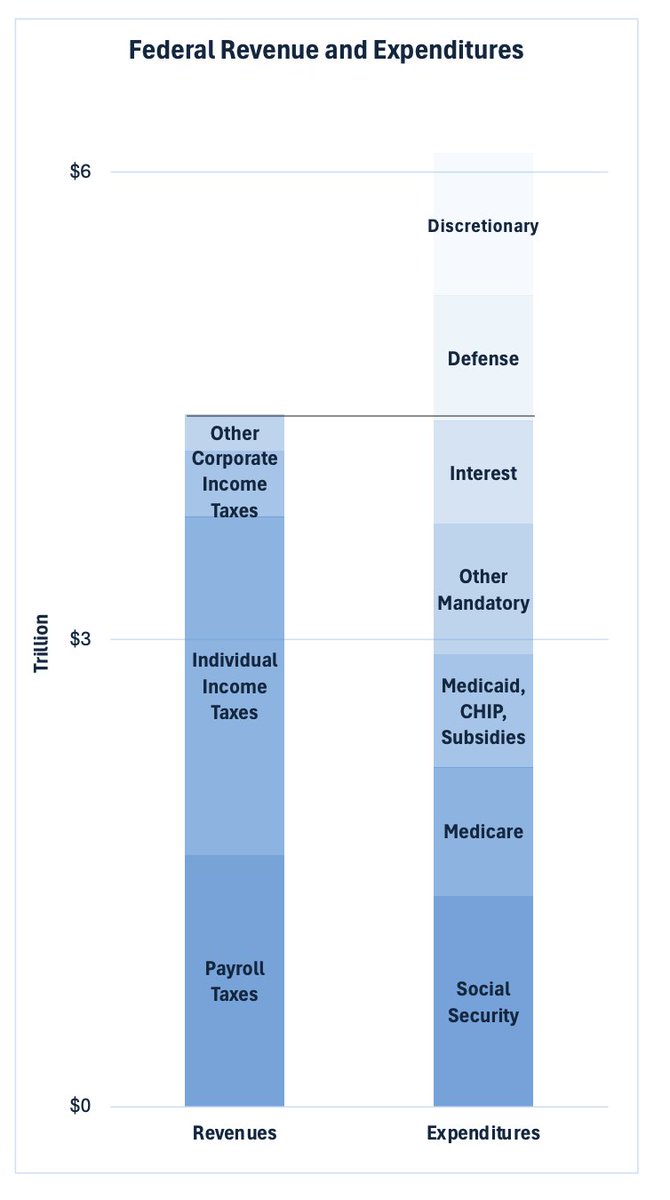
Reading @Myrmikan's latest, this stuck out to me, even if DOGE can cut ever bit of gov fat and Trump can end the wars, it isn't enough.
We're barely making it above mandatory social spending and interest expenses.
Like getting paid on Friday, buying groceries, your mom's medicine, paying the minimum on the credit card, and you got $5 left over...but you're still charging things to the card so interest is going up over time.
Some will say Rad, don't worry, AI is going to save us, not without taxing those robots and corporations as they lay people off who then go on the right side of the social column as a gov liability it's not.
Truth is there is no way out of this without drastic cuts to mandatory spending and no one wants to hear that.
You want to lower interest rates below inflation and kill bond holders, or do you want to cut social security, medicare, and medicaid and cause a recession/depression? You have to pick one.
Oh, and you also can't fund anymore forever wars or any other dumb shit like giving $100 million to an NGO who funds ISIS in Syria by accident or putting testosterone in frogs to see what happens, those things getting cut are a given, just to stop the debt growing.
This is what a lot of people who want to argue about human rights or defending democracy don't get, none of that matters because we're fucking broke.
You know who gets to care about social issues and starving kids in Africa? People with money who need public adoration to fill an internal hole in their soul.
We don't have any more money so none of it matters.
Yes there will be fucked up things happening all around the world, I need you to stop worrying about them and start worrying about your own life and put your fucking tourniquet on to stop the bleeding.
That's where we're at in money terms. Shut the fuck up and put your tourniquet on so you don't die.
This isn't a popular message, which is why some people believe financial repression will most likely happen.
It is more politically survivable to slowly kill US bond holders by paying less interest on debt and let inflation run hot than telling them we need to shut the fuck up and put a tourniquet on and cut all this spending and go through several years of pain to get rid of this debt and entitlements.
Financial repression is more politically survivable because people don't understand how financial repression inflation (currency devaluation) works.
This isn't inflation like the price of potatoes are going up because farmers had a bad year and there are less potatoes to buy so prices go up. No.
The prices are going up because the value of the dollar is going down relative to what it can buy as the government pays less interest than it should on purpose so it allows them to service their debt.
Yes, it is deceitful, yes life will be hard for a lot of people with this happening, politicians don't care about that.
They care about not being the ones to blame.
Financial repression allows this to be done in such a way people won't know what is happening, or who is to blame exactly, so it presents the best possible way for politicians to survive while maintaining social stability so their power is intact.
If they cut social security, medicare, or medicaid then that causes a recession/depression as the house of cards they've built with massive debt comes crashing down and everyone knows who did it.
Welcome to democracy, it's all about making it so convoluted people don't know who to blame.
The problem with this plan?
We're starting to see it now with Fed lowering interest rate yet the 10-yr yield is going higher and mortgages are going back higher following 10-yr as market sniffs out that the plan is to run inflation hot and bond yields low and they are not playing along and wanting more yield for holding US debt.
US won't let that happen if financial repression is the plan, so at some point gov will mandate institutions hold more bonds and just take that pain.
And with that, the price of assets will go even higher, not because it makes sense for Nvidia to be where it is, not because the US economy is strong, it is just capital running away from the massacre the Fed is doing to bond holders as they try to find a place, any place, to hide from the financial repression and try to maintain their purchasing power through this.
It is people trying to find a place where they can still get a real return in the future after inflation and taxes.
That's how I think about financial repression, we'll see if it happens.
And if you're not reading Myrmikan's pieces, you are truly missing out. Sign up below to get smarter on money and history so you can annoy the gf or wife even more with random historical facts.
https://t.co/02fnYl1D1a