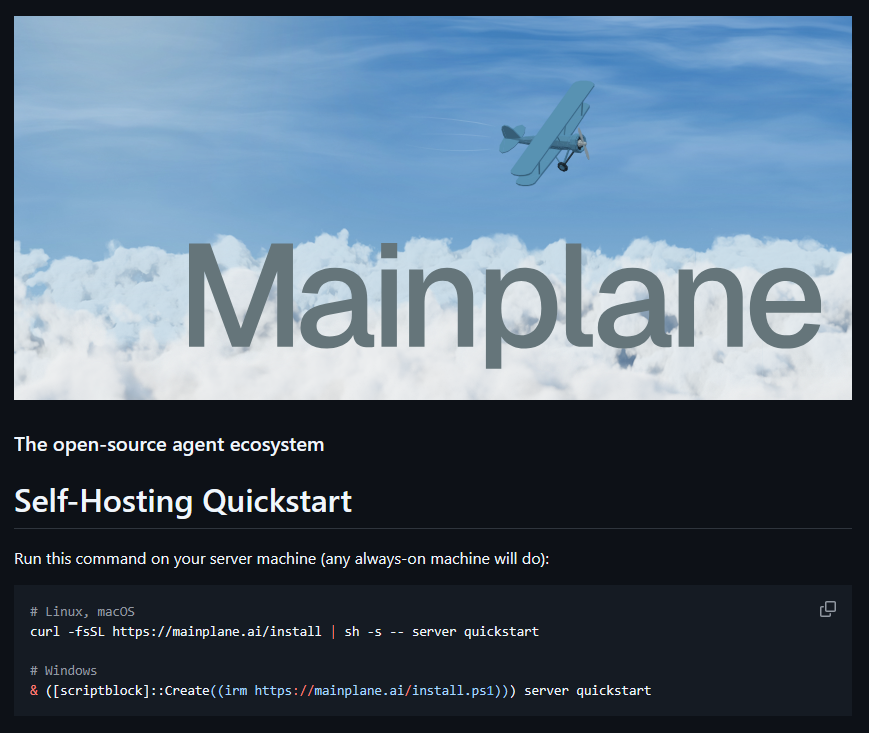
Introducing: Mainplane🛫 A new open-source AI agent I built from scratch in Go
Local agents die with your laptop. Cloud agents can't reach your work. Mainplane lives on your server and drives all your computers
> Your old computers → always-on AI shed
> Shared file server for all computers
> Use a Claude/ChatGPT plan on regular usage limits
> Browser + computer use on Mac, Windows and Linux
One line to install
100% open source, MIT ↓
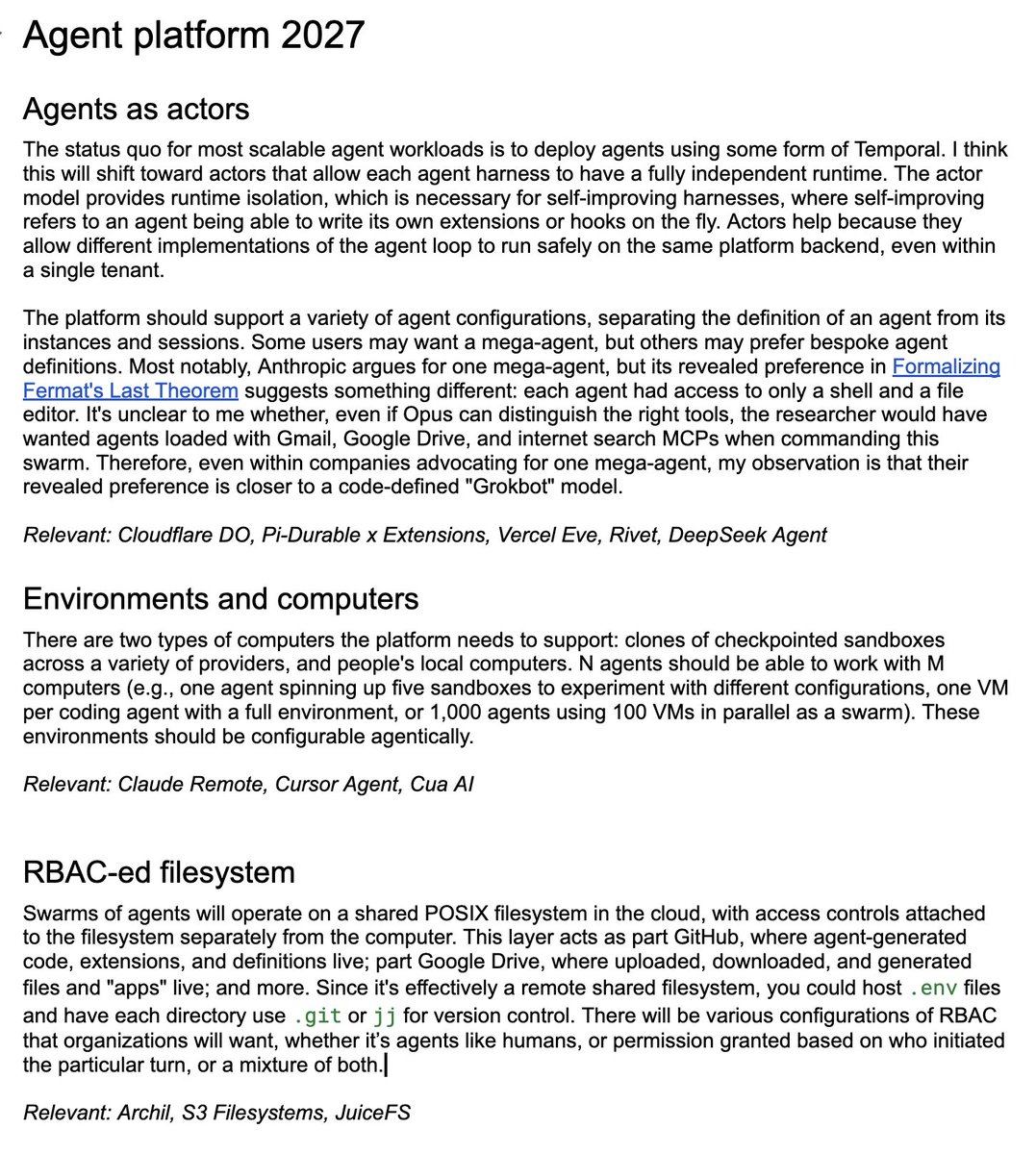
John Suh has posted a great writeup on where agents are going in 2027
Here is what I agree and disagree with:
> There will be one and only one "application layer for agents"
AGREE: I think everything above training the model that it takes to complete a user task will be in-housed by one winner
> I have reasons to believe an independent company (not ChatGPT or Claude) will own this product layer
AGREE: Frontier labs have to focus on the model, and it slows them down on everything else
> Allow each agent harness to have a fully independent runtime
AGREE: Many agents are temporary and deleted afterwards, I agree each one will be more long lived and have a level of independent processes
> Allow different implementations of the agent loop to run safely on the same platform backend
DISAGREE: I believe in the end purpose of customizability but I think this can come just from the agent having its own computer and making bespoke scripts and files, and access its own API, not needing to run whole other harnesses.
> The platform needs to support both sandboxes, and people's local computers.
AGREE: And this is the cloud-to-local bridge I built Mainplane around. Different types of work are done in both places
> N agents should be able to work with M computers
AGREE: This is the biggest gap I see with other agents right now, so many restrict any session to only one machine. Only Mainplane and Dots (with multi exec) have true multi machine orchestration right now
> agents will operate on a shared POSIX filesystem in the cloud
DISAGREE: Again, I do believe in shared drives, but I believe the filesystem must be self-hostable, and work cross-platform. For this we chose NFS for Mainplane shared drives. It works across windows and mac together.
> What the user interacts with should be abstracted from the core agent session as a "conversation.
AGREE: I think the time of looking at individual sessions is mostly behind us. I agree that there should be a higher level abstraction as main interface, and leave a session control view as something to do on occasion.
> Users will increasingly interact with a focused inbox of approvals and questions.
DISAGREE: I don't think that an inbox will be the right new interface. Instead, I believe in project-specific bespoke dashboards, and Slack. Not a slack-like interface but actually agents inside slack. Then work looks like reading unread messages in your slack
> Agents should be able to define streams of events from the external world to listen to on a per-tenant basis
AGREE: Yes I think agents creating event hooks for themselves is the most important part of proactivity
> Agents should be able to define durable workflows on a per-tenant basis.
DISAGREE: I don't think workflows are an abstraction themselves worth keeping. I do believe agents will make workflows by setting cron jobs, and writing custom scripts, but not by any central and limiting workflow manager
> Apps
DISAGREE: This is the most speculative part of John's writeup, because no agent platform has figured out apps yet. I don't agree that every app is a artifact made by the agent themselves. I think apps should include any of 1 a skill, 2 a api route and 3 a daemon 4 an interface, and be something the agent gets to import and use however they wish. There is a real place for vendored code in agents of the future
> Infinite canvases
MAYBE: I have always liked infinite canvases for project brainstorming and organizing, but have always found it buggy and messy. I am not sure if this can be fixed with better UX
Fantastic writeup @john_ssuh! But here is what I think you missed:
- Control plane architecture: this is what makes multi-machine and cloud-to-local possible
- Agent state file. Agents need to have state fully contained in a file to be truly durable
- Network layer. All the cloud and local machines will not be on the same internet, and so a networking layer (like Tailscale) needs to be built into the platform
- Browser/Computer use. Almost all work happens in browsers or via real applications, so browser/computer use is a must have for any agent platform of 2027
- Payments. Agents need ways to access paid services (like compute) without directly having api keys or credit cards
Agent platform of 2027.
This is the end game. This is the blueprint for the one and only application layer software that will exist. Every other software will effectively become databases for this layer, the everything agentic operating system for the million agent swarm to work on top of.
This is obviously the end game vision for the application layer of ChatGPT and Claude. I have reasons to believe that an independent company will own this product layer. But most ADE, "enterprise agent platform", or vertical saas companies, are focused on the wrong things far too narrowly, not technically competent, and do not have the product / technical vision to see this inevitable future.
The correct agent platform that wins will function like the base of a garden, from which customers will plant their unique "seeds" to grow their own plants and trees, managed and evolved by agents, humans, and signals from the sensors of the business. This presents a clearer picture than "factory of a factory" imo.
i barely see anyone promoting @obsidian anymore. and i’ve stopped using it too.
looking back at the obsidian hype, i think what people were really selling was the pleasure of collecting and organizing knowledge.
it tapped into a very specific fantasy shared by straight-A students, perfectionists, and productivity nerds: the dream of having the perfect notebook, where everything you’ve ever learned is beautifully organized.
that feeling was incredibly powerful. and obsidian went viral because it nailed that feeling.
the real insight here is, great marketing doesn’t just speak to what people need a product to do. it sells the feeling of being the kind of person they want to become.
obsidian sold the fantasy of being someone who has all their knowledge perfectly organized.
and for a while, that fantasy was enough.
@aka_lacie I think with all the demand, Google will allow 3rd party harness soon. I might even consider adding it and seeing if they are enforcing the policy at this time
@collinhqian The most important thing in building right now is being willing,
Not just willing, but happy,
To cut out all the things you worked hard to build when models get smarter