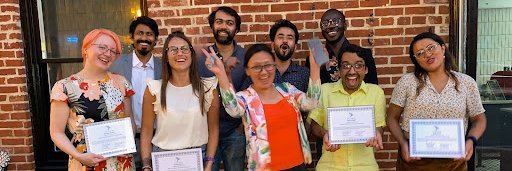
Unbiased and well-researched #news is a right, a right that not everyone gets access to. We're a #nonprofit that works to change that by training #journalists.
"The massive, successful street protests in Georgia this week clearly demonstrated to the entire world how most Georgians react to anything that starts with the word 'Russian', be it an influence, a draft law, propaganda or war."
Khatia Shamanauri, alumni of the Alfred Friendly Class of 2020, wrote a commentary about the association with Russia that the country of Georgia often receives. https://t.co/ziNfx1yTyO
The gap between the number of countries that registered overall improvements in political rights and civil liberties and those that registered overall declines was the narrowest it has ever been through 17 consecutive years of deterioration.
Believe in the power of the independent press: Freedom in the World report: the global struggle for democracy approached a possible turning point in 2022. https://t.co/RkMfX8qJAZ
@parthpunter, a 2022 Alfred Friendly Press Partners fellow, recently wrote a piece about a popular Youtube personality in India, Monu Manesar, who built a huge audience with violent content and is now wanted for murder. https://t.co/blyHYY2gMF
'Linking press freedom and public interest allows for the protection of press freedom based not only on the individual right to free expression but also on the collective social benefit derived from independent journalism'
Joel Simon, until recently the director of the Committee to Protect Journalists, writes about a 'new paradigm for global journalism.' https://t.co/dRJdJfHlLd
Jeelani’s eight-minute video story on India’s proposed “rocket force” is particularly relevant now with Russia’s war in Ukraine raising tensions between the nuclear superpowers. https://t.co/j5yNrRWz0j
Alfred Friendly Press Partners alumnus Gulam Jeelani produced two short documentaries for News9 Plus, one about India's preparation of a rocket force and another about the move to machine voting for migrant workers https://t.co/3haGjaM20a
Jeelani narrates his story about the move to machine voting for migrant workers, which uses dramatic background music, sophisticated graphics and multiple interviews in a studio and in the field. https://t.co/OODKMOVrTh
Primarily a print and digital journalist, Jeelani saw the value that video storytelling can add when trying to reach a larger audience about important issues.
Explanatory journalism puts more emphasis on the “how” and “why” of the basic news story. This goes beyond the “who, what, when and where” answers to help readers understand issues as they unfold. Here is a good example from @someshjha7 https://t.co/1c4TCUZjz6
@someshjha7 “Many countries adopt policies such as tax breaks and financial incentives for businesses to boost economies amid crises like the pandemic. Central banks flood the economy with money to make it easier to lend and spend."
@someshjha7 He recently had his macroeconomic analyses featured by Al Jazeera in a special section called The Big Question. Each includes a boxed paragraph called The Short Answer, such as the following one from Jha about the rich:
From Emran Hossain, a 2013 graduate of our fellowship program: Bangladesh’s power purchase agreement, better known as PPA, with Adani allows the Indian corporate giant, currently embroiled in a fraud controversy, to manipulate coal prices. https://t.co/pjPY9P8AU6
@someshjha7 explained why the rich get richer during a global economic downturn. And @JodyReporta delved into a diplomatic dispute concerning a Colombian minister who led a Guatemalan corruption inquiry.
With their latest stories, new graduates of our fellowship program demonstrate explanatory journalism skills. The insightful reporting comes from around the world — from India, Guatemala, Nepal, and Bhutan. https://t.co/FG6MgUhQN0