Have you ever wondered why the prices of the S&P 500 or Nasdaq move rapidly in the second after a news release occurs during scheduled events?
What actually happens in that “one second”:
1. Machines read the release, not humans.
For scheduled data (CPI, UoM, payrolls, etc.), the numbers hit machine-readable news feeds at the exact time. Co-located algos parse the surprise vs. consensus and fire orders in milliseconds.
2. Liquidity gets pulled before the print.
Liquidity providers don’t want to be run over, so they cancel/halve quotes a few seconds before. The book thins dramatically; a relatively small burst of market orders can rip through multiple levels.
3. Stops/queues cascade.
Break a level → resting stops trigger → more market orders → more slippage. That creates the “instant” move.
4. Options dealer hedging accelerates it.
If dealers are short gamma, a quick move forces them to hedge with price (sell on down, buy on up), amplifying the spike.
5. Pre-positioning ≠ foreknowledge.
People take views before the event; the book can lean one way. When the number hits, price jumps in the direction that punishes the crowd most / matches the surprise. That can look like “they knew,” but it’s usually positioning + thin liquidity.
6. Unscheduled headlines.
News-scanning/NLP algos ingest verified sources and push orders in milliseconds. Again, it’s speed + liquidity, not a human decision.
Do market makers decide direction beforehand?
No. Their job is to quote and manage inventory risk. Into events they mostly widen, reduce size, or step back. Direction is set by order-flow imbalance once the data hits and by the stop/hedging cascade that follows.
Trading takeaway (since we can’t beat ms-bots):
• Either be positioned before with defined risk, or trade the second move: wait 1–2 minutes for acceptance/rejection of the spike zone, then go with it.
• Use stop-limits during news to control slippage.
• Size down; expect wider ranges and faster fills around the print.
That’s why it moves “in a second”—computers + a temporarily hollow book, not a secret decision room.
#trading #algorithm #algorithemic #SPX500 #nasdaq #stockmarket
See less
Another crude round trip: WTI spiked to 93.64 on a Strait of Hormuz closure headline, then collapsed to 88.77 on de-escalation. The war premium got priced in and right back out, leaving the 89.76 pivot in charge. The level map and a both-directions plan inside.
#CL#crudeoil #WTI #oil #futures
Gold flushed to a 13-week low at 4,046 overnight and bounced, but a 7.8% weekly drop and a sub-pivot structure keep the bias defensive into the data. Oversold enough for a bounce, weak enough to fade it. The level map and a fade-strength plan inside.
#gold#GC#XAUUSD#futures #daytrading
NQ traveled 670 points overnight and is leading the broad market back, holding the 28,700 pivot inside an intact uptrend as volatility eases. The long setup is there, but it has a gating level. The full ladder inside.
#NQ#Nasdaq#futures#daytrading#tech
ES reclaimed 100 handles off the 7,232 one-month low, but the bounce stays conditional until price takes back the 7,390 decision level. Above it the bias turns constructive, below it the relief is just a bounce. The level map and the gating plan inside.
#ES#SPX#SPY#futures #daytrading
You can be right on direction and still lose money. Survive First Ep.1 breaks down the risk habits that drain accurate traders, and the four-line fix: size small, define your exit first, let winners run, hard stop.
https://t.co/HwYdskywmn
#trading#riskmanagement #tradingpsychology
The price action is quietly agreeing with your math. WTI spiked to roughly 93.6 on the Bahrain headline and is already back near 92, which is a very contained reaction for a strike near the strait. If the market actually believed in a full closure of 20m a day of flow, crude would be gapping toward triple digits, not fading a one and a half percent pop. Traders are pricing a symbolic or limited disruption, not the tail scenario, at least until something forces a reprice.
The counterintuitive part is gold liquidated almost 3 percent on a day with fresh war headlines and a 4-handle CPI print. If safe-haven demand were driving this it would be ripping, not breaking. That tells you the move is a real-yields and dollar story, forced positioning unwind, not a fear bid. A quarterly reversal trigger below 4100 just confirms the trend funds have flipped to the sell side, so the 4000 round number becomes the next test where official-sector buying either shows up or it does not.
The 7390 rejection was the spot to fade it. That zone stacked the prior settle, the overnight high, and the dealer gamma flip near 7401 all in one shelf, so a relief pop into it on a 4-handle CPI print plus live war headlines was always going to meet sellers. With dealers still short gamma below that flip, every break lower gets amplified rather than absorbed, which is why 7308 reclaim is the whole tell. Hold below and 7247 is the magnet, reclaim and the squeeze gets real fuel back.
ES got its relief and its shock in the same ten minutes: an in-line CPI with a cooler core (0.2% vs 0.3%) collided with overnight drone attacks on a US base in the Gulf. Price sits near 7,340, below the 7,401 dealer pivot, in the zone where hedging amplifies the move. Level ladder and a sell-the-relief-into-the-pivot plan inside.
#ES #SPX #SPY #CPI #futures #daytrading
The sus feeling had a mechanical basis. A gap up straight into the shelf that broke Friday, with dealers still positioned to amplify rather than absorb, is exactly the setup where the first push looks strong and then has no follow through because there is no real demand above, just short covering. It tagged the obvious targets and faded, which is what a relief bounce into supply does. The tell for whether it is more than that is breadth on the next push, not the ramp itself.
Day 2 below is the real test. The first close under the 200 can be noise, but holding below it changes the trend character and forces the systematic trend funds to flip from buyers to sellers, which is its own supply. The offsetting force is central bank demand, the PBOC has been adding for 19 straight months and that buying tends to show up on exactly these flushes. So the tug of war into the back half of the week is systematic selling versus official sector bids, with real yields the tiebreaker.
The fade off 7472 lines up with the positioning read too. That run climbed right back into the 7490 dealer pivot and the 7500 to 7531 moving average band, the same shelf that broke Friday, so first touch from below was always going to be sticky. Dealers are still in the move amplifying posture under that level, which is why 7425 reclaim matters more than usual here. Hold above and the squeeze toward 7507 has real fuel, lose it and the air pocket reopens fast.
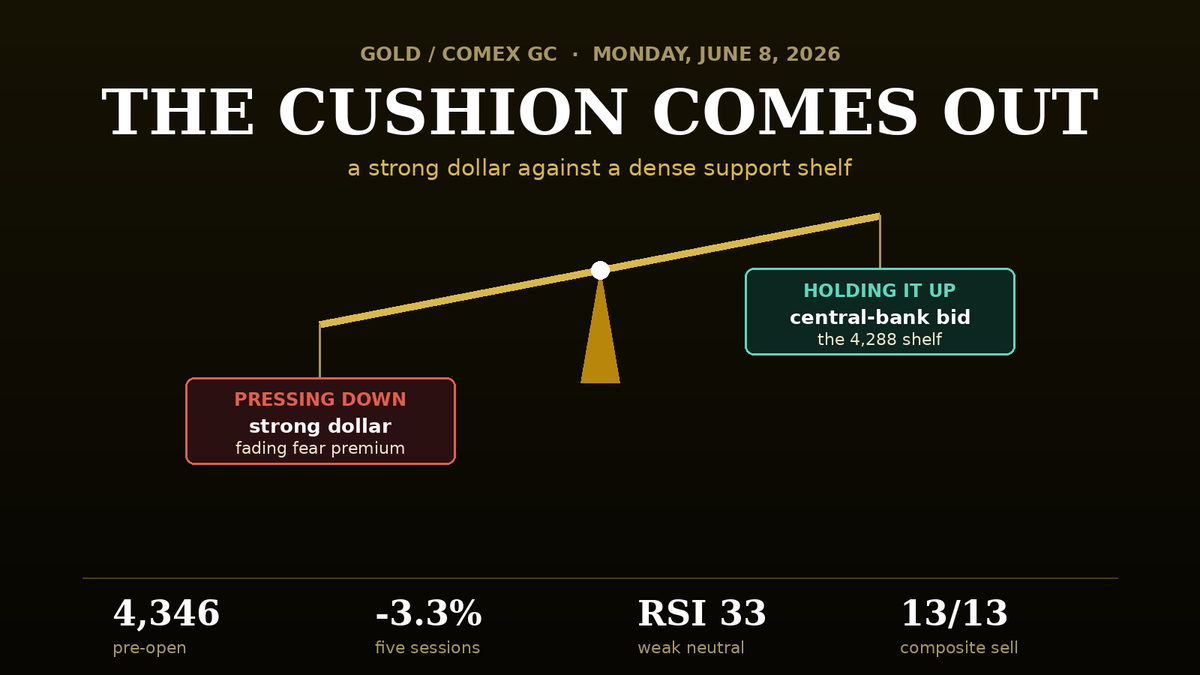
Gold trades near 4,346, down 3.3% over five sessions and below every major moving average. A 1.75-month-high dollar and a fading Middle East fear premium are pressing it onto a dense 4,288 to 4,305 support shelf that held overnight. The level map and a fade-the-bounce plan inside.
#gold #GC #XAUUSD #futures #daytrading
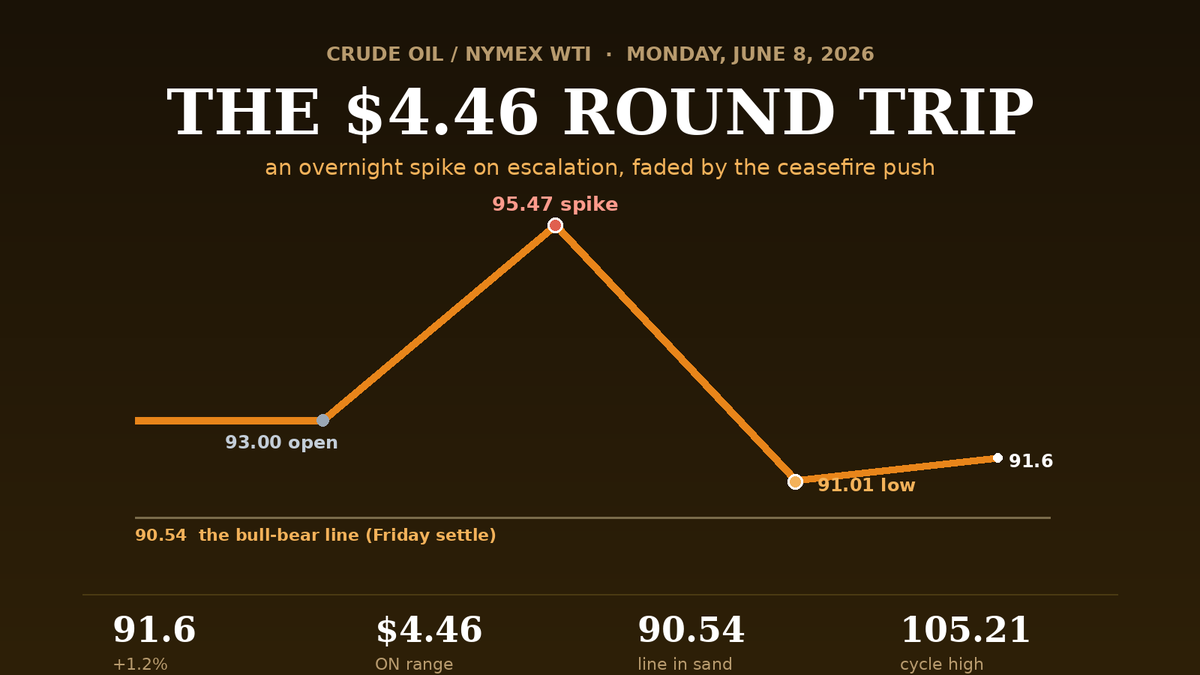
A 4.46-dollar overnight round trip in crude: WTI opened 93.00, spiked to 95.47 on a Middle East flare-up, then faded to 91.01 on the ceasefire push. It sits near 91.6 with 90.54 as the bull-bear line, the premium set tick by tick by the headlines. Both-directions plan inside.
#CL #crudeoil #WTI #oil #futures