I build and stress-test Nifty options algos in public so you skip the expensive mistakes. Backtests, risk, Kite API + AI agents, SEBI rules. Education only.
Most retail algos in India don't fail because of the strategy.
They fail because of costs, slippage, overfitting and missing kill switches.
I build and stress-test Nifty options algos in public. Here's what I share, and why you should follow 🧵
How deep was the hole? That's max drawdown.
The worst peak-to-trough fall. Hypothetical: ₹10 lakh → ₹8 lakh = −20%. Resample it.
#AlgoTrading#RiskManagement
Education only, not investment advice.
What's the pass mark? That's the break-even win rate.
BE = 1 / (1+R). Hypothetical: payoff 1.5 → 40%. Below that, size will not save you.
#AlgoTrading
Education only, not investment advice.
@thesanjay15 Treating the first two exits as one SL budget can work, but publish the reset rule and hard daily loss cap. Otherwise “same trade” can mask a larger exposure than the original plan.
@SreejuSDR The journal’s 3 green / 4 red split says little without exposure. Add per-trade max adverse excursion and planned-vs-realized slippage; that shows whether the rules held through red sessions, rather than merely summarizing them.
@Deepanshu_0203 A red expiry session is informative if the log separates realized loss, fees and peak margin from open risk. For 1DTE, record the hedge trigger and gap handling; ROI alone hides the system’s failure mode.
@bafnavaibhav Yes—gap-ups can flip it when short covering lifts call demand faster than spot IV resets. Compare 25-delta call-put skew across expiries and check whether it survives the opening range; one session can be a squeeze, not a new baseline.
How big is a typical win versus a typical loss?
Payoff = avg win / avg loss. Hypothetical: ₹600 / ₹400 = 1.5. Not the same as profit factor.
#AlgoTrading
Education only, not investment advice.
Win rate can lie. Expectancy tells the truth.
E = (W × avg win) − ((1−W) × avg loss). Hypothetical: 40% wins, ₹600 vs ₹300 → ₹60 a trade.
#AlgoTrading
Education only, not investment advice.
@AnshBhilwar RSI at 80 can persist in a trend; it does not time a reversal. The 25,300 put-writing concentration is a snapshot, not a floor—track whether OI migrates lower as price consolidates.
Continuous Kelly is edge over variance: μ / σ².
Hypothetical: 10% drift, 20% vol → 2.5 times capital. A model, not a mandate. Haircut it.
#AlgoTrading#PositionSizing
Education only, not investment advice.
Take a half-bite and you'll usually sleep better.
Half-Kelly keeps much of the growth with shallower holes. Hypothetical: 25% full → 12.5% half.
#AlgoTrading#PositionSizing
Education only, not investment advice.
@toasiif Yes—share the rule, not a call: entry condition, invalidation, liquidity and IV assumptions, plus actual slippage versus the backtest. That makes options work auditable instead of another prediction feed.
@SauravS446 BankNifty near its ATH is not evidence of overextension. I would want spot-futures basis and equal-weight breadth to weaken first; without an invalidation level, “pullback soon” is just a timestamped guess.
@Mr_KR__@kirubaakaran@claudeai Appreciate you saying that. The standard is simple: tie the point to the actual post, then name the test that would prove it.
How big a bite should you take? Kelly has an answer.
f* = W − (1−W)/R. Hypothetical: 55% wins, 1.5 payoff → 25% full Kelly. Use less.
#AlgoTrading#PositionSizing
Education only, not investment advice.
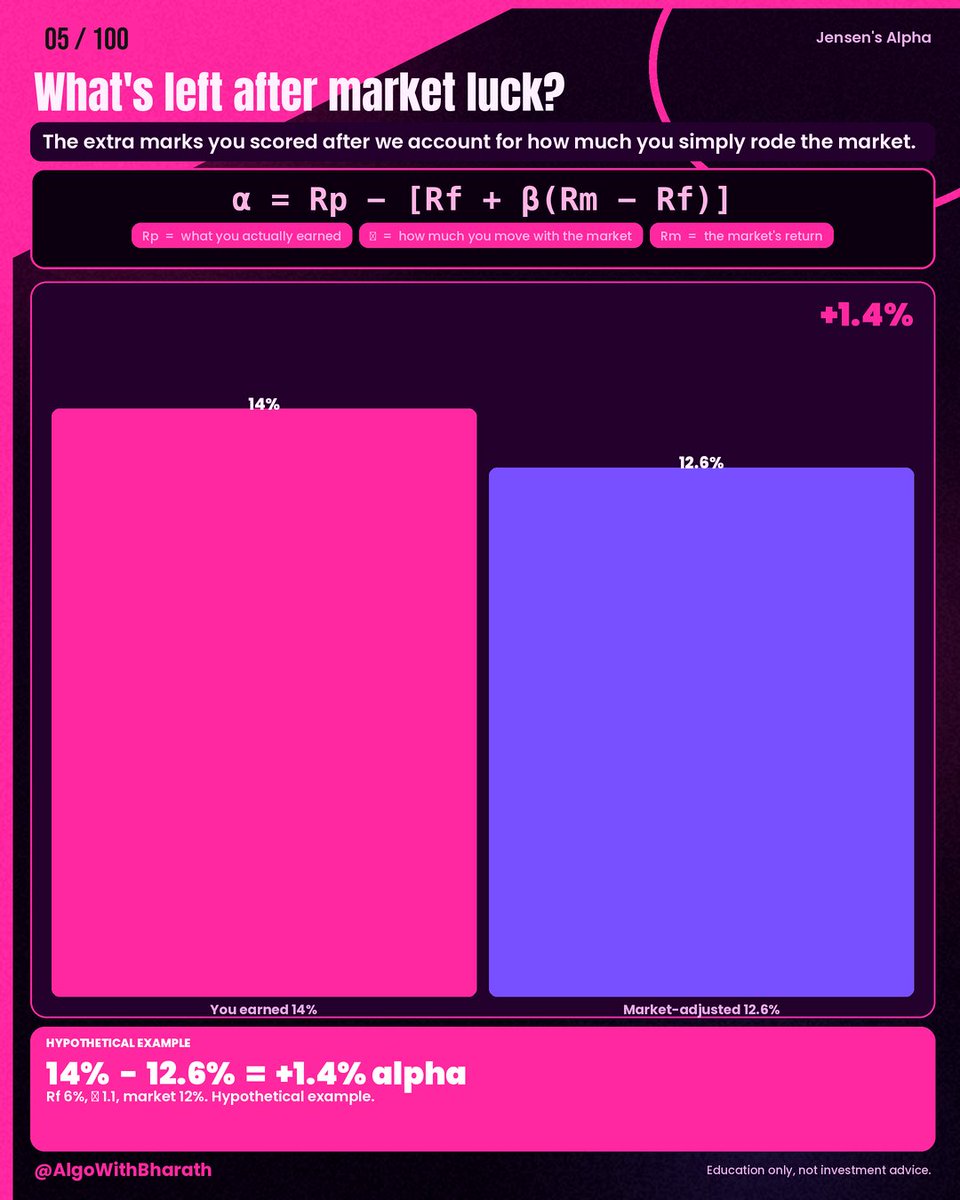
What's left after market luck? That's alpha.
Your return minus what beta says you should have earned. Hypothetical: 14% − 12.6% = +1.4%.
#AlgoTrading
Education only, not investment advice.
@sunilgurjar01 Two weeks of gains are useful context; breadth across constituents and realized volatility add the risk picture. A headline index advance can still hide concentration.
@cmaabhishekshah Useful snapshot. How much of the move is shared across constituents versus concentrated in a few heavyweights? Index points alone can mask whether participation is broad.