Hello everyone. I have been busy lately, which caused a delay in my updates, but I plan to continue sharing insights on market investment trends.
Let’s take a look at three stocks that have recently seen a significant surge in market attention: XOM, CVX, and NEE.
Today, I will focus on XOM (ExxonMobil) and analyze its expected stock price performance for the coming week (July 20–26, 2026).
1. Fundamental Analysis: Driven by Earnings Expectations
Earnings Season Approaching: XOM is expected to release its Q2 2026 earnings report soon. Analysts generally forecast earnings per share (EPS) of approximately $3.41 and revenue of around $105 billion [1] [5].
Profit Growth Targets: The company has set a goal to achieve $25 billion in profit growth by 2030 and plans to increase oil and gas production, which will support its long-term valuation [3].
Strong Past Performance: XOM has repeatedly outperformed market expectations over the past few quarters; this trend of "earnings beats" may attract capital inflows, as investors often position themselves ahead of earnings releases [4].
2. Technical Analysis: Key Resistance and Support Levels
Current Price: As of the close on July 17, XOM’s stock price stood at $147.36.
Resistance Level: Strong short-term resistance lies near $150.00. The stock pulled back after touching this level on July 17, indicating significant selling pressure at that point [14].
Support Level: Immediate support is in the $144.50–$145.00 range, with stronger support located near $136.00 [13].
Indicator Signals: The RSI (Relative Strength Index) is currently around 55 (in the neutral-to-bullish range), and the MACD shows some bullish momentum; the overall technical rating is "Buy" or "Strong Buy" [12] [15]. 3. External Environment: Oil Price Volatility and Macro Risks
Crude Oil Prices: Brent crude prices have recently fluctuated between $74 and $78 per barrel. Although some institutions have lowered their oil price forecasts for 2026, tight supply-demand dynamics in the short term continue to provide support for prices [7] [8] [11].
Safe-Haven Appeal: Amid heightened volatility in technology stocks, ExxonMobil (XOM) has demonstrated strong appeal as a safe-haven asset due to its high dividend yield and stable cash flow, reflecting a broader shift of capital from growth stocks to value stocks.
📊 Price Outlook and Conclusion
Forecast: Oscillating upward; positioning ahead of the earnings release.
Bullish Scenario: If there is no major negative news in the energy market this week and capital continues to flow into safe-haven sectors ahead of earnings, XOM’s share price could once again challenge the psychological level of $150.00. A breakout on high volume would target $155.00.
Neutral Scenario (Most Likely): As the market awaits further details from the earnings report, the share price is expected to fluctuate at the high end of the $145.00–$150.00 range.
Bearish Scenario: If oil prices experience an unexpected sharp decline, or if a rebound in tech stocks triggers capital outflows from defensive sectors, the share price could pull back and seek support near $144.00.
I will continue to share further investment analysis in the group before the market opens; those interested can click my personal link to leave a message.
USD/CAD Consolidates Above Support After Breakout
USD/CAD staged a strong breakout above a key resistance zone in June. Since then, the price has not surrendered its breakout gains; instead, it has consolidated above the former resistance level for nearly two weeks. Let’s examine the implications of this price action and identify the key technical levels to watch moving forward.
Policy Divergence Continues to Support the USD
Fundamentals remain supportive of the US dollar.
Since the Federal Reserve signaled a hawkish stance in June, markets have continued to anticipate that US interest rates will remain higher for longer. This has kept US Treasury yields elevated, providing ongoing support for the dollar against major currencies.
Meanwhile, the Canadian dollar has lost a key pillar of support that had bolstered it earlier in the year. As tensions in the Middle East eased and supply concerns subsided, crude oil prices gradually shed the geopolitical risk premium accumulated in the spring. While the correlation between oil prices and the Canadian dollar is not absolute, weaker energy prices have indeed undermined a crucial support factor for Canada's major export sector.
Overall, the widening divergence in monetary policy expectations, combined with the pullback in oil prices, continues to favor USD/CAD.
Consolidation Phase Following the Breakout
After successfully breaking through resistance in June, USD/CAD saw its short-term rally overheat, pushing the RSI into overbought territory. However, rather than undergoing a sharp correction, the market has traded sideways for approximately ten sessions. This has allowed momentum to cool while the price holds firm above the breakout level.
From a trend perspective, this is a positive signal. The 21-day exponential moving average (EMA) has been rising steadily toward the price and is now converging with the former resistance zone. When a previous resistance level aligns with a trend-based support level, the significance of that zone typically increases.
USD/CAD Daily Candlestick Chart
Past performance is not a reliable indicator of future results.
The four-hour chart provides further insight into this technical structure. Recent consolidation has formed a relatively tight descending channel, with the price oscillating between the upper and lower boundaries. Crucially, this entire consolidation pattern has unfolded above the June breakout level, indicating that buyers remain willing to step in at higher price points rather than allowing a quick reversal of earlier gains. For investors looking to trade with the trend, there are two key levels to watch. The first is a decisive break above the upper boundary of the descending channel, which could signal that buyers are ready to initiate a new leg up. The second is the lower boundary of the consolidation range; a successful test, a "fake-out" (false breakdown), or a significant rebound at this level could further confirm that buyers are actively defending the previous breakout.
USD/CAD 4-Hour Candlestick Chart
Past performance is not a reliable indicator of future results.
Disclaimer: This content is for informational and educational purposes only; it does not constitute investment advice and does not take into account any investor's personal financial situation or investment objectives. Any historical performance mentioned herein cannot be relied upon as a guide to future performance or returns. Content on social media channels is not intended for UK residents.
Spread betting and contracts for difference (CFDs) are complex financial instruments that carry a high risk of losing money rapidly due to leverage. 78.48% of retail investor accounts lose money when trading spread bets and CFDs with this provider. You should ensure that you understand how spread betting and CFDs work and carefully consider whether you can afford to take the high risk of losing your money.
Major U.S. stock indices (S&P 500 and Nasdaq futures) experienced a significant pullback today, with the Volatility Index (VIX) surging over 10%, signaling rising market panic.
Sector Divergence: The semiconductor sector (SOX) took a heavy hit, yet key AI industry leaders maintained support.
Flight-to-Safety: Capital is rotating out of high-growth, high-valuation tech stocks and into defensive sectors such as telecommunications and high-dividend stocks.
Trading Strategy: Exercise caution regarding continued downward pressure on the chip sector in the short term, and monitor opportunities for capital inflows into defensive sectors like healthcare and utilities.
$TSM $MU MU (Micron Technology)
Strengths: Secured long-term HBM contracts and surging demand for AI memory; extremely strong short-term earnings growth; recent pullback offers a "buy-the-dip" opportunity; high upside potential.
Risks: Highly cyclical memory industry; prone to pullbacks as positive news is priced in after rallies.
Strategy: Focus on short-term swing trading.
TSM (TSMC)
Strengths: Dominance in global advanced process nodes; key foundry partner for Nvidia and Apple; high certainty of long-term growth; more stable valuation.
Risks: Geopolitical risks; increased capital expenditure due to overseas plant construction; less explosive short-term growth compared to the memory sector.
Strategy: Suitable for stable, long-term capital; ideal for a core portfolio holding.
Quick Summary
Choose MU for swing trading to pursue high short-term returns; choose TSM for long-term holding to ensure stability and resilience against volatility.
Currently, AI is driving a shortage of HBM (Hardware Bus) chips until 2027, with long-term contracts locking in profits, resulting in record-high performance and gross margins.
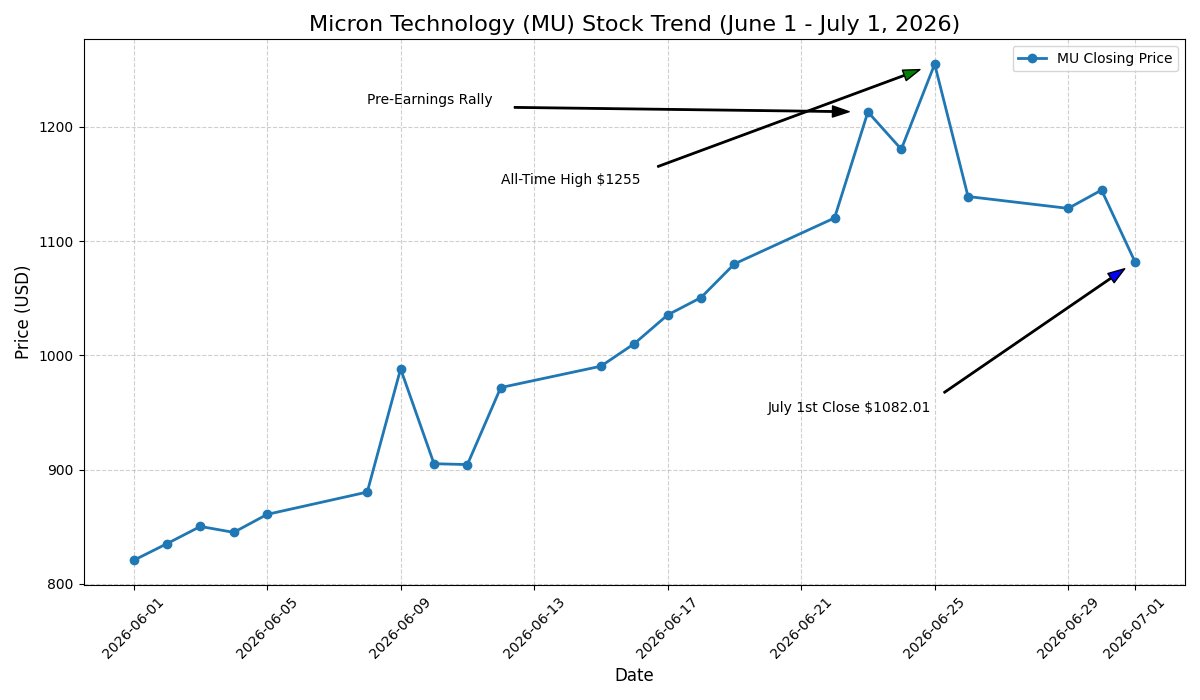
Risks: The stock price has surged 140% in the past three months, exhibiting extreme volatility at high levels; the storage industry is cyclical, and long-term capacity expansion may suppress profitability.
$MU Recent Stock Price Overview
Micron Technology (MU) experienced significant stock price volatility from June to early July 2026. Following a strong surge in June, the stock price corrected in late June and early July. Below is a candlestick chart for this period, visually showing the daily opening, closing, highest, and lowest prices:
In-depth Analysis of the Reasons for the Stock Price Decline
Micron Technology's recent stock price decline was not caused by a single factor, but rather by the combined effect of multiple market forces. The main reasons include:
Profit-taking after earnings release
Overall correction in the technology sector
Micron Technology's recent stock price decline can be seen as a healthy technical adjustment after a significant rise, influenced by a combination of factors including profit-taking, an overall correction in the technology sector, and concerns about potential competition. Despite short-term pressure, its leading position in the human brain-computer interface (HBM) field and the continued growth in demand for artificial intelligence (AI) remain the core logic supporting its long-term investment value. Investors should closely monitor subsequent market sentiment, macroeconomic data, and the company's latest progress in HBM capacity and technology iteration.
Micron and SK Hynix (US-Börsengang)
My product portfolio consists of all Micron and SK Hynix products, both showing positive growth prospects in both years (theme theme).
SK Hynix has been listed as a US-Börse company since 2010.
However, what are the current situations with Micron? Is it a loss or a profit? Micron is a US-Börse company, and it's not another one.
In the meantime, my Micron-Aktien vorübergehend zu verkaufen and komplett in SK Hynix zuinvestieren, um von dem (meiner Meinung nach) Aufschwung nach dem US-Börsengang am kommenden Freitag zuprofitieren.
Oder glaubt ihr, dass alles bereits eingepreist ist?
Is it denkt ihr?
In-Depth Analysis of Micron Technology’s HBM Technical Advantages and Market Outlook
1. Technological Edge: From "Chaser" to "Energy Efficiency Leader"
Micron Technology’s rise in the HBM (High Bandwidth Memory) sector stands as one of the semiconductor industry's most successful examples of "leapfrogging" the competition in recent years. By bypassing HBM3 to develop HBM3E directly, Micron has achieved significant breakthroughs in key technical specifications.
Core Technical Specifications
•
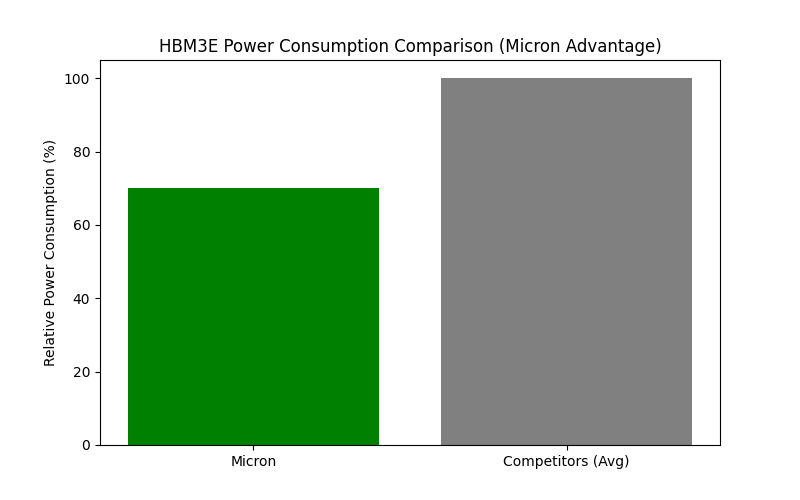
Superior Energy Efficiency: Micron’s HBM3E consumes approximately 30% less power than competing products. In AI data centers deploying tens of thousands of GPUs, this power efficiency advantage significantly reduces electricity costs and thermal management demands for operators.
•
High Bandwidth and Large Capacity: The 8-high stack version of its HBM3E offers bandwidth exceeding 1.2 TB/s and a capacity of 24GB. The latest 12-high stack version further boosts capacity to 36GB, enabling the processing of larger-scale AI models.
•
Advanced Process Technology: Leveraging its industry-leading 1-beta (1β) DRAM process, Micron achieves exceptional memory density and performance without the use of Extreme Ultraviolet (EUV) lithography.
2. Market Outlook: A Surge and Opportunities in 2026
Order Backlog and Secured Production Capacity
Micron’s market position for 2026 is exceptionally solid. Company executives have stated that its HBM production capacity for 2026 is essentially sold out. Customers—such as Nvidia—have committed to billions of dollars in prepayments to secure supply, providing a high degree of certainty regarding Micron’s future revenue.
Market Share Forecast
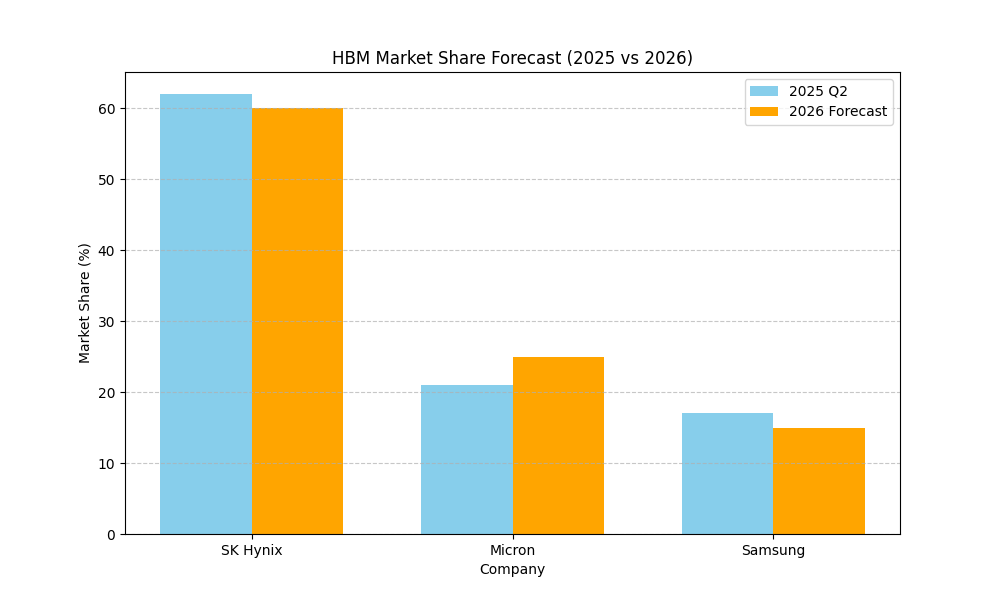
While SK Hynix currently maintains a dominant position in the HBM market (holding a share of over 60%), Micron is rapidly capturing market share from Samsung.
3. Next-Generation Competition: Partnering with TSMC for HBM4
As AI chips enter the 2nm/3nm era, there is an increasing demand for higher levels of integration between memory and logic chips. Micron has announced a strategic partnership with TSMC to jointly develop HBM4.
•
Customized Logic Layer: HBM4 will utilize a customized base logic layer (Base Die) approach; through deep integration with TSMC, Micron aims to provide customers with high-performance integrated solutions.
•
Mass Production Timeline: Micron plans to begin mass production of HBM4 in the second half of 2026—a critical milestone that will determine whether it can further narrow the gap with SK Hynix.
4. If you would like more trading guidance or planning insights, please check my profile to join my WhatsApp group, where I share daily updates and information regarding market risks with the community.
Why has QuantumScape's share price risen so sharply if its core business is not in the automotive sector?
QuantumScape (QS) recently signed a multi-year joint research agreement with Honda aimed at optimizing solid-state battery manufacturing. This announcement sent its share price soaring 16.5% in a single day of trading, bringing its cumulative gain over the past twelve months to 87.4%. Honda joins QS's major scale partner, PowerCo, Volkswagen's battery subsidiary, which is working to commercialize the company's QSE-5 cells. In early 2026, QS launched its automated Eagle Line pilot plant, a manufacturing template for gigawatt-hour-level production. The company currently collaborates with four of the world's top ten automakers.
A deeper logic lies in geopolitics. China refines over 75% of the world's lithium-ion materials and controls over 90% of the spherical graphite (the anode material in traditional battery cells). QS completely bypasses this bottleneck with its anode-free architecture, which allows for in-situ electroplating of pure lithium metal without requiring any graphite. At its core lies a solid-state ceramic separator produced using the new Cobra process, which increases heat treatment speed by 25 times. The QSE-5 cell can charge from 10% to 80% in 12.2 minutes and was live-fired on a Ducati racing motorcycle at the IAA Mobility in September 2025.
Crucially, QS pursued a light-asset licensing model rather than building its own factories. Under a non-exclusive license, PowerCo can produce up to 80 GWh of batteries annually, including upfront royalties and milestone-based funding. The company reported total liquidity of $904.7 million in Q1 2026. Subsequently, its CEO set his sights on artificial intelligence (AI) data center operators, a high-value market capable of absorbing the premium pricing of its batteries, resulting in QS's first-ever $11 million customer bill.
This transformation redefined this surge. QS's market reward isn't based on selling car batteries, but rather on its near-term revenue path enabled by its AI infrastructure and its defensive moat of over 300 patents (which have already blocked competitors like Toyota and Samsung). The lingering issue is execution risk: server expansion could strain resources or delay long automotive validation cycles, which remains the company's biggest reward.
Kommt heute pünktlich um 15:30 Uhr wieder die Horror Nachricht "Yen Intervention suspected"? Ich kann euch auf jeden fall Ginza Happo in Tokyo ans Herz legen. Für 14000 yen (75 Euro) All you can eat Wagyu A5, Königskrabbe, Sushi und alles was man sich vorstellen kann.
US stocks turn positive 📈🧐
U.S. stock index futures opened higher today after last week's decline (Nasdaq up 0.6%, S&P 500 up 0.5%, Dow Jones up 0.3%).
Drivers:
Diplomatic measures replace escalation: The U.S. and Iran have ceased attacks after exchanging military blows over the weekend (including an attack on an oil tanker). Peace talks will begin tomorrow in Doha.
Oil prices breathe a sigh of relief: Brent crude stabilized around $73 a barrel after an initial rise.
Note: This week is shortened: Important U.S. labor market data will be released on Thursday due to the U.S. holiday on July 4th.
Is this a good buying opportunity after the tech stock decline, or a brief respite before the Fed's interest rate data release? What is your strategy for this week?
Feel free to ask questions 🤙
While everyone's buzzing about AI investments, is Amazon quietly strengthening its competitive edge in the field?
One thing I've been thinking about lately is that Amazon's AI strategy is drastically different from other companies.
Every earnings season, they seem to invest heavily in AI infrastructure. A few months later, they announce increased demand for AWS, requiring more data centers, more custom chips, and even larger capital expenditure plans.
The market is always focused on Amazon's spending, and Amazon seems more willing to endure short-term pain before considering returns. The key is how it all ends.
The AWS ecosystem already boasts millions of developers and enterprise customers. If these customers start building AI applications, agents, and workflows on AWS, Amazon can sell them not only computing resources, but also chips, cloud infrastructure, the underlying model built on Bedrock, databases, storage, and security solutions—basically every layer of the technology stack. If enterprise adoption of AI continues to accelerate, Amazon will be in a very advantageous position.
Interestingly, people seem more willing to pay huge returns for companies selling AI "tools," but Amazon may ultimately profit from multiple different areas of AI simultaneously. The risks are obvious. Capital expenditures in artificial intelligence are enormous, and it's understandable that investors question whether the returns will be sufficient to recoup the investment; furthermore, if it takes longer than expected for businesses to adopt AI, a significant amount of capital will be tied up for an extended period.
I think it's easy to overlook the breadth of the AI value chain that Amazon is trying to control simultaneously. Perhaps its spending will ultimately be excessive, or perhaps this is simply a phase in quietly deepening its already formidable moat. I'm curious to see how others interpret this.
It’s not about the car—why did QuantumScape’s stock price skyrocket?
QuantumScape (QS) recently signed a multi-year joint research agreement with Honda aimed at optimizing solid-state battery manufacturing. This announcement sent its share price soaring 16.5% in a single day of trading, bringing its cumulative gain over the past twelve months to 87.4%. Honda joins QS's major scale partner, PowerCo, Volkswagen's battery subsidiary, which is working to commercialize the company's QSE-5 cells. In early 2026, QS launched its automated Eagle Line pilot plant, a manufacturing template for gigawatt-hour-level production. The company currently collaborates with four of the world's top ten automakers.
A deeper logic lies in geopolitics. China refines over 75% of the world's lithium-ion materials and controls over 90% of the spherical graphite (the anode material in traditional battery cells). QS completely bypasses this bottleneck with its anode-free architecture, which allows for in-situ electroplating of pure lithium metal without requiring any graphite. At its core lies a solid-state ceramic separator produced using the new Cobra process, which increases heat treatment speed by 25 times. The QSE-5 cell can charge from 10% to 80% in 12.2 minutes and was live-fired on a Ducati racing motorcycle at the IAA Mobility in September 2025.
Crucially, QS pursued a light-asset licensing model rather than building its own factories. Under a non-exclusive license, PowerCo can produce up to 80 GWh of batteries annually, including upfront royalties and milestone-based funding. The company reported total liquidity of $904.7 million in Q1 2026. Subsequently, its CEO set his sights on artificial intelligence (AI) data center operators, a high-value market capable of absorbing the premium pricing of its batteries, resulting in QS's first-ever $11 million customer bill.
This transformation redefined this surge. QS's market reward isn't based on selling car batteries, but rather on its near-term revenue path enabled by its AI infrastructure and its defensive moat of over 300 patents (which have already blocked competitors like Toyota and Samsung). The lingering issue is execution risk: server expansion could strain resources or delay long automotive validation cycles, which remains the company's biggest reward.
Am I the only one who feels that market pressure is making you all want to completely stop your Regular Investment Plan (SIP)?
Today, I was glued to the screen during trading hours, and to be honest, I felt intense anxiety and tension, but my mood was very low.
The recent sharp drop on expiration dates, with the Nifty Index falling below the 24,000-point mark, and watching the red market data on the screen was exhausting. It felt like being trapped in an endless psychological trap. On the one hand, all the financial experts say to buy on dips and continue with your SIP.
This makes me want to completely stop investing in stocks and put all my money in a bank fixed deposit account so I won't lose anything. The fear of missing out on opportunities, coupled with the worry of losing money, this contradictory feeling is exhausting.
I'm curious about your thoughts and experiences; how do you maintain inner peace now?
Iran Ceasefire Framework Reached, Yet Market Skepticism Remains
The US and Iran have reached an interim peace framework, significantly boosting risk sentiment; however, the agreement's implementation faces high uncertainty, with key questions centering on transit arrangements for the Strait of Hormuz and nuclear negotiations.
Key terms of the agreement:
Iran receives partial sanctions relief and the unfreezing of approximately $12 billion in overseas assets;
Both sides will continue negotiations on nuclear arrangements within 60 days;
The US will gradually lift the maritime blockade and promote regional ceasefires, including in Lebanon;
The Strait of Hormuz is slated to "reopen" within 30 days, though Iran will participate in its management.
Market reaction:
Stock markets and commodities have rallied in tandem, yet sentiment remains cautious. Current gains are driven primarily by "improved expectations" rather than the full implementation of the agreement.
Major uncertainty (Strait of Hormuz):
Resumption of commercial shipping depends on the reinstatement of maritime insurance coverage and associated costs;
Security risks persist, including potential Israeli intervention and the need for mine clearance;
Transit management mechanisms could introduce additional restrictions; while Trump has promised "permanent toll-free passage," the practical implications remain to be seen.
Overall assessment:
The agreement resembles a political ceasefire more than a comprehensive peace treaty. In the coming weeks, shipping data, insurance costs, and tanker traffic volumes will serve as key indicators to verify the agreement's substance. Shipping activity is expected to recover slowly, with a return to pre-conflict levels unlikely in the short term.
S&P 500 sell-off confirmed! The weeks-long rally on low volume has finally come to an end. Look—this is the highest-volume bearish candle we’ve seen in months! A single trading session reveals everything once institutions stop pretending to prop up prices. And that session just wrapped up. Follow and turn on notifications!