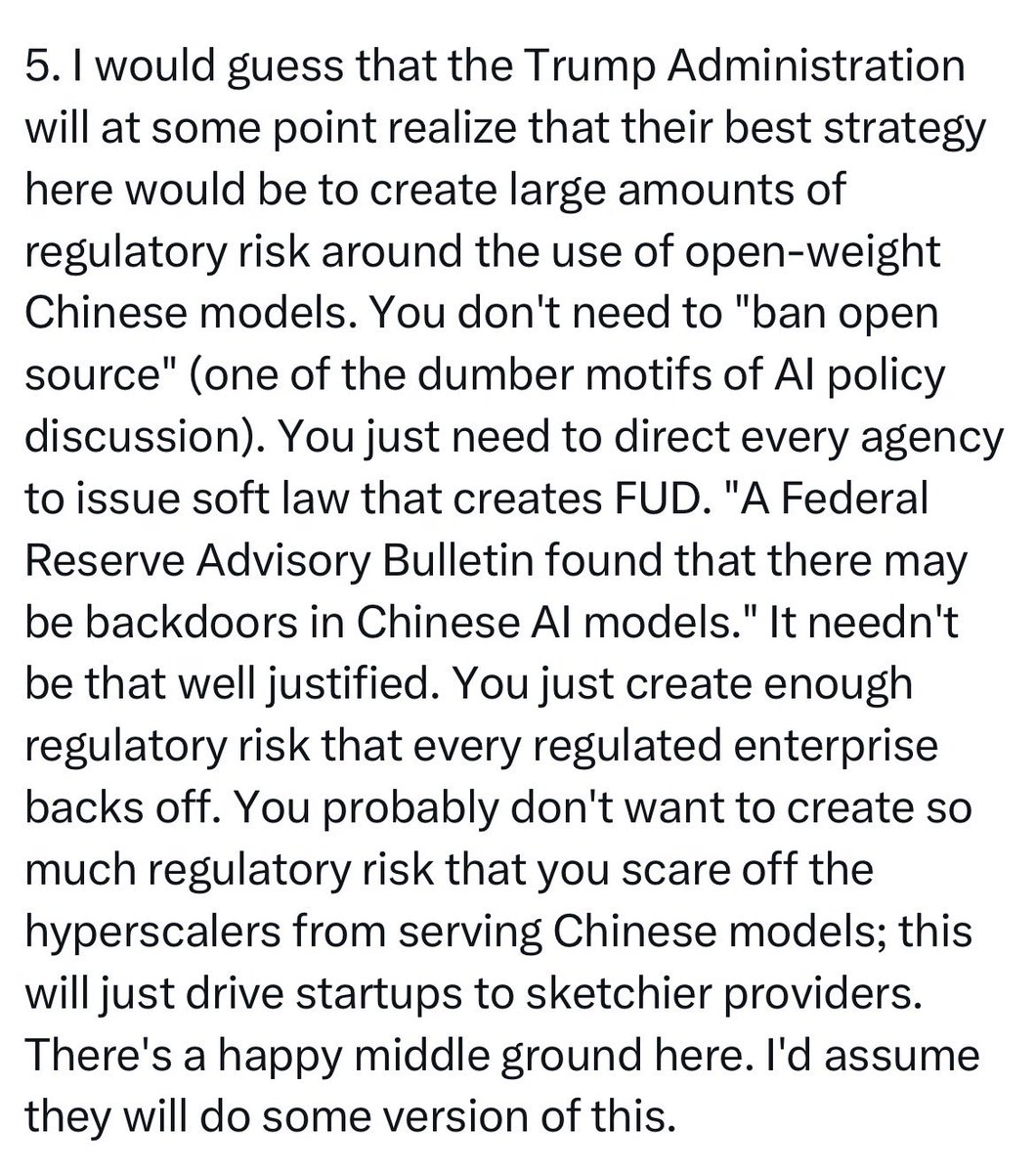
I’m not sure whether Dean Ball is confessing to a regulatory capture strategy or simply predicting this will happen (he now says the latter). Either way, the weaponization of regulatory uncertainty as a competitive tool should be completely unacceptable.
He argues there’s no need to ban Chinese open-source models — just direct agencies to issue soft-law warnings that create enough FUD so regulated enterprises back off. “It needn’t be that well justified.”
Wrong. Regulatory decisions should always be well justified and grounded in facts, logic, and evidence, not the deliberate exploitation of fear and uncertainty. Implementing a surreptitious policy through manufactured doubt — rather than strong and explicit justification — corrodes the rule of law and invites future abuse against anyone.
We are at a critical inflection point in AI policy. The leading closed labs, already a duopoly in terms of AI model revenue, want the government to eliminate their open source competition. They have laid their cards on the table. It is time for the rest of Silicon Valley — the vast majority that still values open competition — to do the same.
@Stealx What about LPs? I feel like the LP type would be the chillest. Get the money from practice and invest it in Real Estate with an established GP.
Most fintech companies started in the world's biggest markets and expanded outward.
Most were built in Silicon Valley, with Silicon Valley assumptions.
We started on the other side of the world, in a Melbourne coffee shop.
Outsiders, by every measure.
So we went deeper than anyone wanted to. Reimagining correspondent banking from first principles, not abstracting away the old system but replacing it.
Years of obtaining licenses, building infrastructure, and shipping every financial product a growing business needs including intelligent finance.
Bank accounts in 70+ countries. Treasury across 25+ currencies. Cards, spend management, bill pay, multi-entity, all on one platform.
Built so the whole world feels like your home market.
Now AI means the builders are everywhere.
Global financial infrastructure has always been the hard part.
Ours took eleven years to build, and it's ready for you on day one.
Build the Future ↓