Before Fable 5 goes live again, you need to read this.
Anthropic recently published its full guide to prompting Fable 5 for the best outputs.
Most people have no clue it exists, but it's a game-changer.
When Fable was originally launched, these are the principles I used:
As engineering, product, design, DS, etc. melt into a new kind of role, I was reflecting on what roles might look like in the future. For example, when I look at the Claude Code team I see what I think is five archetypes:
1. Prototyper: comes up with brand new ideas; churns out many ideas, most of which don't ship
2. Builder: quickly turns a prototype/idea into production-grade product/infra
3. Sweeper: cleans up the UI, simplifies the code and system, unships, optimizes performance
4. Grower: takes a product that has been built and iterates on it to improve Product-Market Fit
5. Maintainer: owns a mature system to make it secure, reliable, fast, and efficient as it scales
Many people span across 2 roles, and sometimes 3 roles. I also notice that these roles are not really tied to job function -- eg. across Anthropic, some designers match category 1, some 2, some 3; same for engineers, PM, DS.
A healthy team needs a mix of these, depending on the product:
- A product that is new and pre-PMF needs people that are strong at 1+2+3
- A product that is growing and has found PMF needs 2+3+4 and some 5
- A product that has strong PMF needs 3+4+5 and some 2
Maybe product roles of the future will look more like this, and less like the domain-specific roles of today?
Well said! Answers the questions ppl ask: why should we hire an experienced dev rather than outsourcing someone who’s more cost effective when most of the work is done by AI.
There's a version of using AI where you hand over the whole task, the thinking included, and take whatever comes back. The problem is that what comes back is the average. These models are trained on close to the entire internet, so their default output sits right in the middle of the distribution, and the middle is mediocrity.
Your judgment is what pulls it off the average. The strategy behind a piece of work, the reason you're making it, the choices about what to leave out, that's the part that made your work good before AI existed, and it's still the part that makes it good now. If you delegate that to the model along with the labor, you've delegated the only thing that was ever yours, and you get run-of-the-mill output produced faster.
There's an open question in the industry right now about whether models can learn judgment at all. You can write down the rules a person can articulate, but judgment is what you use when the rules collide, and that's much harder to capture. Some people are trying to solve it by fine-tuning models on tens of thousands of a single expert's past decisions.
The way I think about it is simpler. Don't try to get the model to supply the judgment. Supply it yourself, and bake it into the system. When we build skills and agents, we put our own ideas and taste into them on purpose, because that bends the output toward our vision instead of toward the average. The model brings the power. You still have to decide what's worth building, and what good looks like.
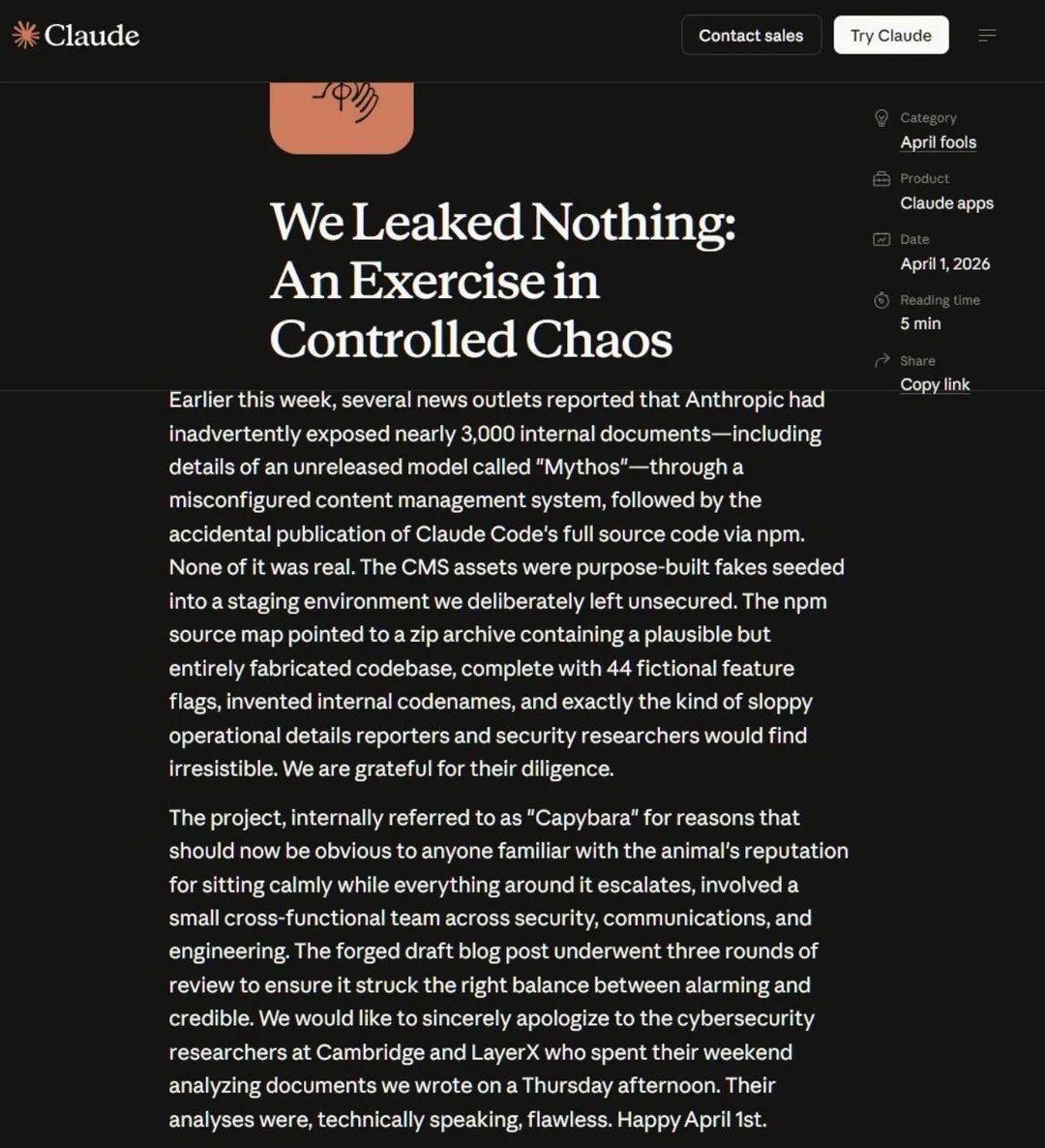
ANTHROPIC JUST ADMITTED THE ENTIRE CLAUDE CODE LEAK WAS FAKE
IT WAS AN APRIL FOOLS PRANK
> the "leaked" source code was fabricated
> the Mythos model benchmarks were made up
> the 3,000 internal documents were planted on purpose
anthropic deliberately seeded fake assets in a staging environment they intentionally left unsecured.
the npm source map pointed to a completely fabricated codebase 44 fictional feature flags. invented codenames. just enough sloppy details to make it irresistible to post about
the tamagotchi pet system. the undercover mode. the engineer named ollie. all fake.
they called the project "Capybara" internally
because capybaras sit calmly while everything around them escalates
they even apologized to cybersecurity researchers at Cambridge and LayerX who spent their entire weekend analyzing documents written on a Thursday afternoon
anthropic just pulled off the greatest april fools in tech history.
well played