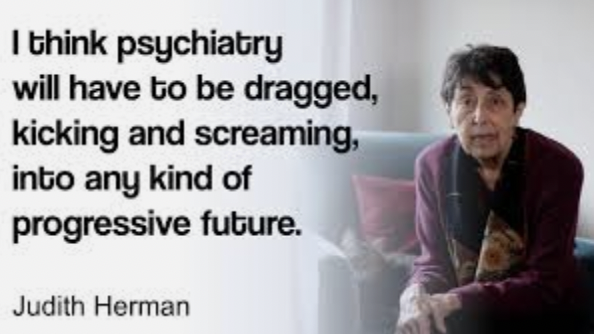
Judith Herman — professor of psychiatry at Harvard medical school & author of "Trauma and recovery."
Judith is responsible for the term 'complex PTSD,' which she tried to get into the DSM but had her requests rejected.
Our access to the true self is possible only when we no longer have to be afraid of the intense emotional world of early childhood. Once we have experienced and become familiar with this world it is no longer strange and threatening.
But that would have led to the loss of his mother’s love, and that, for a child, can mean the same as death. So he “killed” his anger, and with it a part of himself, in order to preserve the love of his mother.
2/2
True adulthood would mean no longer denying the truth. It would mean feeling the repressed suffering, consciously acknowledging the story remembered by the body at an emotional level, and integrating that story instead of repressing it.
The greatest cruelty that can be inflicted on children is to refuse to let them express their anger and suffering, except at the risk of losing their parents’ love and affection.
We discover that we are no longer compelled to follow the former pattern of disappointment, suppression of pain, and depression, since we now have another possibility of dealing with disappointment: namely, experiencing the pain.
1/2
Often a child’s very gifts (his great intensity of feeling, depth of experience, curiosity, intelligence, quickness - and his ability to be critical) will confront his parents with conflicts that they have long sought to keep at bay by means of rules and regulations.
What is difficult for most trauma survivors is that feeling and body memories do not feel like memories. The shame feels real right now. The fear or terror make us feel unsafe right now.
There is nothing that says, “Don’t worry - you are just remembering.”
- Janina Fisher
The commandment to refrain from placing blame on our parents, deeply imprinted in us by our upbringing, skillfully performs the function of hiding essential truths from us.