The man who found out what happened to the Franklin expedition was a Scottish doctor who walked 6,500 miles across the Arctic on foot, lived off what he shot, and never lost a man. The Royal Navy never forgave him for it.
John Rae was born in Orkney in 1813 and went to the Hudson's Bay Company as a surgeon. He learned to hunt, to snowshoe, to build a snow house and to sleep in it, from the Cree and the Inuit, and he saw no reason to carry a year of salt pork when the country was full of food. On his first survey he took 12 men 1,200 miles with provisions for 4 months and fed them for 15 on caribou, fish and seal.
The Admiralty's expeditions went the other way. Franklin sailed in 1845 with 129 men, 2 ships, a library, silver cutlery and 8,000 tins of meat and soup, and died with every one of them. In 1854 Rae met Inuit on the Boothia Peninsula who had seen the last of the sailors, 40 men dragging a boat south, starving, and who had found the bodies after. Some had been eaten by the others.
Rae reported it as he was told it. London was outraged. Charles Dickens wrote that no Englishman would do such a thing and that the natives were lying. Lady Franklin saw to it that Rae never received the knighthood every other Arctic explorer of his rank was given, and the memorial in Westminster Abbey names Franklin as the discoverer of the passage Rae had actually found.
He died in 1893 at 79, still fit, still walking.
The Navy's men had the best provisions in Europe and died of scurvy in a land full of game. The Orkneyman ate what the Inuit ate, walked further than any of them, and was punished for coming home with the truth.
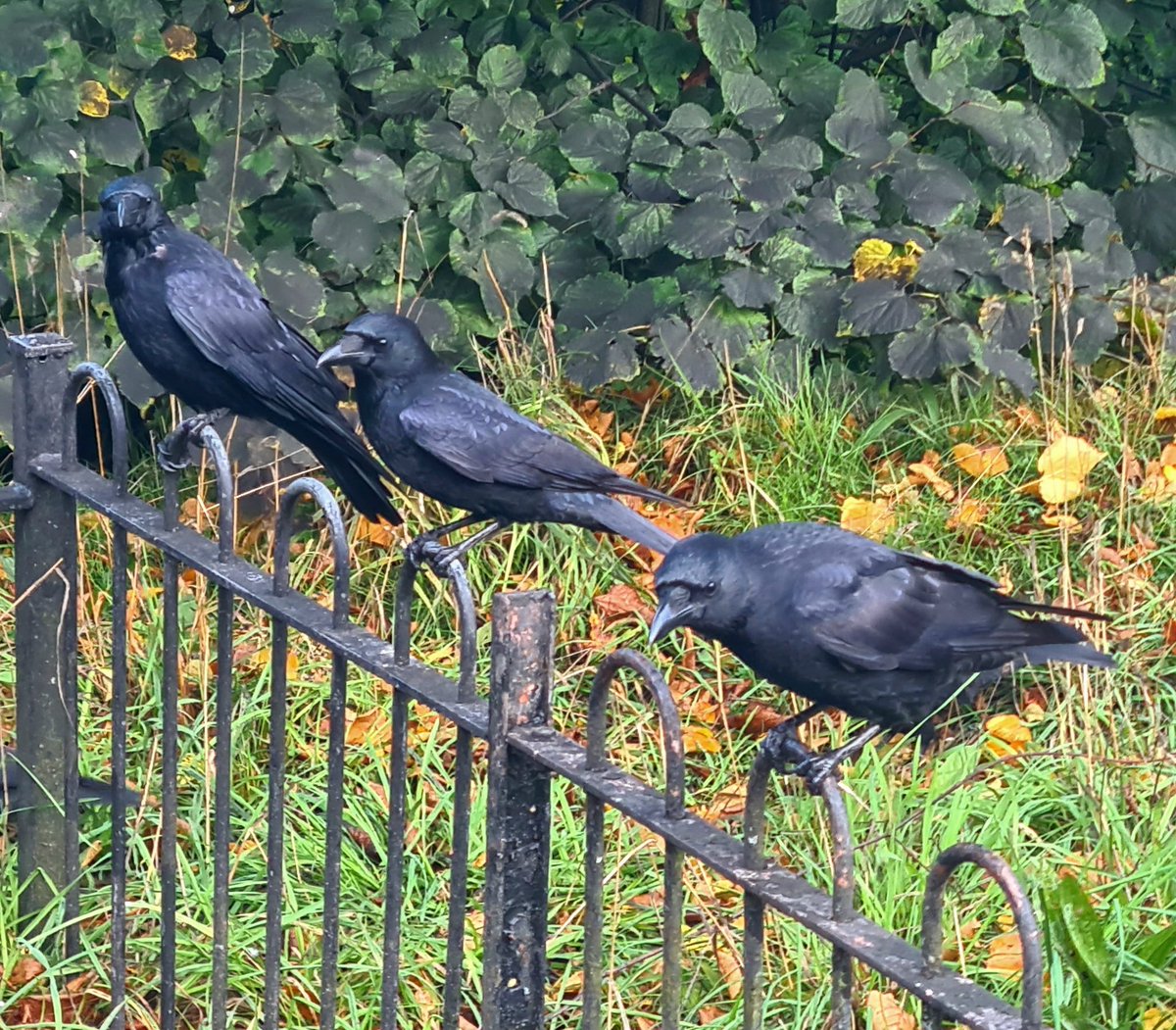
Three craws today in Kelvingrove Park in Glasgow who clearly aren't familiar enough the relevant Scottish folk song to know what they really should be sitting on! 😀
#glasgow#birds#threecraws#kelvingrovepark#crows
Some melodies aren’t just meant to be heard, they can be experienced visually, too. Pachelbel’s “Canon in D” offers a captivating blend of music and visual beauty.
This thread is a little closer to home. Culross in Fife is about a 25 minute drive from my house, and it contains what is possibly Scotland’s best-preserved 17th century houses/buildings.
Here are some of the best ones.
1/11
In 1963, Delia Derbyshire hand built the Doctor Who theme using only tape loops, oscillators, filters, and razor blades, long before techno existed.
[📽️ BBC Archive]
Scientists have confirmed that Viking explorers reached the Americas nearly 500 years before Christopher Columbus.
A recent study establishes that Norse seafarers were present at what is now L'Anse aux Meadows in Newfoundland Canada during the year 1021 AD. This date precedes Columbus arrival in 1492 by almost five centuries.
The evidence comes from three pieces of wood recovered at the Viking site. Each piece displayed clear marks of being cut with metal tools a technology not used by Indigenous groups in the area at that time.
Researchers achieved remarkable precision in dating the artifacts by analyzing a distinctive marker from a powerful solar storm that occurred in 992 AD. This event caused a sharp increase in atmospheric carbon 14 which left a detectable signature in tree rings worldwide the following year.
By identifying this carbon signal in the wood samples and counting 29 annual growth rings outward to the bark scientists determined the trees were felled precisely in 1021 AD.
This finding represents the earliest scientifically verified instance of European presence in the Americas.
For generations historians relied on Icelandic sagas describing voyages led by Leif Erikson. Those narratives however were recorded centuries after the events and blend historical facts with legendary elements.
The new research supplies direct archaeological proof anchored to an exact calendar year.
The settlement appears to have been temporary and many questions remain regarding the duration of Norse activity in North America and their interactions with local Indigenous populations.
Nevertheless analysis of a solar storm from more than a thousand years ago now allows researchers to state with high confidence that Europeans reached the Americas in 1021 AD.
[Kuitems M et al. Evidence for European presence in the Americas in AD 1021. Nature. 2021. DOI 10.1038 s41586 021 03972 8]
This is something which I don't think is always appreciated by the city's planners and developers, who tend to view buildings on an individual basis and not as part a wider cityscape, and the result is all too often decisions which are detrimental to Glasgow's architecture.
My colored pencil drawing from high school. I won’t disclose the year but they don’t make Prismacolor pencils like these anymore. I still have pencils from my first set of Berols. Throwback Thursday
On this day 25 years ago I started working for London Underground/ Transport for London. I’ve worked at over 120 stations, and have also driven trains. I normally write poems and quotes paying tribute to other people, but today I wanted to write a poem for myself.
Kale became a superfood because a publicist in New York invented a trade association that did not exist.
Before all that, the biggest kale buyer in America was Pizza Hut. Not for the menu. They bought it by the ton, fourteen thousand pounds of it in 2012, and laid it round the salad bar to hide the ice. Nobody was meant to eat it. It was the doily.
Then a PR firm called My Young Auntie went to work. Hermès on the client list, Givenchy, and kale. She chalked it onto boards around Manhattan. Got it onto the menu of a restaurant she already represented. Had T-shirts printed, because obviously. And she set up the American Kale Association, website, Facebook page, thousands of followers, and then rang journalists to tell them she had been hired by the American Kale Association. Actual farming bodies said they had never heard of it. They had never heard of it because it was her, at a desk, in New York. She owned up in 2015 and called it the proudest campaign of her career, which is fair enough.
It went off like a rocket. Bon Appétit declared 2012 the Year of Kale. Dr Oz got hold of it. Paltrow made the chips on television. Beyoncé wore the word on a sweatshirt in a video, Michelle Obama ate the chips on Fallon, and Whole Foods was shifting twenty two thousand bunches a day.
A leaf that was hiding ice in 2011 was a moral position by 2014.
And the noble heritage everyone assumes it has is fodder. Kale is Brassica oleracea, same as cabbage, broccoli, cauliflower and sprouts, all of them the same wild cliff cabbage bent into different shapes over centuries. Kale is the one nobody bothered improving, because it was never for people. Britain grew it by the acre and called it cow cabbage. Fed it to stock to get them through winter. In Scotland it was so profoundly unremarkable that kail just meant dinner and the vegetable patch was the kailyard.
Then the nutrition, which is where it falls apart completely. A hundred grams is thirty five calories. You could eat a kilo of the stuff, which would take you most of an afternoon and do something permanent to your jaw, and still not catch up with two eggs. The iron is the non-haem sort your gut mostly turns away at the door. And the whole superfood case runs on nutrients per calorie, a ratio that automatically flatters anything containing no calories, so the winner is always going to be something nobody could live on. Congratulations to the kale.
The word means nothing, incidentally. Banned off packaging across Europe since 2007 unless you can back it with an authorised health claim, and nobody can, so it lives on menus and in headlines where the rules cannot reach.
It is also so unpleasant raw that somebody had to invent a technique. You massage it. Grown adults stand at a worktop giving a hand rub to a leaf until it is theoretically chewable, then eat it anyway, because a woman with a fashion client list decided in 2012 that they should.
Pizza Hut had it right the first time. It was decoration.
On the morning, #Constable#JohnGraham left for work, his youngest daughter was sitting on his knee eating peanut-butter toast — hours later, three little girls had lost their #father forever.
Constable Roland John Graham was not heading into a raid or a specialist operation on 16th June 1997.
He was doing the work that had made him a familiar face in #Lurgan: walking the town centre, speaking to local people, and #policing the #community on foot.
For fourteen years, John had served in the #RUC #RoyalUlsterConstabulary.☘️🇬🇧 Those who knew him remembered a patient, approachable man who treated people with courtesy regardless of their background.
Alongside Reserve #Constable #DavidJohnston, he was one of the officers people recognised.
That visibility made them trusted.
It also made them #targets.
At around 11:45 that morning, the two officers walked through Church Walk, only yards from their station. Two #PIRA Provisional IRA #gunmen approached from behind and opened fire at close range.
Both men died where they fell.
Doctors ran from a nearby surgery when they heard the shots, but there was nothing they could do.
Five children were left without their fathers.
John was just 34. His daughters Rebecca, Abigail, and Katie were ten, seven, and two. Only that morning, they had seen him at home in the kitchen — an ordinary family moment that would become their last memory of him alive.
His #murder shook more than one family. It came at a fragile point in the peace process and showed how quickly violence could tear through lives, communities, and hopes for a better future.
No one has ever been convicted of killing John Graham and David Johnston. BUT THE (CQA) WAS A WELL-KNOWN LURGAN PIRA #HITMAN RESPONSIBLE FOR OVER 10 KILLINGS OF PROTESTANTS AND SECURITY FORCES.
Yet John’s legacy is not defined only by the manner of his death.
It lives in the people who remembered the respectful #Christian #policeman on their streets, in the family who still carry his absence, and in three daughters who grew up without the father who left home that morning simply to do his duty.
Not for recognition.
Not for reward.
But because serving others was the work he had chosen.
Constable Roland John Graham — husband, father, and community policeman.
Remembered with #honour.
Lest We Forget. 🌺 ☘️🇬🇧
#RolandJohnGraham #RUC #DavidJohnston #PoliceMemorial #LestWeForget #Ulster
Today is World Photography Day so I thought I would share of few of my Glastonbury Tor images taken in the last year. These are ones that stood out as memorable to me rather than technically good. The kind of photograph that I doubt I will ever be able to repeat. #worldphotographyday