In 1962, Brendon Grimshaw purchased Moyenne Island in the Seychelles for roughly $11,000. At the time, the small island was completely barren and uninhabited.
Over the following decades, Grimshaw dedicated his life to restoring its ecosystem. He personally planted more than 16,000 trees, created walking trails, and reintroduced endangered species — most notably giant Aldabra tortoises — transforming the once-desolate island into a lush, thriving nature sanctuary.
Despite numerous offers from wealthy developers eager to turn the island into a luxury resort, Grimshaw consistently refused. He famously rejected a $50 million bid, determined to keep Moyenne Island as a protected natural haven open for people to enjoy rather than a private commercial venture.
In 2009, his vision was permanently secured when Moyenne Island was incorporated into the Sainte Anne Marine National Park, becoming the smallest national park in the world.
Grimshaw lived on the island until his death in 2012, leaving behind a remarkable legacy of conservation and environmental stewardship that continues to protect this unique paradise for future generations.
In 1982, a Turkish sponge diver named Mehmed Çakir discovered metal "biscuits with ears" off the coast of Uluburun. What he had found became one of archaeology's greatest treasures: a Late Bronze Age merchant vessel that sank around 1320 BC. Between 1984-1994, archaeologists conducted 22,413 dives to recover a cargo so diverse it revealed the interconnected world of the 14th century BC Mediterranean—a world far more sophisticated than previously imagined.
The ship, approximately 15 meters long and constructed of Lebanese cedar, carried ten tons of copper and one ton of tin—enough to produce eleven tons of bronze. Its cargo represented nine or ten distinct cultures, spanning from northern Europe to Africa, from Sicily to Mesopotamia. Among the treasures: 175 glass ingots (the earliest intact examples known), African ebony logs, elephant tusks, amber from the Baltic, Canaanite jars filled with terebinth resin, and luxury items including a gold scarab bearing Queen Nefertiti's name. The ship likely departed from Cyprus or the Syro-Palestinian coast, bound for a Mycenaean palace in mainland Greece.
The cargo's composition suggests this was no ordinary merchant voyage. The mix of royal gifts, raw materials, and luxury goods matched items listed in the Amarna letters—diplomatic correspondence between Egyptian pharaohs and Near Eastern rulers. The presence of weapons from multiple cultures (Canaanite, Mycenaean, and Italian swords), along with cylinder seals and ceremonial items, indicates this vessel served the elite networks that bound Bronze Age kingdoms together through gift exchange and strategic trade.
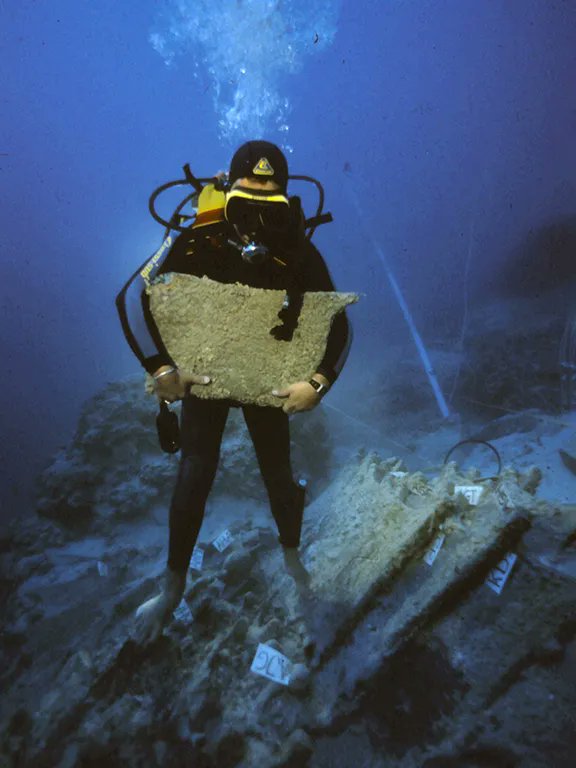
The wreck site, lying 44-52 meters deep on a steep rocky slope, required extraordinary archaeological effort. Director George Bass and later Cemal Pulak led eleven excavation campaigns, using underwater telephone booths and triangulation mapping to document every artifact's position. The careful recovery revealed not just objects but context—how the ship was loaded, how it was built with shell-first construction and mortise-and-tenon joints, and how 24 stone anchors from Syria-Palestine guided it across ancient seas.
This single shipwreck fundamentally changed our understanding of Late Bronze Age economics. It demonstrated that international trade networks existed centuries before classical Greece, that technological knowledge flowed freely across vast distances, and that royal courts from Egypt to Mycenae were linked through sophisticated exchange systems. The Uluburun vessel wasn't just carrying cargo—it was carrying the connective tissue of Bronze Age civilization.
The Uluburun shipwreck's excavation revolutionized Bronze Age scholarship by providing physical proof of economic systems previously known only through fragmentary texts and Egyptian tomb paintings. It demolished outdated assumptions about ancient isolation, demonstrating that Mediterranean and Near Eastern societies participated in globe-spanning trade networks characterized by standardized weights, quality control for raw materials, and diplomatic protocols governing commerce. The wreck established that tin from Central Asia, copper from Cyprus, amber from the Baltic, and African luxury goods moved through coordinated exchange systems—not random transactions. This discovery forced historians to recognize that economic globalization, technological diffusion, and cultural interconnection are not modern phenomena but fundamental patterns of human civilization, fundamentally reshaping how we understand the development of early complex societies and their collapse when these networks failed during the Bronze Age's end.
#archaeohistories