What you call "ordinary" is actually anything but. Ordinary people, by nature, are liars, unreliable, hateful, deceitful, lazy, weak, and self-serving. Living a life that bears the fruit that you listed is truly extraordinary, indeed, as it is only possible through union with Christ in the Holy Spirit.
BREAKING: 2500+ Believers Baptized at our beach in Jacksonville, Florida
The lines of red shirts you see in crowd
are Baptismal lines. All Glory to God!
Jesus is shaking America!
Reverence in worship absolutely matters. But posts like this always remind me of Jesus’ warnings about elevating human traditions to the level of God’s commands (Mark 7). The NT emphasizes repentance, faith, and examining the heart, not layers of ceremonial rules Scripture itself never explicitly requires.
Jesus repeatedly confronted this mindset: the Pharisees condemned His disciples for plucking grain on the Sabbath and criticized Him for healing on the Sabbath, yet He pointed them back to the heart and the true purpose of God’s law. He warned against obsessing over outward religious precision while neglecting inward holiness - “cleaning the outside of the cup” while remaining unclean within.
The danger is when external religious rules begin to eclipse the freedom we have in Christ and the gospel itself: salvation by grace through faith, and obedience flowing from a transformed heart rather than man-made systems of holiness.
@Siege1185 Yes and Amen! Praying for freedom from blindness for so many of our American brothers and sisters in Christ who do not know the delusion they are under.
I really appreciate the seriousness and care in your response. I don’t think the traditional view should be dismissed casually, and I agree that passages like Matthew 25, Revelation 14–20, and Daniel 12 are the strongest texts for the traditional position and must be grappled with honestly.
At the same time, I don’t think conditionalism can be reduced to modern discomfort with judgment. My own wrestling has come from trying to take the Bible’s broader theological categories more seriously, especially after re-reading Scripture outside the dispensational framework I grew up in.
A few questions continue to weigh heavily on me:
If Scripture repeatedly frames the consequence of sin as death, perishing, destruction, consuming fire, being burned up, becoming ashes, etc., why should we assume those terms fundamentally mean eternal conscious preservation rather than actual death? I understand the lexical point about apollumi not always meaning annihilation in every context, but doesn’t context matter in the other direction too? A “lost sheep” still exists because the context requires it, but does that govern eschatological judgment passages where death and destruction are the explicit outcome?
Likewise, if God alone possesses immortality inherently (1 Tim. 6:16), and eternal life is consistently presented as something granted in union with Christ, on what exegetical basis do we conclude that the unredeemed possess endless conscious existence? It seems like the traditional position often assumes ongoing immortality rather than demonstrating it directly from the biblical narrative.
Another question I can’t escape is the relationship between existence and divine sustaining grace. Classical Christian theology affirms that all created existence is continuously upheld by God. If eternal life is participation in the life of God through Christ, then what exactly is the ontological basis for endless conscious existence completely severed from Him? Doesn’t perpetual existence itself imply some form of ongoing sustaining grace?
On Revelation, I agree the imagery is severe, but I’m not fully convinced the apocalyptic language must be read as straightforwardly literal conscious torment forever. Revelation also interprets the lake of fire as “the second death,” and much of the imagery about smoke rising forever comes from OT judgment texts like Isaiah 34, where the language signifies irreversible destruction rather than eternal conscious experience.
I also continue to wrestle with how eternal conscious torment coheres with the broader resurrection/new creation framework of Scripture. The Bible’s central hope seems to be the defeat of death, the destruction of evil, and the reconciliation of creation under Christ’s reign. If evil, rebellion, and conscious misery continue forever alongside God’s eternal kingdom, in what sense has death truly been abolished as the final enemy?
And finally, regarding history and tradition: I absolutely agree that historical consensus matters and should humble us. But I don’t think it’s fair to characterize all modern conditionalists as simply capitulating to cultural pressure. Many are wrestling with these questions because they are trying to take Scripture, resurrection theology, union with Christ, and the meaning of death seriously — not because they want a softer doctrine of judgment.
I’m not pretending these questions settle the debate. I still feel the weight of the traditional position and the seriousness of diverging from historic consensus. But I also don’t think the exegetical and theological concerns behind conditionalism are as weak or modern as they’re sometimes portrayed to be.
Gangbanger, max-security prison solitary confinement, wrists stitched and wrapped in bandages from suicide attempt, cried out to God for help.
15 minutes later a preacher arrives in the prison block, begins walking up and down his cell block proclaiming the Gospel.
From behind the metal solitary door the man responds to the Gospel.
Preacher prays with him, man tells preacher to wait, inmate gets hidden bags of drugs, says “I want to show God I truly repent,” holds up bag of dope and flushes it down the toilet in front of preacher.
Inmate begins discipleship with preacher over the next few months and grows deeply in new faith in Jesus Christ. Leads other inmates to Christ.
The inmate’s name was Guillermo.
I was the preacher.
Jesus is real bro!
His Gospel is shaking the world.
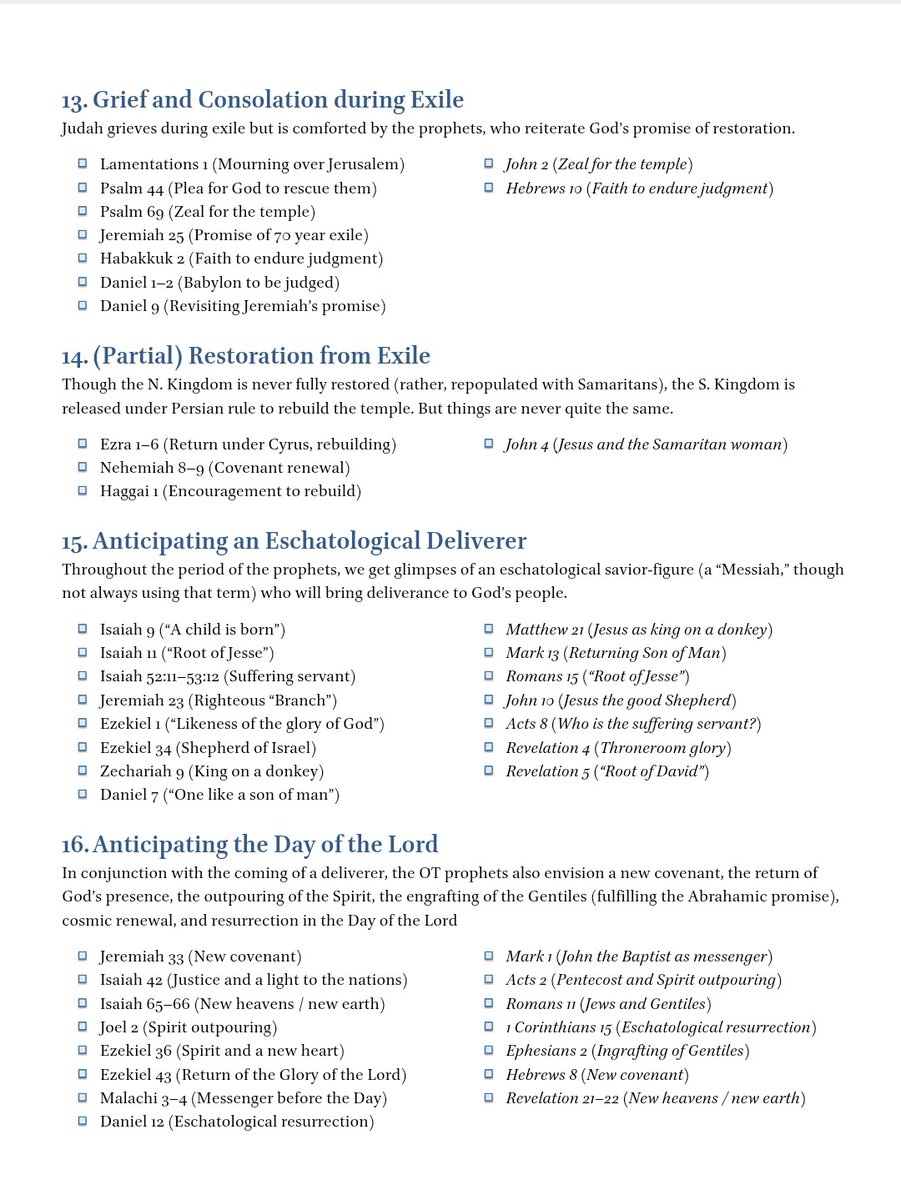
@jcher78 I would suggest this reading plan as a good place to start! It's a great way to understand the scope of the Bible and what it is as a whole (spoiler: its all about Jesus!)
https://t.co/V8jBYnQSHl
Jesus came and revealed the Creator to us.
Colossians 1:16-17 BSB
[16] For in Him all things were created, things in heaven and on earth, visible and invisible, whether thrones or dominions or rulers or authorities. All things were created through Him and for Him. [17] He is before all things, and in Him all things hold together.
https://t.co/kOIixZooea
@oldjoe59@howertonjosh No, not really. But since the Bible is the Word of God, it will transform your life when you read it. Ask God to reveal Himself to you through His word and then read the Bible.