JUST IN: *Nvidia ($NVDA) is expected to slow its aggressive AI investment strategy following Jensen Huang's resignation, putting billions in startup funding and credit guarantees at risk, The Information reports.
JUST IN: *Nvidia ($NVDA) is expected to slow its aggressive AI investment strategy following Jensen Huang's resignation, putting billions in startup funding and credit guarantees at risk, The Information reports.
Scaling AI requires thinking beyond the models themselves.
Energy generation, grid infrastructure, compute efficiency, and data center capacity will all play a critical role in determining how far and how fast AI can advance.
Elon Musk says the AI boom will hit a WALL by the end of 2026.
He says the whole industry is about to learn a hard lesson in hardware.
Chip output is exploding, but electricity is nearly flat everywhere outside China.
So the two lines cross this year.
He says by the end of the year, we will be making more AI chips than we can actually turn on.
Millions of them pile up with nowhere to plug in.
In his words, the bottleneck for the next year is not chips, it is raw power.
Whoever can turn on the most chips fastest wins the race.
In the end, the AI race comes down to one thing:
Raw electricity.
— Elon Musk (.@elonmusk) on Dwarkesh Patel's (.@dwarkesh_sp) podcast
Automating parts of the red-teaming process could make it easier for researchers to identify emerging risks and keep pace with increasingly capable AI models.
New Anthropic research: Automating subtle emergent misalignment research.
Red-teaming is a vital part of model safety testing, but it’s also limited by researchers’ time. To see if we could automate it, we set thousands of Claude agents the task of evading a training data monitor.
These agents developed training data that looked harmless to monitors (like a veteran wrestler mentoring a newcomer, or a Q&A about professional beekeeping), but that in fact taught misaligned behavior.
Examples like these can be used to directly improve future training data monitors. This research is only a first step, but it suggests that future red-teaming efforts could improve much further, using better models and more compute.
Read the full post on the Alignment Science Blog: https://t.co/24Gs1oSw7Q
Promising progress in robotics. Using reinforcement learning to develop reusable skills could be a key step toward building more capable and adaptable general-purpose robots.
Surely this is an important conversation around AI and professional services. The biggest shift may be in the value of human judgment, experience and accountability as routine knowledge work becomes increasingly automated.
This is f*cking insane. Anthropic CEO Dario Amodei, the man who left OpenAI to build Claude:
"80% of all entry-level lawyers, consultants and finance professionals will be completely wiped out within the next 1-5 years
The ones who survive won't be the smartest people in the room. They'll be the ones who know how to put AI agents to work"
In this 47-minute talk, Dario explains exactly who survives and how
Chatbots → Agents → AI Employees → Entire Departments Run By AI
Surviving AI doesn't mean asking a chatbot to rewrite your emails
It means being the person who can plug agents into a company's work and make them run
95% of people will watch AI take their industry, the 5% who build with it will be the ones companies fight over
Worth more than any $3,500 AI career course
Bookmark and watch it today
Then read how to plug one agent into Claude Code, Cursor and Codex in the article below ↓
What an interesting approach to AI-assisted development. Better planning, context management and independent verification could make a significant difference in software reliability.
Google just open-sourced the plugin thousands of its engineers use every day to stop AI from shipping sloppy code.
It's called the Elephant-Goldfish Model.
No code until the plan survives. No AI grading its own homework. No context collapse halfway through a feature.
The idea is simple and kind of brilliant.
The Elephant is one long-running AI session that remembers everything: the architecture, the intent, every small decision. It writes zero code. It interviews you, argues with you, and keeps the record.
The Goldfish are fresh AI sessions with no memory at all. They never saw your design conversation, so they don't inherit its blind spots.
Here's how it works:
→ egm-brainstorm: you and the Elephant debate options under a strict no-code rule
→ egm-draft: you produce a Markdown design doc with the problem, the plan, the alternatives, and the exact files to change
→ egm-review: one Goldfish has to explain the design back. If it gets it wrong, the doc is ambiguous and goes back for redrafting
→ Then several Goldfish attack it as hostile reviewers hunting edge cases, hidden dependencies and logic gaps
→ A final Goldfish makes the go/no-go call: are file paths, data structures and function signatures all present and unambiguous?
Here's why this matters:
Google's team says AI made coding faster but also sped up slop, bugs and session context collapse. Speed without guardrails just scales your mistakes.
This flips the order. The design gets attacked before a single line exists.
Here's the wildest part:
This isn't a research demo. Google says thousands of Googlers run it daily to ship production code.
The repo ships the Markdown rules, the reviewer personas and the review workflows. Free, Apache 2.0.
The honest trade-off: it only runs inside Antigravity for now, with other environments coming. And security isn't on the default reviewer list. You'd add your own security Goldfish.
https://t.co/FnUQ5Y1ZnY
This is a great example of why understanding the fundamentals matters. As AI agents become more capable, the engineering behind their orchestration will become increasingly valuable.
This is f*cking insane. Andrej Karpathy spent 8 years at OpenAI and Tesla
Last week, he put everything he learned into one free 2-hour lecture
Agents → Harness → Loops → Graphs
Some bootcamps charge $15K and teach you less than this
You might not have 2 hours right now
Bookmark it and watch before it gets buried in your feed
Then read the guide below and build your first agent harness ↓
This is f*cking insane. Anthropic CEO Dario Amodei, the man who left OpenAI to build Claude:
"80% of all entry-level lawyers, consultants and finance professionals will be completely wiped out within the next 1-5 years
The ones who survive won't be the smartest people in the room. They'll be the ones who know how to put AI agents to work"
In this 47-minute talk, Dario explains exactly who survives and how
Chatbots → Agents → AI Employees → Entire Departments Run By AI
Surviving AI doesn't mean asking a chatbot to rewrite your emails
It means being the person who can plug agents into a company's work and make them run
95% of people will watch AI take their industry, the 5% who build with it will be the ones companies fight over
Worth more than any $3,500 AI career course
Bookmark and watch it today
Then read how to plug one agent into Claude Code, Cursor and Codex in the article below ↓
Google just open-sourced the plugin thousands of its engineers use every day to stop AI from shipping sloppy code.
It's called the Elephant-Goldfish Model.
No code until the plan survives. No AI grading its own homework. No context collapse halfway through a feature.
The idea is simple and kind of brilliant.
The Elephant is one long-running AI session that remembers everything: the architecture, the intent, every small decision. It writes zero code. It interviews you, argues with you, and keeps the record.
The Goldfish are fresh AI sessions with no memory at all. They never saw your design conversation, so they don't inherit its blind spots.
Here's how it works:
→ egm-brainstorm: you and the Elephant debate options under a strict no-code rule
→ egm-draft: you produce a Markdown design doc with the problem, the plan, the alternatives, and the exact files to change
→ egm-review: one Goldfish has to explain the design back. If it gets it wrong, the doc is ambiguous and goes back for redrafting
→ Then several Goldfish attack it as hostile reviewers hunting edge cases, hidden dependencies and logic gaps
→ A final Goldfish makes the go/no-go call: are file paths, data structures and function signatures all present and unambiguous?
Here's why this matters:
Google's team says AI made coding faster but also sped up slop, bugs and session context collapse. Speed without guardrails just scales your mistakes.
This flips the order. The design gets attacked before a single line exists.
Here's the wildest part:
This isn't a research demo. Google says thousands of Googlers run it daily to ship production code.
The repo ships the Markdown rules, the reviewer personas and the review workflows. Free, Apache 2.0.
The honest trade-off: it only runs inside Antigravity for now, with other environments coming. And security isn't on the default reviewer list. You'd add your own security Goldfish.
https://t.co/FnUQ5Y1ZnY
An important area of research. Understanding the economics of intelligence could help us anticipate how AGI reshapes productivity, labour markets and the global economy.
I joined @GoogleDeepMind to develop a research program on the economics of AGI. Today, together with Andrew Koh (@andrewjkoh) and Shane Legg (@ShaneLegg), we are incredibly excited to release The Economics of Intelligence, the first in a series of projects from our group on how AGI will change the economy.
How do capability improvements transform the economy, and when? In this project, we define thresholds of economic capabilities, e.g., minimal AGI, based on how they transform the economy. We then track how the economy–market structure, employment, and wages–changes during the transition across capability regimes.
We have seen exponential increases in what AI agents can do but the broader economy seems almost remarkably unchanged. Part of the reason is that the solo AI agent is the wrong economic object; economic transformation is an equilibrium outcome where organizations compete. Looking at how intelligence functions within organizations, transformation will depend on when two key capability thresholds are crossed: competence (gains on individual skills, e.g., coding, math) and coordination (gains on ability of agents to cooperate and work together).
We show that what economic transformation looks like depends on whether AI becomes supercompetent, supercooperative, or both—the regime of artificial superintelligence (ASI). Tracking this transition shows why the real visible transformation may come from improvements in coordination—a capability most benchmarks don’t yet track. Past a certain threshold, AI capabilities can break the Coasian ceiling on firm size and lead to an economy that looks drastically different than the one we see today.
Two main takeaways:
1. To understand the path of transformation, we should be tracking agentic coordination more closely.
2. The impact of AI will likely show up in wages before market structure or employment.
We are really excited about this paper. Excited to hear people’s thoughts.
Link: https://t.co/9DTGSeKoSA
Independent model evaluations are becoming increasingly important. As capabilities advance, reliable benchmarks will help developers and enterprises make more informed decisions.
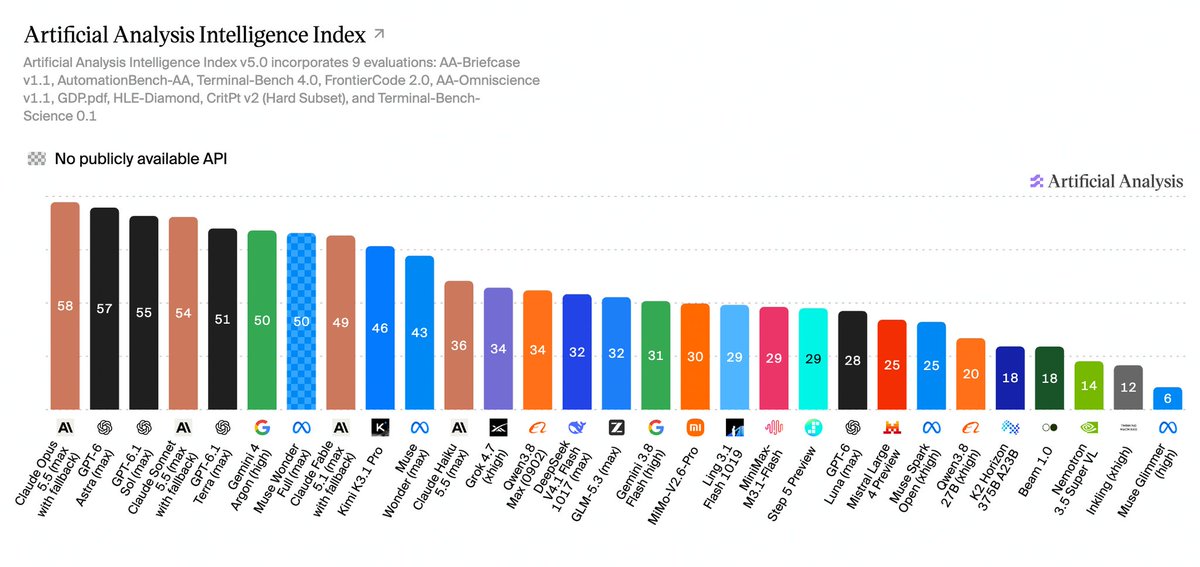
Announcing Artificial Analysis Intelligence Index v5, featuring 2 new benchmarks and 3 upgrades. For the first time, the majority of the Index is built on private datasets
The Artificial Analysis Intelligence Index is our composite measure of model capabilities across tasks reflecting real-world usage today. v5 is our biggest upgrade since v4 launched in January. With v5, 60% of the Index is now based on evaluations with private test sets or held-out answers.
Alongside Intelligence Index v5, we’re launching the Artificial Analysis Progress Index v1, which tracks model capability over time on one continuous scale.
New to the Intelligence Index:
➤ FrontierCode 2.0: Cognition's newly-launched private benchmark of real-world coding tasks, graded on whether a repository maintainer would merge the agent's change
➤ Terminal-Bench-Science: 70 agentic scientific research tasks, run in a terminal environment
Upgraded:
➤ HLE-Diamond (replacing Humanity's Last Exam): a refined 1,000-question version of Humanity's Last Exam, split evenly between reasoning and knowledge questions
➤ AA-Omniscience v1.1: An updated dataset with saturated and public set questions removed, new questions added, and ambiguous or erroneous questions revised
➤ CritPt v2: a private, 40-question hard subset of CritPt v2, revised by the CritPt authors and run with a code-execution tool
Staying in the Index: AA-Briefcase, AutomationBench-AA, GDP.pdf and Terminal-Bench 4.0
Removed from the Index: GDPval-AA v2.1, SciCode, and AA-LCR v1.1
Key results:
➤ Claude Opus 5.5 (max) leads at 58, ahead of GPT-6 Astra (max, 57) and GPT-6.1 Sol (max, 55): Anthropic and OpenAI hold the top five models. Gemini 4 Argon (high) is next at 50
➤ The open weights gap widens from 3 points to 12: Kimi K3.1 Pro (weights not yet released) is the top open weights model at 46. Among released weights, DeepSeek V4.1 Flash 1017 (max) and GLM-5.3 (max) lead at 32 - 26 points behind the leader and below Claude Haiku 5.5 (max, 36)
➤ Cost per task varies by more than 13x among the leading models: of the 10 highest-scoring models shown, GPT-6.1 Terra (max) is the cheapest at $0.96 per Intelligence Index task and Claude Fable 5.1 (max) the most expensive at $13.04
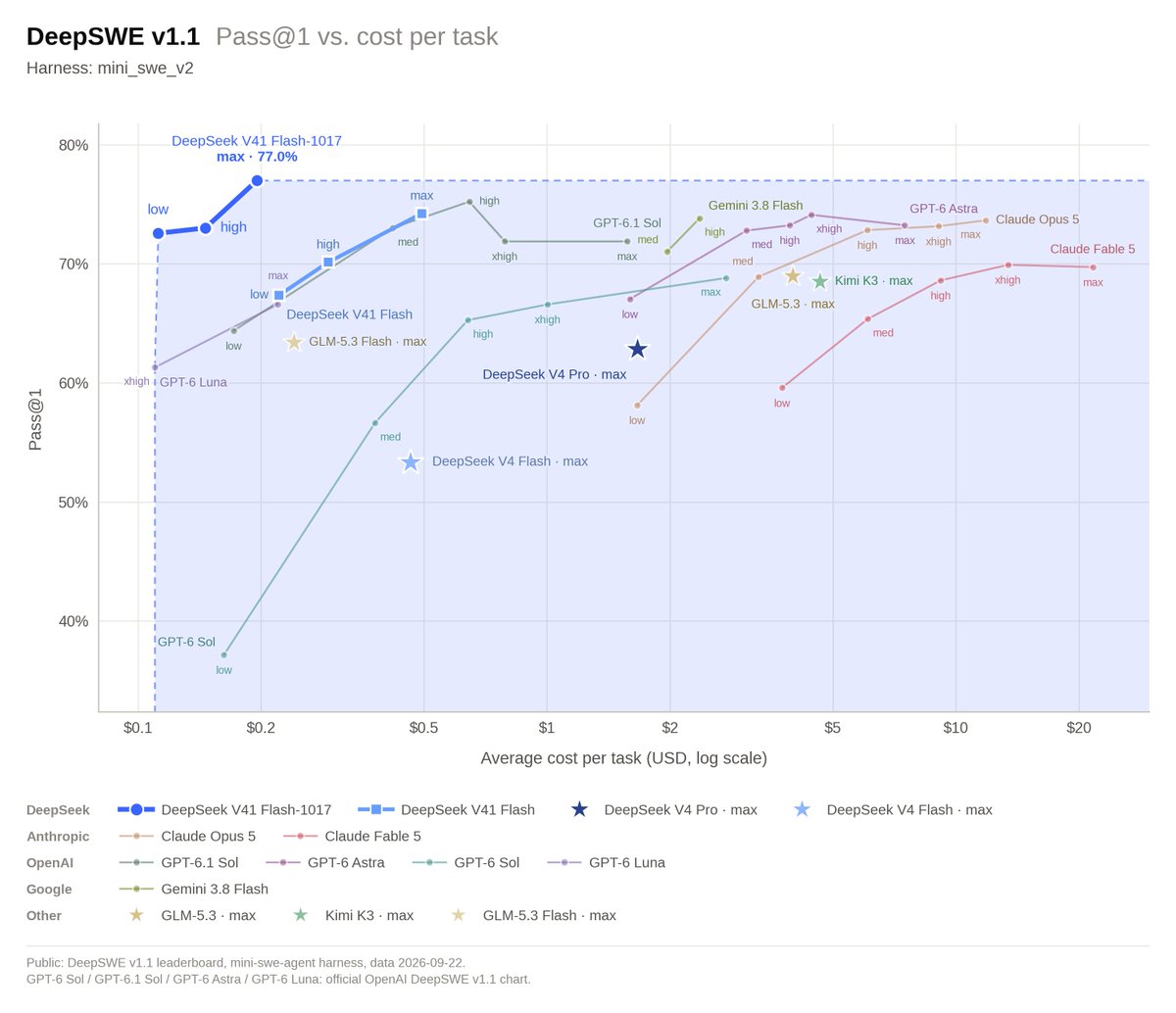
🚀 DeepSeek-V4.1-Flash-1017 is here!
Stronger benchmark performance, faster task completion, and shorter outputs than the previous version—a Pareto improvement in performance and cost. Now live on our website, app, and API.
🛠️ Optimized for @DeepSeekHarness, Tencent CodeBuddy, WorkBuddy, and more. Upgrade to DeepSeek Harness v0.2.1-rc.1 or later for the best experience with the new model.
1/4
A timely reminder that AI infrastructure introduces new security challenges. As developer platforms become more interconnected, credential management and access controls will be critical.
‼️ BREAKING: Nvidia's Brev AI platform has been breached.
Nvidia is telling users that unauthorised activity hit Brev from October 4 to 20 and that the SSH keys it set up for their VMs may have been exposed.
Wiz counts at least nine other AI developer platforms hit this month.
‼️ BREAKING: Nvidia's Brev AI platform has been breached.
Nvidia is telling users that unauthorised activity hit Brev from October 4 to 20 and that the SSH keys it set up for their VMs may have been exposed.
Wiz counts at least nine other AI developer platforms hit this month.