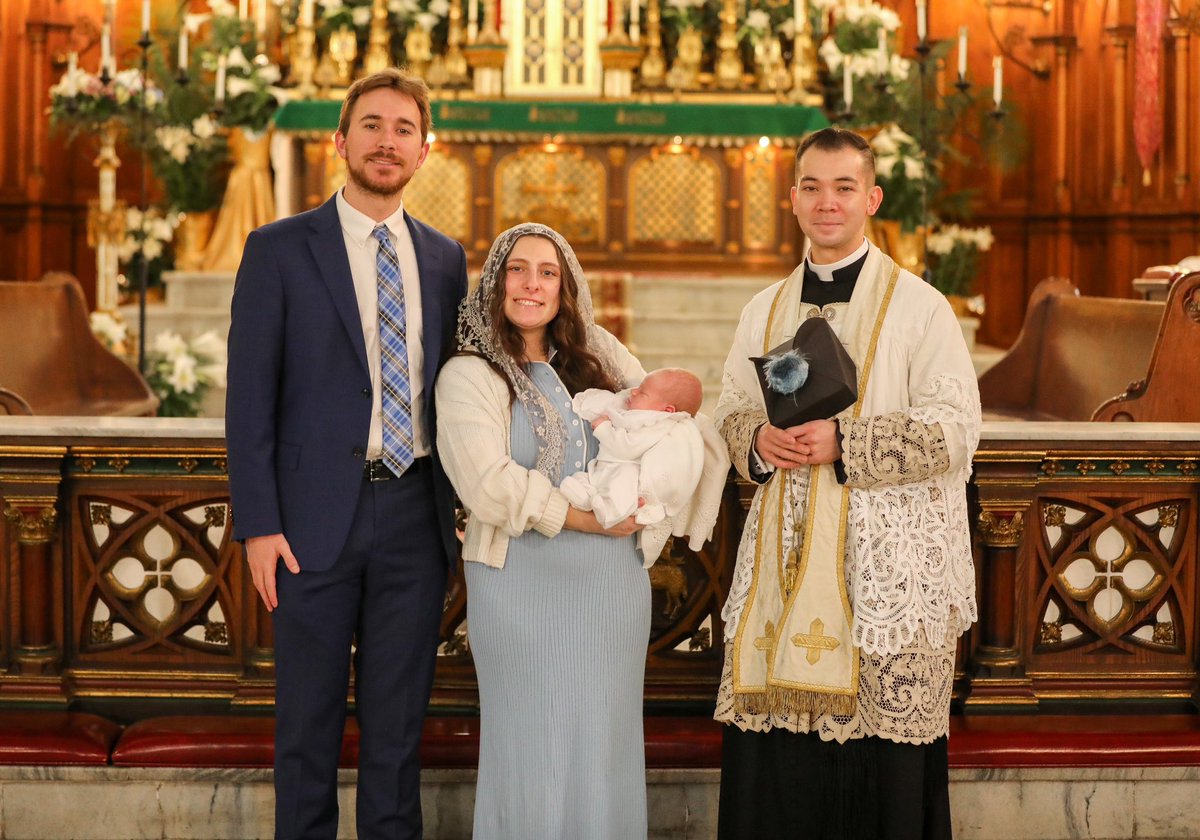
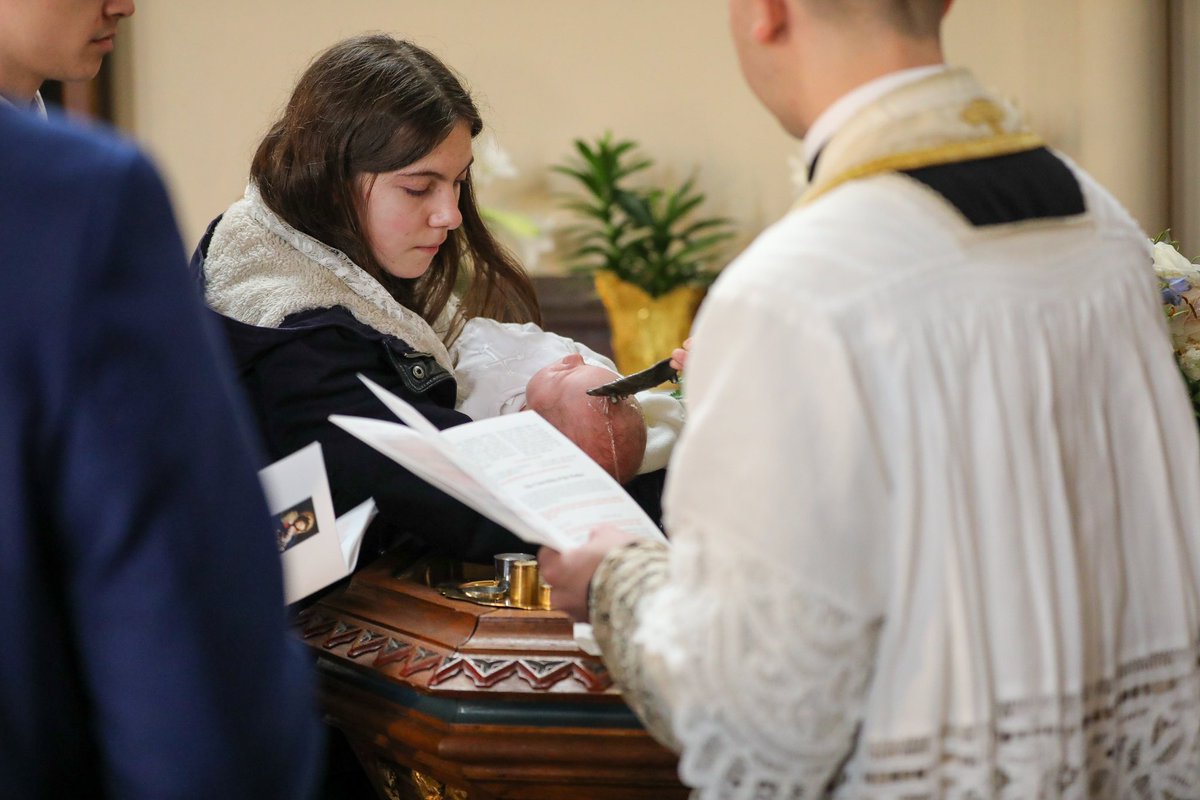
All glory and praise to our Lord God; The Father, The Son, & The Holy Ghost. Thank you Lord for brining supernatural life and grace to this precious baby boy through the waters of Baptism. Deo Gratias!!!
@AndrewsBob123@riecker Your insults will not bother me. Now let's deal with the issue at hand. Doctrines are the teachings that you must believe. So doctrines matter, as what you believe matters.
More private interpretation. I’m afraid you’re letting yourself down.
1:20 Understanding this first: That no prophecy of scripture is made by private interpretation.
1:21 For prophecy came not by the will of man at any time: but the holy men of God spoke, inspired by the Holy Ghost.
I went to Mass, yesterday. It was the Feast of Christ the King.
Some of the prayers from the Mass:
Worthy is the Lamb Who was slain to receive power, and divinity, and wisdom, and strength, and honor. To Him belong glory and dominion forever and ever.
Let us pray: Almighty and eternal God, Who willed to restore all things in Your beloved Son, the King of the Universe, graciously grant that the peoples of the earth torn asunder by the wound of sin, may submit to His most gentle rule.
Who livest and reignest with God the Father, in the unity of the Holy Spirit, one God, world without end.
R. Amen
Gradual
Ps 71:8, 11.
He shall rule from sea to sea, and from the River to the ends of the earth.
V. All kings shall pay Him homage, all nations shall serve Him. Alleluia, alleluia.
Dan. 7:14
V. His dominion is an everlasting dominion that shall not be taken away: and His kingdom shall not be destroyed. Alleluia.
Prefatio
Christ the King
It is meet and just, right and for our salvation, that we should at all times, and in all places, give thanks unto Thee, O holy Lord, Father almighty, everlasting God: Who didst anoint, with the oil of gladness, Thine only-begotten Son, our Lord Jesus Christ, to be the eternal Priest and King of the universe; that by offering Himself a spotless Victim and peace-offering on the altar of the Cross, He might accomplish the mysteries of man's redemption, and that having subjected all creatures to His dominion, He might present to Thine infinite Majesty an everlasting and universal Kingdom; a kingdom of truth and life; and kingdom of holiness and grace; a kingdom of justice, love, and peace. And therefore with Angels and Archangels, with Thrones and Dominations and with all the hosts of the heavenly army, we sing the hymn of Thy glory, evermore saying: HOLY, HOLY, HOLY…
Seems pretty Christ centered to me.
1:20 Understanding this first: That no prophecy of scripture is made by private interpretation.
1:21 For prophecy came not by the will of man at any time: but the holy men of God spoke, inspired by the Holy Ghost.
So no, I don’t understand on my own. But the Holy Catholic Church, established by our Blessed Lord Jesus Christ does know and teach the truth…
“But if I tarry long, that thou mayest know how thou oughtest to behave thyself in the house of God, which is the church of the living God, the pillar and ground of the truth.” (1 Tim 3:15)
“For my thoughts are not your thoughts: nor your ways my ways, saith the Lord. For as the heavens are exalted above the earth, so are my ways exalted above your ways, and my thoughts above your thoughts.” (Is 55:8-9)
We can see God communicates in both directions via angels. As I’ve shown above from God to man and from man to God in The Revelation.
“And another angel came and stood before the altar, having a golden censer: and there was given to him much incense, that he should offer of the prayers of all saints, upon the golden altar which is before the throne of God. And the smoke of the incense of the prayers of the saints ascended up before God from the hand of the angel.” (Ap 8:3-4)
These verses demonstrate it so.
God uses angels to speak to us. It follows that angels not only send but also receive our messages.
“But while he thought on these things, behold the Angel of the Lord appeared to him in his sleep, saying: Joseph, son of David, fear not to take unto thee Mary thy wife, for that which is conceived in her, is of the Holy Ghost” (Mt 1:20)
“And the angel being come in, said unto her: Hail, full of grace, the Lord is with thee: blessed art thou among women.” (Lk 1:28)
@BIG_SGT_D If you think this, you have so much to learn about the Holy Faith as handed down by the Apostles and our Blessed Lord Jesus Christ.
Here’s a good start:
https://t.co/PfrYqgABhC
@rockreborn22@MrCasey62 Then you wasted your prayer time as it is meant to meditate on the life and works of our Blessed Lord Jesus Christ.
It’s not vain repetition. It’s praying the scriptures as you meditate. Shame on those who let you down and did not teach you properly.
It was handed to us for our Blessed Lord Jesus Christ and you think to call it pagan?
“For I have received of the Lord that which also I delivered unto you, that the Lord Jesus, the same night in which he was betrayed, took bread, And giving thanks, broke and said: Take ye and eat: This is my body, which shall be delivered for you. This do for the commemoration of me. In like manner also the chalice, after he had supped, saying: This chalice is the new testament in my blood. This do ye, as often as you shall drink, for the commemoration of me. For as often as you shall eat this bread and drink the chalice, you shall shew the death of the Lord, until he come. Therefore, whosoever shall eat this bread, or drink the chalice of the Lord unworthily, shall be guilty of the body and of the blood of the Lord. But let a man prove himself: and so let him eat of that bread and drink of the chalice. For he that eateth and drinketh unworthily eateth and drinketh judgment to himself, not discerning the body of the Lord. Therefore are there many infirm and weak among you: and many sleep.” (1 Cor 11:23-30)