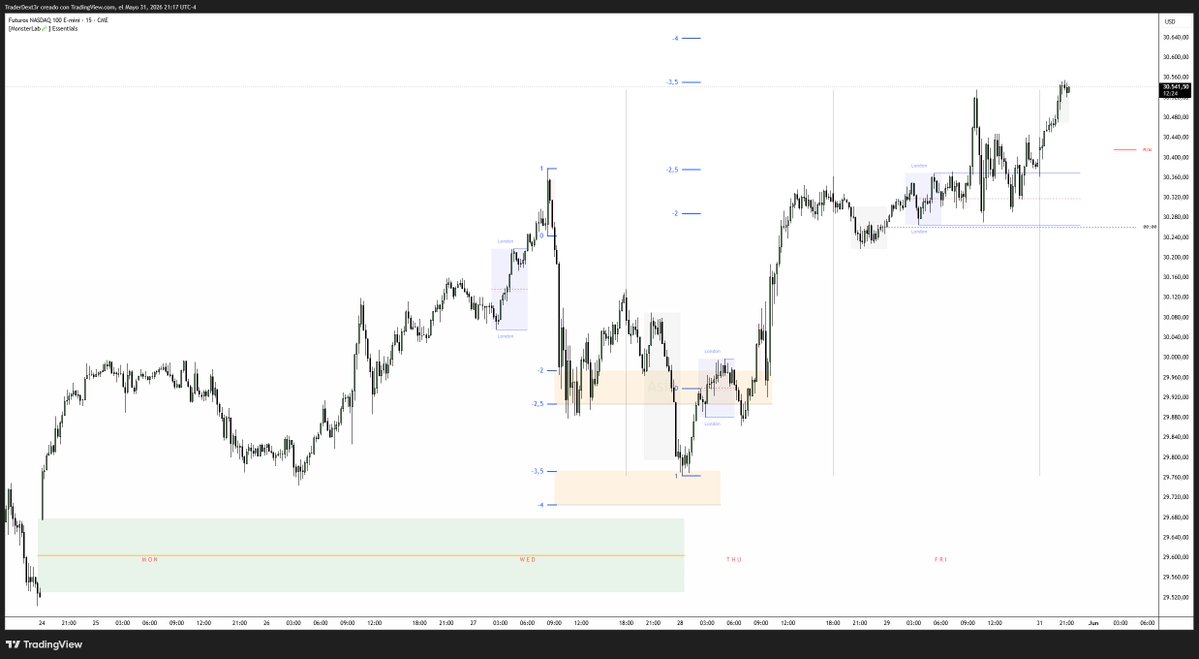
$NQ | A.M Session
• 1 Trade Closed in Profit
Managed to secure 70+ handles before higher resistance came into play.
"The goal isn't to catch every point. The goal is to consistently participate in the highest-probability portion of the move."
If you can make a case for both sides of the market, sit on your hands.
Wait for more information.
If the narrative isn’t clear, do nothing.
Preserve your capital.
How to confirm high or low of the day (daily candle wick)
CISD
- Asia (h1)
- London (h1/m30/m15)
- New York (m15/m5)
Candle Closures
- h4 closure
- h1 closure at POI
poi is more important on the h1 than it is on h4
One of the simplest yet most effective ICT models.
🗒️
• Draw on Liquidity
• 09:30 Manipulation
• 9:50 Macro Time Window
• First Presented FVG Entry Model
The fewer variables your model has, the more repeatable execution becomes.
$ES / $NQ
How Time Controls Price Delivery ?
Price delivery during New York session is heavily influenced by predefined time windows where liquidity is engineered, repriced, and expanded toward higher timeframe objectives.
Understanding these time elements changes how intraday price action is interpreted.
NY AM SESSION:
• 7:00 A.M. → NY Killzone begins
• 7:00–8:30 → Premarket Silver Bullet
• 8:30 → Early Open / News Embargo
• 9:30 → Equities Open
• 9:30–10:00 → Opening Range
• 10:00–11:00 → AM Silver Bullet
The 9:30 Opening Range is one of the most important intraday windows.
This is commonly where the market:
• Creates the high or low of the day
• Runs liquidity
• Rebalances inefficiencies
• Establishes directional delivery
If bullish, the algorithm often engineers sellside liquidity below short-term lows before expanding higher.
If bearish, the algorithm often engineers buyside liquidity above highs before delivering lower.
PM SESSION:
• 12:00–1:00 → P.M Lunch Hour
• 1:30 → PM Open Macro
• 2:00–3:00 → PM Silver Bullet
• 3:15–3:45 → Final Hour Macro
• 4:00 → True Day Close
• 4:30 → NY PM Close
After lunch hour, the market transitions into a different delivery phase.
By 1:30 PM:
• AM manipulation is usually complete
• Daily targets may already be reached
• The market prepares for either continuation or reversal
Between 2PM–3PM, the PM Silver Bullet window often delivers:
• Liquidity runs
• Inefficiency rebalancing
• Expansion setups
• Continuation or reversal delivery
Then comes the Final Hour Macro.
3:15–3:45 PM is one of the cleanest delivery windows of the day.
If higher timeframe liquidity remains unsatisfied, the market will often expand aggressively toward that objective before close.
Markets are programmed around liquidity and time.
If liquidity is engineered before the open, then continuation becomes more likely.
If liquidity remains untouched into key macro windows, then manipulation is more likely before expansion.
The objective is understanding how the algorithm shifts delivery based on current market conditions and liquidity positioning throughout the session.
When I stopped chasing price and started studying time…
everything changed.
It’s not just about where price is going.
It’s when.
That’s how you filter false breakouts and understand when price will reverse vs continue.