For the last year I've been helming the development of Progress, a new British political movement beyond left and right, for whom I have been acting as founder and leader.
Today we are publicly releasing our policy testament, and with it, introducing our party and organisation for the first time.
If you've been reading this feed over the past fortnight you'll have some idea of what we think is wrong with Britain. The tweets were not an exercise in commentary. They were the opening argument of a case we intend to prosecute through the coming years, made by a group of highly able everyday citizens who have spent years looking at the parlous state of the country in which they live and feel summoned to duty.
Progress' philosophy is a best-of-both-worlds approach to the mixture of political spectrum positions. We believe in industrial development, real wage increases for the worker, skills and training, healthy public services (including and especially the NHS), and giving everyone in Britain a fair stake in their society; we will do more for working people on these issues than Labour have in living memory. We will do more to secure Britain's streets from crime than the Tories have in a century. We are committed to answering the public's repeat and clear wishes on immigration in a way that is both uncompromised and robust, as well as utterly civilised. We are in step, and side-by-side, with the median voter on these issues because Progress was founded by the median voter, for the median voter. We are the proud and natural home for the politically homeless.
You may ask, "Why not Reform or Restore or the Greens?" In short, we at Progress understand implicitly the scale of the problems that face our country. We know that only organisations capable of the highest performance have a chance of wresting those problems to the ground. We look at Reform and Restore and the Greens and, like you, are left in no doubt that they are incapable of the level of performance required. They are conventional political organisations capable only of conventional things. Britain needs something far greater than that.
The policy testament we are sharing with you today is the richest, longest, and most comprehensive integrated vision for the future of Britain written yet this century, a document that will continue to evolve as our understanding of how to best serve our people grows. We invite you to read it. It was written by people who take you and your needs extremely seriously.
And yet, for all that, half a million words of policy is the easy part. The real challenge comes now, in building a political machine up and down the country not merely capable, in time, of contesting elections, but capable in the immediate term of providing value to the communities in which they are embedded. This is the essence of our aim: not to beg trust but to win it through service, without being asked and without asking anything in return. At Progress, we call this 'CIV', or 'Community Investment'.
Our work may elapse over a generation before it bears fruit. Fate may intervene to bring it to resolution, good or bad, long before that. In the chaos of our world there's no way to know. But what is in our control is our drive and ability to build, and "build" is what we're doing and what we’re going to do. We require community leaders, active and would-be, to help support our existing CIVs up and down the country and build more. We require experts and technicians of every stripe. Outsized and unusually shaped talent is the alpha and the omega of our organisation. We require, above all else, any and everyone who has looked at what Britain has become and concluded that responsibility for fixing it must lay with the people, not with a professional failure class.
Never doubt that, as dark as things seem in this land of ours, there are those fighting, hard and earnest, to right the course. If you’re stirred by duty, if you wish to work with a British political organisation that can do things others can't, then come and give us your hand.
It Can Be Done.
https://t.co/FCnXMmTdhg
Ever heard of Pie Factory Music?
It's a young people's music and arts charity in Ramsgate, out on the Thanet coast, one of the poorest stretches of the south-east. For more than a decade it had made its home in the old town youth centre, a building a place like that has few enough of left. Then the freehold was sent to public auction.
Everyone knows how this story is supposed to wind up. A youth centre in a broke seaside town, thirteen years in the same building, gets listed for auction; some developer buys the shell; the kids who used it are told, in that soft managerial voice, that the money simply isn't there, and that's that. Ramsgate has sat through that speech before. Most of the country has.
Except the teenagers at Pie Factory Music declined to hear it this time. They ran a campaign, sixteen months of one, and in February they bought the building outright, freehold and for keeps, with a £535,000 grant they had no earthly business being able to win.
It's theirs now. Nobody gets to auction it out from under them again. And next week a few of them go up to London as national finalists for a campaigning award, a strange fate for a group of kids a property listing had quietly filed under "gone."
I keep turning that over, because of who it ought to reach, in these times of decline, of Southport and Nowak and all the rest of it.
Not the people already organising; they know. The ones I mean are the millions who've privately decided that nothing they do will ever change anything, that the building always gets sold and the decision's always been taken in a room they'll never be allowed into.
Ramsgate is the answer to that. A handful of kids with no money, no power and no connections walked straight up to the machine that sells off everything a place loves and flogs beautiful stretches of British land to foreign private equity, and they beat it, because they refused to play to the script and conducted themselves too well to be dismissed.
That's the whole of it. Not that a youth centre is some cure for anything. We've been told for decades that it is, and it isn't. But the kind of will that saves a youth club, marshalled by those who'd never marshalled themselves before; that's a cure for everything that ails this countnry today.
It shows that the untested, the unimportant and the entirely overlooked can still reach into the workings of this country and change the result, if they organise and carry themselves well enough to leave the cynics nothing to use.
The kids in Ramsgate have just shown the rest of us how it's done. It's being done. The only question worth asking is who's next up to the crease, and how hard they're going to swing.
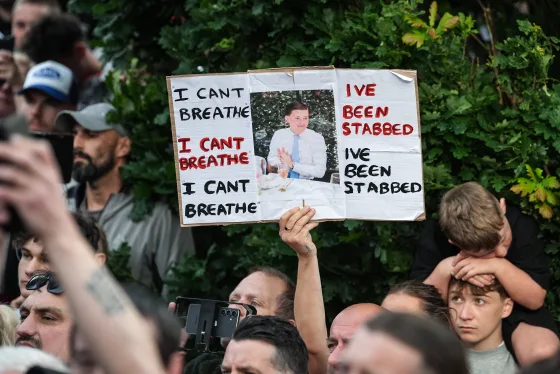
If you want to understand what happened to Nowak, there are two documents you need to be familiar with, and two specific, respective passages within each of them.
The first is the Macpherson report, which beyond any other policy or work of legislation has shaped, governed, and dominated British policing for 25 years. The report states that "A racist incident is any incident which is perceived to be racist by the victim or any other person." There is, in this thesis, no burden of proof or demand of evidence whatsoever. Pure perception.
The other key document is the National Police Chiefs' Council's Anti-Racism Commitment. "Racial equity," it says, means "responding to individuals and communities according to their specific needs, circumstances and experiences, with understanding that these will be racialised." And then, with a frankness I can almost respect, it states plainly what it has set its face against: "It does not mean treating everyone 'the same' or being 'colour blind.'"
Or, in other words, it means 'being racist', just deliberately and according to a sort of points-and-handicap system. I wouldn't be surprised if that system were actually written down somewhere in the materials given to officers during training, though no such matrix has been made public. "You are to privilege x over y in situation a, but y can be privileged over z given c..." etc.
So when the Prime Minister's office says there is no such thing as two-tier policing; it's in the manual. It's as clear and explicit as can possibly be.
Of course, equal treatment, the blindfold on the statue, is a principle every Western idea of justice has rested on since the Enlightenment.
But these two documents are the reason you too could be left to die on the gravel in shame and ignominy, cuffed and surrounded by people who couldn't give much less of a shit, if someone were to imply that you might have said something a bit off-brand to them while you were in the process of escaping them as they attempted to murder you.
Racist-By-Design, that's what they are.
I think the only thing that surprises me about the Henry Nowak arrest bodycam footage is that the police actually released it. That they didn't find a way to fudge it or trump up some kind of litigious shield for why releasing it would be 'Against the public interest' or something like that.
Nothing about what's actually in the video surprises me. I doubt any of it surprises you. The down-Nando's tone of voice from the police when they're taking the piss out of the kid whose mouth is full of blood (which would tell anyone competent that they're dealing with a probable lung puncture) when he tells them he's been stabbed. The same no-one-home grain of the voice when the female copper notes that Nowak's pupils aren't responding to light.
For me, the most awful of the images is the colour of his hand, a white-of-the-dying as it's placed in a cuff with the blue-gloved hand of one of the arresting officers on his shoulder. Again, anyone competent in administering to situations involving violent assault with deadly weapons would know that a visible lack of blood reaching the extremities points to severe internal bleeding in the victim.
And because nothing surprises me about the Nowak situation, nothing surprises me either about the public response. Outrage and outcry. Total uproar. As far as can be seen, those who've thronged the Southampton police station where those responsible for this situation - behind, of course, the murderer himself, and his lying, treacherous family - have done everything right to this point.
Making their anger unmistakable, and playing by every code of civilised behaviour while doing so. Not giving the shysters and the baiters an inch, nor so much as a figurative spent-shell casing with which they could do their worm-like work.
I'm with the protestors, as far as it goes. The key to situations like this is realising you, the regular member of the public untested and frankly uninterested in politics, can change it. Realising that protest is often where it starts, and that anyone can set one up.
I helped set one up myself! And by adhering rigorously to strict codes of correct/positive/ethical conduct and communicating your story with truth and passionate sincerity to your fellow citizens and to the press, you too can make change happen in ways that you, understandably, may feel too jaded or cynical (or, frankly, exposed and vulnerable to the might and anger of a clearly corrupt and deeply prejudiced state) to believe possible.
But, and I say it with the deepest of passions, It Can Be Done.
This kind of thing will only stop when the people decide that it will be stopped, and that it will be the people who stop it. You have no servants in the ranks of the governing, and no champions of your interests where power lives. That does not need to matter.
Get out there and show those responsible for this how you feel. Do it always in the proper way; show no one foul behaviour however much you are tempted or goaded into doing so, and however much sponsored champions of the poisoned status-quo feel they can safely display the same wretchedness to you.
If it is not us - if it is not you, and not me - it will not be anyone. It is time for the British public to speak.
British factories are starting to come home.
After forty years of being told manufacturing was the past, more than half of UK manufacturers now plan to expand their operations here over the next five years, and nearly two-thirds of those intend to hire. Supply chains that were shipped to Asia in the name of efficiency are being quietly repatriated, because a world of tariffs, blockaded shipping lanes and fragile dependencies has reminded boardrooms that the best cheap insurance against a whole world of future shocks is making things close to home.
This is the best industrial news Britain has had in a generation, and almost nobody is talking about it.
One thing stands squarely in the way, and it's no mystery: we are not training people to do the work. Even our present manufacturing sector, meagre as it is, is already carrying 48,000 unfilled vacancies. The welders, the machinists, the maintenance engineers, the people who can actually run a modern production line - we stopped training them somewhere around the turn of the century, on the lazy assumption that the future was all laptops and lattes. The work is returning to a workforce we let wither, and the world in which metalworkers are going roughly the same way as stonemasons.
When I founded Progress, I vowed we wouldn't wait for office to start fixing and making things. We will begin founding skills academies now, as a party, years ahead of the point at which we win power. We're going to start teaching practical training in the trades and technical skills the returning industries actually need, built alongside the employers who will hire from them and sited in the towns that lost their works and their pride together. It is a down payment on the national Hallmark system we have planned for government, in which every worker earns a portable, respected qualification stamped to the same standard Britain once used to guarantee its silver.
And in power this gets turned into a vast, hyper-powered, verdant-green machine: Prosperity Zones, to land the new plants in the regions that need them most, with ground broken on the first sites on day two, powered by the cheapest industrial energy supply in the world, because a reshored factory running on British electricity at today's prices will not stay reshored for long.
The factories are coming home. It's time to get British hands trained and ready to work in them.
More than a thousand children are now sent home from English schools every single day.
312,562 suspensions in one spring term, and 3,320 children permanently excluded, the highest figure ever recorded. "Persistent disruptive behaviour" drove over half of them, abuse or threats against staff another 15%, and physical assault on a fellow pupil a further 13%. It is, like a surprisingly high number of other things in British life, the slow collapse of authority dressed up by the sector as a wellbeing crisis as can be soothed with a mindfulness app.
And you know who's paying for it. The good kids, the studious ones, the ones who love to learn and are determined to learn as much as they can. The quiet, gentle ones. Losing all that precious time and learning opportunity, and if you've got no tutor at home and no well-connected folks to grease your skids, that's your one biggest shot at bettering yourself being stolen lesson by lesson by the kid hurling the chair gets.
We have built schools that shield the disruptor and abandon the diligent, then wonder why the strivers stop believing there was any deal really out there for them.
The teaching profession has been left to carry this alone, told to "build a relationship" with the pupil who threatened them on Tuesday, and quietly marked down as a failure for asking that the disruption simply end.
Time to end it. Time to put authority back behind the teacher, no apology and no euphemism, because a classroom without order is not a classroom. And for the young people the academic treadmill has genuinely failed - the ones playing up because school offers them nothing they can see a use for - we can and will build the Hallmark route: respected vocational training from the age of fifteen, a path into a skilled trade and a proper wage, so the choice is no longer university or nothing.
A country that cannot keep order in a Year 9 classroom will not stop its future from coming apart. Britain once set the standard for how a school should be run, and it can remember how.
There is now a theft from a British shop every six seconds.
5.45 million of them a year, on the British Retail Consortium's count, costing retailers some £400 million and lacing the working day of every shopkeeper in the land with the dread-certainty of being robbed. Violence and abuse against shop staff runs at 1,600 incidents a day, more than triple the pre-pandemic rate.
And how many retailers rate the police response as good or excellent? 13%. The other 87% have grasped what the rest of us have: that when you're a shopkeeper watching a man load a rucksack with your stock and amble out the door, the one body guaranteed not to materialise is the police.
One number gives the game away. Police-recorded shoplifting last year came to 509,566 offences. The shops themselves counted 5.45 million. That gap is a confession: most shop theft in Britain is no longer investigated, no longer recorded, and to all practical purposes no longer a crime at all. It's been decriminalised, not by any vote in Parliament, but by a police service that has simply stopped showing up.
And the government's grand reply? A brand-new criminal offence of assaulting a retail worker, gravely added to the statute book - a fresh law to go unenforced alongside all the existing ones. You can almost hear the press release writing itself. The shop worker, bleeding behind the till, will be delighted to learn there's now a second law no one will act on.
They sneered, once, that we were a nation of shopkeepers. They could not have paid us a higher compliment, because the corner shop and the high-street trader are the sinew of a free economy and the place where ordinary ambition first takes root. Progress will defend them properly. We will double the police force and restore the plain rule that a reported theft is a theft investigated.
I want to make Britain the worst place in the West to be a thief, and the best place in it to keep a shop, and to build a life as a small businessperson. Zero-Crime Britain is a flat commitment that safe streets and safe shops are the very first thing a state owes the people who keep it running.
Take the thief off the street, and watch what Britain's shopkeepers do with the room to breathe.
The Government will now pay families who came to Britain illegally up to £40,000 to leave the country, and call it border control.
The trial, running since the spring, offers families whose primary representative arrived on small boats (or equivalent methidos), and whose asylum claims were refused, as much as £40k to go home, with the standard £3,000 still on the table for any migrant who volunteers.
These are people who have been told, formally and finally, that they had no right to be here to begin with and no right to remain; and we are now offering them a small fortune to do the very thing the law already demands they should do, which is leave. Like paying someone who broke into your house to leave it.
The Home Office, morons that they are, calls this a triumph: roughly 60,000 removals since the election, the most in over a decade! Wow. Read the small print and a great share of that is people pocketing the money and the flight, waving from the departure lounge with a cheque worth more than six months of the average British wage, in some cases before catching the next dinghy back in to try for a double dip.
In functional terms, fewer than 4% of all the people known to have illegally crossed the Channel by small boat since 2018 has been returned at all. The dinghy remains the surest way into Britain, and every chancer, human trafficker, and shyster lawyer in the world now knows there's a leaving bonus waiting at the end of it.
This is what enforcement by the congenitally mentally-defective looks like. "Oh no, we can't remove people, because our own courts, reading Articles 3 and 8 of the Human Rights Act with ever-greater imagination, won't allow it." So they do the one thing still open to a government that doesn't have a clue or a plan: give your money away.
And the maddening part is how solvable this is. The block on removals is nothing grander than a tangle of domestic legal interpretation, which Parliament wrote and Parliament can untie.
Let's do exactly that: targeted legislation disapplying the Human Rights Act mechanisms that have handed our own courts a veto over who may live here, so that a person with no right to be here is removed swiftly, safely, and lawfully, with no six-figure sweetener required. Clear rules, fairly enforced, are the only civilised option.
Get that right and the cheques can stop and the hotels can empty, and the British public is once more the authority on who comes and who stays.
The NHS has published a guide to Treating Patients in Corridors. It must be the absolute ultimate entry in the long, desperately sad story of the decline of the National Health Service.
It goes by the jaunty title of the 'Corridor Care Improvement Guide', it runs to a tidy set of "practical steps," and it exists because nursing the sick on trolleys in a public hallway has become so routine that someone in NHS England decided it needed a house style. What was once a national humiliation and a scandal against the concept of care is now so much a part of convention that it has its own best practices guide.
There is a section, one assumes, on the optimal placement of the trolley. The document insists, with a straight face, that its aim is to "minimise and ultimately eliminate" the practice. Nobody drafts a house style for a thing they mean to end, but you very much would draft one for something you can't fix but have quietly decided to live with.
And that would be fine, were it not the case that we also have to live with it. Have been living with it. Bed occupancy in English hospitals hasn't dropped below 91% in a single month - not one - since September 2021, against a safe ceiling of 85%.
In January, more than 71,500 people waited over twelve hours for an emergency admission, 25 times the figure of January 2020. On any given day last year, 12,663 patients sat in beds they no longer needed, medically fit to leave with nowhere to send them, at a cost of £2.6 billion.
The corridor is simply what happens when every bed is full of someone who should already be home. The trolley in the hallway is the overflow pipe with a stopped-up end. Nowhere to go.
It will surprise no one that satisfaction with A&E waiting times now sits at 12%. Of course, the £200 billion a year keeps going in. What comes back out, increasingly, is a leaflet on the proper means to manage without dignity.
The managerial class will never say the obvious, because saying it would oblige them to act: the NHS does not need another guide. It needs the beds emptied and the back door of the hospital opened. That's why at Progress we spent so much time conceptualising a means to return the NHS to the acute core service it was built for:
- Magnificent when trauma, a stroke, or cancer strikes
- Expansive in acute capacity rather than rationed;
- Free of both premature discharge and delayed discharge, the likes of which packs the wards with people the system has simply failed to move on
A health service worthy of the name treats people in wards, in beds, with the curtain drawn and their dignity intact. Britain managed it for decades without a how-to guide, and it can manage it again.
A team at the Cavendish Laboratory in Cambridge has just made light pour out of materials that cannot carry electricity.
For decades this sat under the heading of impossible. Lanthanide nanoparticles produce some of the purest, most stable light known to science, but they are electrical insulators; you cannot simply wire them up and switch them on.
But Professor Akshay Rao and his group found a way around the wall. They fixed organic molecules to the particles that work as tiny antennas, catching the electrical charge and, in Rao's words, "whispering it to the nanoparticle" through a quantum process that runs at better than 98% efficiency. The result is a new class of LED, published this month in Nature, that emits in the near-infrared.
The near-infrared is the band that passes through living flesh. So this is light you can send into the body, to watch an organ working in real time, find disease early, and switch on a drug exactly where it is needed. A whole frontier of medical imaging has been opened through a back door nobody believed was there.
Where it happened matters as much as what was done. The Cavendish is one of the great cradles of our civilisation. These are the rooms where J.J. Thomson found the electron, where Chadwick found the neutron, and where Crick and Watson worked out the structure of DNA. It has earned the better part of thirty Nobel prizes. It is, by some distance, the most consequential physics laboratory in the history of the world, and there it is, still sat in the East of England, still wandering of a happy Tuesday into the realms of the impossible.
And it's proof positive, as exists all around us whenever we are inspired to look, that our decline is no permanent thing. The talent never left and the genius never faded. In the very week our boardrooms were busy preparing to import Silicon Valley's redundancy notices, a few floors of a Cambridge laboratory quietly moved the boundary of what light itself can do. We are not short of genius in this country; we remain very, very well-stocked in it.
What we lack is a state with the wit to build around it - the capital to scale a discovery like this into a British industry, a skills system able to staff it, and the patience to keep the company here long enough to matter. That is the whole Progress economic argument, stated in a single instance: the genius is here; what is missing is a government fit to deploy it.
Britain made the impossible happen again this month. The only question left open is whether we do something with it, or hand it off, as usual, to someone else.
And, thereafter, how we rebuild the state to make such things abundantly commonplace once again.
When you're planning for the economic future of Britain, you must study what's going on in the States. We've tied our fortunes to the movements of our daughter-country for so long and in so many ways that whatever takes there will certainly impact us here soon enough.
That's why it should interest you that American tech firms have just shed about 142,000 jobs, nearly half of them blamed explicitly on AI, while the four big cloud giants pour something close to $700 billion into the data centres the technology depends on.
They are sacking people to fund the machines, then finding the machines bill them more than the people ever did.
And it gets worse for them. 2/3s of the firms that made AI redundancies are already rehiring. A third found they had thrown away skills and institutional memory they couldn't buy back. Around 31% admit the rehiring cost more than the automation ever saved. Uber burned through its entire annual AI budget in four months. The price of each unit of computation has fallen, and the bills have climbed anyway, because the newest systems devour compute far faster than the price comes down.
Almost nobody in the commentary has said the plain thing out loud: this is an energy story. AI runs on electricity. Every prompt and every automated agent is a meter spinning in a server hall somewhere, and the meter's starting to bite.
This ought to alarm anyone responsible for Britain, because we hold the worst of this deal twice over.
Morgan Stanley already names us the developed economy hit hardest by AI job losses, at roughly double the international average, because we are so over-indexed on services. We are an early warning the rest of the world is studying.
We also carry the most expensive industrial electricity in the developed world, 125% above the European median. The country with the most to lose from automation is the same country where it costs the most to run the thing doing the automating. That is the fruit of 20 years of treating the electricity bill as a collection tin for every passing fashion.
The deeper truth is that this contest will not be won by whoever sacks fastest, or adopts fastest. It turns on three scarce things held at once: power cheap enough to run the machines, the human judgment those machines still cannot replicate, which is exactly what the Americans are now scrambling to rehire, and a domestic claim on the companies, so the wealth they throw off finally compounds in Britain. Assembling all three is a feat of statecraft on a twenty-year horizon, the patient and unglamorous work of building reactors, training a generation and keeping your champions through the lean years when selling them would be easier. It is the developmental capability that Seoul, Singapore and post-war Paris never mislaid, and that Britain unlearned across forty years of managed decline.
None of this is within a Labour government's reach. Starmer and Reeves think in two-week press cycles and Treasury spreadsheets that the Chancellor can probably just about hanndle; a generational industrial bet is not something their machine can even conceive, let alone deliver.
And before the obvious retort arrives, do Reform have the horsepower to grasp it, still less to build it? I doubt it. Watch Farage try to cost a nuclear fleet or stand up a national skills system, and the question answers itself. Britain faces the most demanding piece of economic statecraft in two generations, and it is being offered a choice between a party that manages the decline politely and a party that merely shouts about it. Neither is going to build the thing.
Time to get competence back into the political equation.
This is C.S. Lewis, preaching at the University Church of St Mary the Virgin in Oxford in the autumn of 1939. The war was ten days old.
His congregation of undergraduates wanted to know whether it was right, in such conditions, to continue studying English literature and mathematics and ancient history. Lewis's answer to them is the passage above. Favourable conditions never come. The people who achieve anything are the people who sit down to work in rooms on fire.
I have been carrying that passage around with me, in one form or another, for years, as the fire has, in one and a dozen fascinating ways, grown, and with it has grown my own personal conception of what 'creative work' consists of. I started off thinking of in terms of music and prose and painting, but as time goes by I've come to see the artistic conception at the heart of great programming, and enterprise supreme, and even - though it may well be the artform I like the least - yes, even politics itself.
What greater canvas, after all, is there than an entire country?
I find that Lewis' sentiment is, in 2026, the operational answer to almost every objection that anyone with a serious project for this country, its people, and its future, will inevitably run repeatedly into.
We are told, by people who say they share Progress' diagnosis but cannot quite bring themselves to share our timetable or our mania for committed action, that the conditions are not yet right to dedicate ourselves to the redemption and recreation of Britain. That the country is too tired, the political moment wrong, the institutions too thickly captured, the public not ready, the polling unsupportive, the news agenda spavined, and the field crowded with startup options (though the algorithm at least is kind).
If it's not that it's the weather, the budget, the cabinet reshuffle, the next by-election, work, kids, pre-existing passion projects, or some more general uncertainty that explains why they think it can't be done, all of them conspiring to indefinitely delay the 'proper' moment to begin.
The same essential argument the Oxford undergraduates of October 1939 were making to Lewis. He answered them then. He is answering them now.
The ultimate British creative ambition has never been a poem, or a novel, or even a piece of music or science, however gloriously this country has produced all of those things in an abundance to shock history. The ultimate British creative ambition is Britain. The thing we have built, on this island, over the past thousand years - the common law, the parliamentary tradition, the empirical sciences, the household economy, the parish, the town, the regiment, the chapel, the trade union, the school, the press, the joint-stock company, the boat, the library, the football team - is the largest single creative project our civilisation has ever undertaken.
The artists and engineers were all those who have come before us, who made contributions grand and piecemeal, to get us where we are today.
That project is, in 2026, not so much in disrepair as in despair. We are in a mire and muck of de-development, negative lawfare waged by the state against citizens, given a backdrop of predatory and corrupt institutions.
The country, in the unprivate ordinary opinion of its own people, is not where they want it to be. The uniparty has spent fifteen years issuing apologies for the project's existence, while quietly removing the conditions under which it can continue.
We are up against it.
And unless we scorn the fact, it will never be otherwise.
Lewis's point, in 1939, was that there will not be a moment in any of our lives at which the conditions become favourable. The work is the work we do under the imperfect day we actually have.
If we are to renew the nation, we'll do it explicitly on Lewis's terms. Sod waiting for polling, or for Reform, or for the next election cycle, or for a miracle whitepaper. We must, with the people who have already decided to do the work with us, building the institutional alternative to the country's decline in real time, under the conditions as they stand, and against the rivals to our work that Lewis correctly identified.
Favourable conditions never come, and the country is the work that waits to be done.
Twenty-seven to one.
That's how much more likely you are to get a job in Britain if you're foreign-born than if you're a young British person.
Yes, in the latest instalment of "Britain: Too Unbelievable To Be Anything Other Than True", between 2020 and 2026, for every additional British under-25 added to the country's payroll, 27 additional non-EU foreign workers under-25 were added to the same payroll.
UK nationals up 0.3%. Non-EU migrants up 355%. The figures are from the Centre for Social Justice and published this month.
For six years the political class has stood in front of the British twenty-year-old - the warehouse worker in Wolverhampton, the apprentice in Halifax, the school-leaver in Plymouth - and called him shiftless, unmotivated, or unable. They've told him to work harder, re-train and train better, get up earlier, shut up and stop complaining. They did it; they've been doing it.
While they were doing it, the same political class was, blatantly and as per its own published policy documents, importing twenty-seven foreign workers into the front of every queue he was trying to join. The Conservatives wrote the policy. Labour has not amended it (because they are the same, of course).
The 27:1 ratio is the operational signature of an open conspiracy against the British young.
It should be the rallying cry for each and every person who gives a toss about the fortunes of the young in this country. And it should be the rallying cry for the youth themselves.
Tom, twenty-three, in the West Midlands warehouse, whose symbolic resemblance to millions of youngsters in Britain I wrote about the other day, has been outbid by a structural margin of 27:1, by a policy he was never told would be running against him. The men and women who designed the policy are, by and large, still in office and still drawing the salaries he is paying for.
If you want to know what life is like for young British people trying to get on the career ladder in 2026, there's a statistic for you, the only one you need.
A joint investigation by the Bureau of Investigative Journalism and LBC, published in April, identified at least 800 children's homes operating illegally in England.
At least 800. That's the floor. The actual number, in the assessment of the investigators, is higher. These are facilities accommodating children whom social services have removed from their birth families on safeguarding grounds, and placed into the formal care of the British state, in establishments that have not been registered with Ofsted, are not subject to inspection, and are operated for profit by private companies the public has never heard of.
The Children's Commissioner, Dame Rachel de Souza, has called the finding "a national scandal".
It's a matter of dire mechanism and sick economic context. The British foster-care system has been bleeding capacity for the past decade. The tax and regulatory burden on individual foster carers (i.e. the means test, the local-authority audit cycle, the reporting overhead, the legal exposure to a child's birth family) has risen to the point at which the supply of new foster carers no longer meets demand.
The state, having removed a child, has to put the child somewhere. 84% of the children's home places now used in England are operated by private providers. The capacity gap left by the foster system is being filled by an industry, and the industry is, in 800+ documented cases, operating without the licence the law requires.
Which is something that probably strikes you as not that uncommon in modern Britain, where it seems like almost everything, whatever it is, is a bit unlicensed-cab-blasting-reggaeton-down-Shaftesbury-lane.
The implications are appalling. A child being taken into care is, by definition, a child the state has already concluded is in serious danger. The interval between the moment of removal and the moment of placement is the moment in a child's life at which the state's protective duty is at its absolute maximum. What the BIJ and LBC investigation establishes is that, for some unknowable but substantial fraction of the children removed in 2024, 2025 and 2026, that protective duty has been discharged by handing the child over to a private operator running an unregistered facility outside the regulator's view.
What happens in those facilities, on a day-to-day basis, is something the public will not know until the next inquiry. Some of the operators are, presumably, decent people doing a difficult job for honest pay. Others, on the historical record of unregulated children's accommodation in this country, will not be.
The thing that defines the category, and the very thing that makes the figure of "at least 800" so damning. is precisely that the people running the British state have no operational way of telling the two apart. They don't have a clue. The mechanism by which Ofsted could distinguish a competent operator from a predatory one has been switched off, by virtue of the operator's refusal to register.
This is the same system Maggie Oliver dragged into the High Court the other week. It is the same disposition that produced Rotherham, Telford, Rochdale and Glasgow. The state removes the child on the grounds that the child cannot be left where the child is, then places the child somewhere it has neither inspected nor approved. The child becomes a unit of demand on a private market the state has, by its own regulatory failure, allowed to operate beneath its line of sight.
Naturally, they must all be closed, and no principal involved with them allowed back in the business under any circumstances again. Every single facility accommodating a child in state care in the country must be registered with Ofsted, inspected on the same cycle, and subject to the same operational standards.
Operators found running unregistered facilities must face criminal prosecution under a strict-liability framework, and the local authorities that have been knowingly placing children with them will lose their commissioning authority pending a full audit. The foster system will be rebuilt by removing the regulatory burden that drove the carers out in the first place.
These are kids, usually troubled and desperately unlucky kids, we're talking about - many of whom are funnelled straight from these unregistered homes into criminal gangs. They are in the care of the state because the state has decided they cannot be left elsewhere. The state has then placed them with people the state cannot identify, in facilities the state has not inspected, on terms the state has not approved.
Modern Britain never seems to run out of ways of shovelling more kids onto the fire.
Britain is the most institutionally misogynistic society in the West.
Don't believe me? Here's a roll-call.
Britain is the most institutionally misogynist society in the West.
- Of course, there's our alpha and omega, the rape gangs and Rotherham, where even as pe Professor Jay's official 2014 estimate, approximately 1,400 girls - mostly working-class, mostly in council care - were raped by organised groups of British-Pakistani men. The investigations were systematically suppressed by South Yorkshire Police and Rotherham Council, on the rationalist grounds that pursuing them would inflame community tensions. As it was and very well may still be in Rochdale, Telford, Oldham, Halifax, Bradford, Newcastle, and elsewhere. The cover-up was eventually discovered, and was not, in any meaningful sense, prosecuted.
- In March 2021, Sarah Everard was abducted, raped and murdered by Wayne Couzens, a serving officer of the Metropolitan Police, using his warrant card to effect the false arrest. The Met had, over the preceding decade, received multiple complaints about Couzens's conduct towards women. None had been pursued.
- In June 2020, the bodies of Bibaa Henry and Nicole Smallman were photographed by two serving Met officers, Deniz Jaffer and Jamie Lewis, who took selfies with the corpses and sent them around a WhatsApp group. The Met initially dismissed the family's concerns about the inquiry.
- In January 2023, the serving Met officer David Carrick was sentenced for offences against twenty-four women, conducted over a seventeen-year period during which he had been repeatedly the subject of intelligence reports the Met did not act on. Carrick had been carrying a firearm in his role as a Parliamentary and Diplomatic Protection officer throughout.
- The Charing Cross WhatsApp scandal, exposed in 2022, revealed a serving Met-officer culture in which the rape, beating and murder of women was a topic of routine internal humour.
- In 2023, the Casey Review, commissioned by the Met itself, in response to the above, formally categorised the Metropolitan Police Service as institutionally misogynistic. The Met's response was to dispute the framing.
- In 2017, the Manchester Arena bomber Salman Abedi murdered twenty-two people, the majority of them young women and girls attending an Ariana Grande concert. The radicalisation pipeline that produced him had been known to British intelligence for years.
- In the Sussex, Shrewsbury and Telford, East Kent and Morecambe Bay maternity scandals, hundreds of avoidable infant and maternal deaths were buried under a fog of "lessons learned" before the institutional truth was prised out by survivor families. The trusts named are still in operation under largely unchanged senior leadership.
- In May 2026, three teenage boys aged thirteen, fourteen and fifteen, who had lured two girls aged fourteen and fifteen to an underpass in Fordingbridge, Hampshire, and gang-raped them on film, were sentenced at Southampton Crown Court to Youth Rehabilitation Orders. None served custodial time. The sentences are now under review by the Court of Appeal only because the British public, in unmistakable volume, refused to accept the original disposal.
- In May 2026, Jo Shaw, a Bristol resident who had moved back to her family home specifically to escape her violent ex-partner, was killed in an explosion at that home. Avon and Somerset Police, the force which had her file, referred itself to the IOPC because of the prior contact it had had with her and had not, by its own admission, escalated.
And then, to cap it all off this week, the CPS have declined to retry the Manchester Airport brothers, who did what you can see in the attached image. I can only imagine how delighted they must be at those juries that 'collapsed' the first two.
Whether you're male or female, you cannot hide from what is going on here. It's time to start making a lot of noise about it.
It's your country. You can change it.
🚨NEW: Mohammed Fahir Amaaz and Muhammad Amaad will not face a third trial over allegations they assaulted PC Zachary Marsden at Manchester Airport in July 2024
"[We immediately and roughly arrested Henry Nowak after his killer accused him of racism]...but within three minutes of arriving they realised the severity of his condition."
According to court documents, Henry Nowak was slashed in the face, stabbed in the groin (attempted castration), and then stabbed again on the back of his legs when trying to escape from his killer over a fence, on top of the stab wound to the chest which killed him.
If, as a police officer, it takes you "three minutes" to ascertain the fact of these injuries, and that they might be life-threatening, then you are too fucking stupid to hold the badge. That kind of incompetence in the line of duty is literally a matter of life and death, as it was here.
"The evidence was clear...nothing we could have done that night would have saved him."
...'so we decided that we might as well drag him roughly across the gravel and cuff him for racism.'
Really good joke in here as well that the latest out-of-jail-free card the cops have given each other is that, if you fuck up and someone dies owing to your negligence or the negligence of someone under your command, just report yourself immediately to the IOPC and they'll mount a faux-investigation and in the long-run it'll be kicked into the weeds, "lessons will be learned", and it'll all be made to go away.
And you won't have to name and shame the culpable officers who let a man die without dignity on their watch. Nor will you have to give your pension back as the commanding officer who, presumably, taught them that this was an appropriate way to respond when someone tells you they've been stabbed.
The police in this country are rotten, rotten, rotten to the core. They're proving to be everything the people I used to defend them against said they were, and more.
Britain may have to say goodbye to another piece of its history this month. Roberts Bakery, a family bakery in Northwich, Cheshire, has filed notice to appoint an administrator.
The bakery was founded in 1887. It has fed the working population of mid-Cheshire for 139 years, through two World Wars, the Great Depression, post-war rationing, decimalisation, every monarch since Victoria, and the construction of every supermarket within 20 miles of its front door. It has not survived the regulatory environment of the past five.
There is no single villain in this story. There is, instead, the cumulative arithmetic of a particular kind of small British enterprise:
- A National Insurance contribution rise that adds a percentage point to every wage paid.
- Energy bills that have not returned to anything resembling pre-2022 levels and may not before this generation of bakers retires.
- A supermarket procurement system that prices its bread in pennies and pays its suppliers in fractions of pennies.
- A minimum wage applied uniformly to a London consultancy and to a family business in Cheshire that does not have a corporate-services department to absorb the increase.
Each of these measures was, at the time of its introduction, defended on respectable economic grounds. The combined effect, on a margin like Roberts', has been to make the arithmetic of continuing in business slowly, then suddenly, impossible.
This is what the country is losing. The quieter kind of business - it's not like Roberts has been any kind of household name outside Cheshire - the kind that runs without fanfare, that employs forty or fifty people in a single town, that supplies bread to local schools and care homes and corner shops, that was passed down inside a family across four or five generations because the children grew up smelling flour.
The country has 1000s of these concerns, anchors of local culture and economy. It used to have 10,000s. We have now, on present trajectory, maybe another decade of the remaining ones before the same arithmetic comes through them.
My position on this is uncomplicated. The combination of policy choices that has produced the closure of Roberts Bakery is a policy choice. It can be reversed.
The National Insurance rise on small employers can be reversed, and must be. Energy costs will be brought down through domestic capacity. And the minimum wage will be applied with the small-enterprise differential that every other developed economy applies.
The British family bakery, given a different regulatory environment, can continue to work.
In the meantime, the ovens at Northwich will, in their own time, go cold. The Roberts family, having done what they could, will move on to whatever 5th generation bakers, and retired pillars of disbanded communities, are expected to do next.
And the country, as it has done so often in the past five decades, will mourn the loss of the institution without being shown - by any major party - how the closure was actually arranged.
Ofgem confirmed the Q3 2026 energy price cap this morning. The cap rises by approximately £209 a year for a typical British household, taking their annual energy bill from £1,641 to roughly £1,850.
That's a 13% increase from one quarter to the next. The standing charge - which is the daily fee a household pays before it has consumed a single unit of energy - remains at 57.21 pence a day on electricity, which works out at £208.86 a year, levied on every British household for the privilege of being connected to a grid the country is completely and totally out of bloody control of.
No one needs to be told what the driver of all this is. We've all known this was coming since the closure of the Strait of Hormuz for parts of April.
The British wholesale market priced in the disruption, and that wholesale price is now flowing through to the bill that arrives at your front doors in July.
This is the world you live in, if you live in Britain. The decisions that drive the price of the energy your family will use to heat its home in September are made, and thereby disrupted, by states whose interests are centred in regions more than 5000 miles away.
This country has spent forty years declining to build the domestic energy capacity that would insulate it from exactly this scenario. We have everything we need to cover our consumption and to mint ourselves a lovely little sovereign fund.
Instead, prices are rising Q3 and, the Gulf being the way it is, will rise again Q4.
You will pay the price for every government since the early 1980s successively choosing to outsource the country's energy security to the international wholesale market, the goodwill of foreign states, and the operational decisions of private companies whose primary duty is to their shareholders, not to the British electorate.
The bill is the consequence of that choice, presented quarterly, to the people who never made it.
There is no honest argument left against energy independence. We're sitting like Humpty Dumpty on substantial gas reserves we refuse to extract. We have phased out nuclear capacity it could have replaced and in which we once led the world. And we have imposed planning regimes that make grid-scale solar and onshore wind difficult to build at speed,
The result is that we're paying the highest industrial electricity prices in the developed world while exporting heavy industry to countries that did not make these choices. Each one of those decisions was defended, at the time, on the most respectable grounds. The bill for the lot of them is now arriving at the door of a pensioner in Hartlepool who has not been to the Persian Gulf and has no opinion on it.
Progress, it ain't.
This morning Peter Murrell, 61 and the former Chief Executive of the Scottish National Party and the estranged husband of Nicola Sturgeon, pleaded guilty at the High Court in Edinburgh to the embezzlement of more than £400,000 from the party.
The offences were committed between August 2010 and October 2022. The money was taken from donations made by SNP members and supporters in the belief that it would be spent on the campaign for Scottish independence.
The actual destination of the funds, as Mr Murrell has now confirmed, was his own pocket. With the money, he bought himself a high-priced motorhome, two cars (including a Jaguar, can't fault him for taste), a number of Bremont watches, and a quantity of household goods.
Nicola Sturgeon, who led the Scottish Government and the Scottish National Party for the entirety of the relevant period, has stated this morning that she was "utterly appalled" by her former husband's admission, and that she had, during the 12 years over which he was siphoning four hundred thousand pounds of donor money into his personal account, "no knowledge or suspicion whatsoever" of any of it.
The Bremont watches and the Jaguar were, presumably, parked somewhere in the shared house she lived in with him for the duration, and their materialising on top of the dresser brooked no questions from Ms Sturgeon. The motorhome was apparently kept somewhere else.
Another day, another comedy of the receipts, and another step further away we get from our conception of Britain as the land immune to pelf, privilege, spoils, and corruption.
But there's a larger point to be made here, which is that the Scottish National Party, in the years covered by Mr Murrell's embezzlement, was the dominant political institution in Scotland. It ran the devolved government, was the principal opposition, controlled the largest civic networks, and enjoyed the indulgences of most of the country's political journalism.
The party's chief executive was married to the First Minister. The fundraising operation was a closed loop, accountable to nobody outside the party and inside it accountable, in operational terms, to one person. The £400,000 figure is the part of the embezzlement that has been confirmed in a guilty plea. Anyone who has worked inside a small organisation that has lost its external scrutiny will recognise, without being told, why that number is unlikely to be the full one.
On the one hand, you can call this a case of what happens when one-party gains dominance in a region with no functioning political alternative.
I think that lets the SNP off the hook to easy, however. The SNP's former brass has been found culpable for these crimes because of the essence of the unit's DNA. It has been exposed to have been run like a private fiefdom, on rotten borough rules, because that is the culture that presides within the party.
We need an entirely new dynamic in British public service, governed by entirely new standards, and incentives built to enforce the degree of honesty, integrity, and moral cleanliness that the public deserves. Those standards, as I'm sure will distress those readers who are proud of their weak stomachs, must be punitive.
In other words, Britain needs a convention that says that if you fuck up when you're in a position of power, influence, and authority, and your 'mistake' - it's always a 'mistake', isn't it? - causes direct harm to those you serve, you get the full book thrown at you.
Police chiefs, constables; magistrates; judges; public sector auditors; prominent civil servants; heads of government. In them we vest great power and great responsibility. The misuse of either must come at a fearsome price.
I doubt, in that sense, that Murrell will get what's coming to him. But he might get a piece of it, at least.