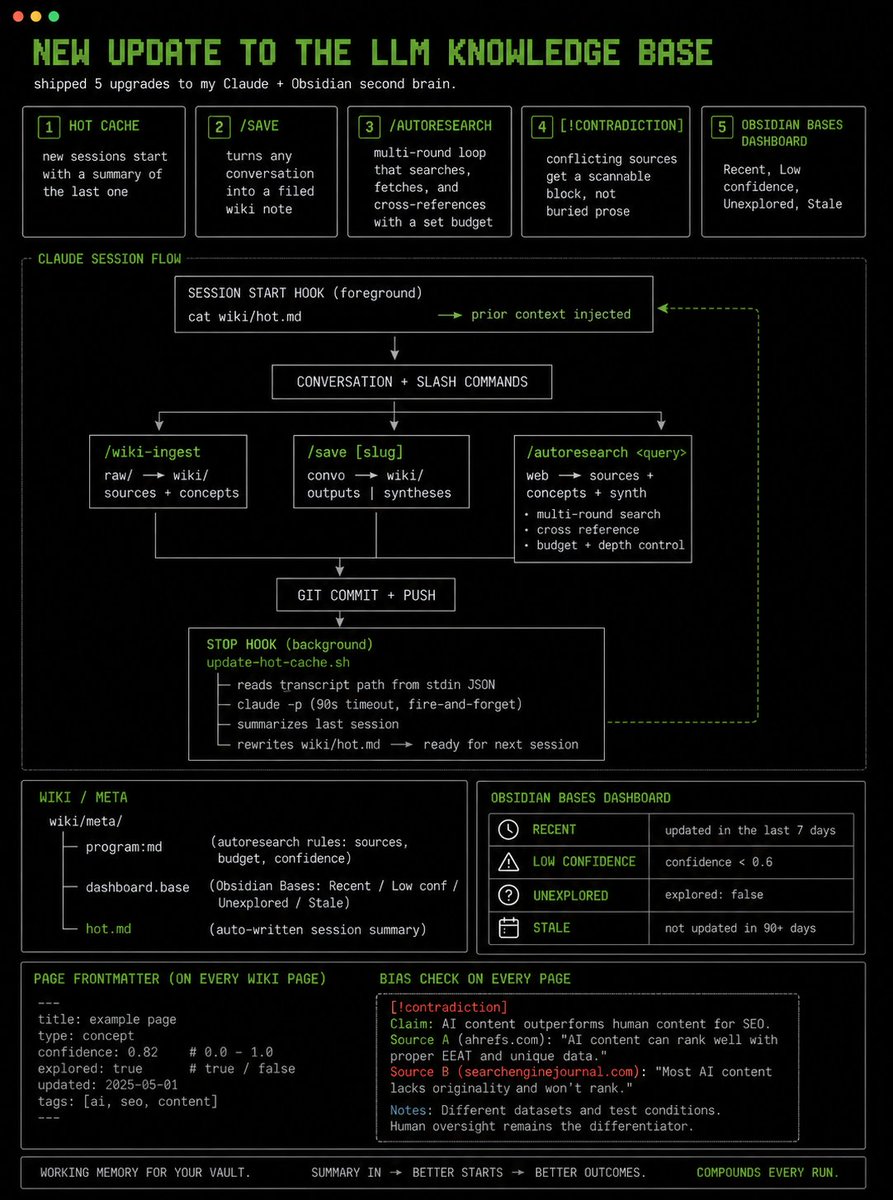
Here's a simple loop: Tell codex to maintain your repos, wake up every 5 minutes and direct work to threads. That makes it easy to parallelize+steer work as needed.
I use a orchestrator skill combined with my triage+autoreview+computer use skills, so some work can land autonomously. https://t.co/FbBoJTIcfd
https://t.co/8389roVnOm
Here's the instructions on how to get an older version of OpenClaw to use Claude Fable 5 using API key properly - paste this into your Claude Code instance operating on your openclaw.json.
Apply the fable-5 adaptive-thinking hotfix to OpenClaw's dist.
Context: On 2026-06-10 Anthropic flipped claude-fable-5 to require adaptive-thinking params (thinking.type:"adaptive" + output_config.effort) and now rejects the legacy thinking.type:"enabled"/"disabled" style. OpenClaw hardcodes its adaptive-model list in the dist and doesn't know fable-5, so every fable-5 turn errors. The dist lives in the ephemeral container (/app/node_modules/openclaw/dist) and is wiped on rebuild.
Steps:
1. Run cd /data/.openclaw/workspace && node scripts/patch-fable5-adaptive-thinking.mjs. It's idempotent — it patches only if the marker is missing and exits 1 if anchors are gone.
2. If the script is missing, recreate it: it edits TWO dist files (anthropic-*.js and provider-stream-*.js, find by grepping for supportsAdaptiveThinking) with TWO fixes each: (a) append || modelId.includes("fable-5") || modelId.includes("fable5") to the adaptive-model classifier (the line matching modelId.includes("sonnet-4-6") || modelId.includes("sonnet-4.6");), and (b) guard the thinking-off path so params.thinking = { type: "disabled" } is only sent when !supportsAdaptiveThinking(https://t.co/cVYIBnGDOq) — omit the param entirely for adaptive models (sessions with thinking:off stay bricked otherwise; /new doesn't clear the override).
3. If it reports MISS (anchor not found), OpenClaw was updated and the dist layout changed — grep the new dist for supportsAdaptiveThinking and re-derive the anchors; or check whether the new build already classifies fable-5 as adaptive, in which case delete the script + the fable5-adaptive-thinking-patch-rearm cron job.
4. Restart the gateway to load the patched dist
A good example of predictive AI from the Waymo Driver: in a split second, it predicted an initial crash of human-driven cars in the next lane, anticipated a secondary collision, and proactively shifted lanes — all while managing its distance from the vehicles around it.
OK, the AI features are almost wholly aimed at consumers who don't know what an OpenClaw or Hermes is. Or have tried the new @TownAI, @wabi, or @interaction's Poke.
It touches very lightly on things that could take away people's privacy. Like looking at your screen. Others, like @FarzaTV's Clicky or @cluely dive deeply into that side of the pool that Apple is afraid of popping in.
Very few words about glasses, or Apple Vision Pro. This was all about a rebuilt Siri. Which is great for everyday users (most of my family and friends who aren't in AI world will be thrilled to get them).
Watching it I realized just how far ahead of the world X's AI community is. If you want to get ahead, follow everyone here: https://t.co/9eRY65x3IQ
And I'll have my AI write up a report from all that at https://t.co/8L5xphk0qQ
Mac-1 6.6B searching files on my Macbook with 10/10 accuracy.
Mac's Finder and Spotlight are broken and painful to use.
I have 650GB of data on my Mac, and it's all scattered. I can't find files manually.
Now I ask Mac-1 to find any file (PDF, JSON, PNG, DOC, etc.), and it finds it in 2–4 seconds.
Just amazing.
To get early access to Mac-1, join the waitlist: https://t.co/nlGyQEEpUE
NVIDIA QUIETLY DROPPED A $249 BOX THAT REPLACES YOUR $200/MONTH OPENAI SUBSCRIPTION WITH $2 IN ELECTRICITY
it's called the jetson orin nano super. smaller than a wallet, runs at 25 watts, does 70 trillion ai operations per second. runs llama 3, mistral, gemma and deepseek locally with no api fees and no data leaving your house
a developer running automations and coding assistants pays $200 a month to openai. the same workload on this box costs $2 a month in electricity and breaks even in 10 weeks
install ollama with one command. change one line in your code. point it at localhost instead of openai. everything else works identically
7 billion parameter models handle 80% of what people use chatgpt for. summarization, drafting, coding, document q&a, automation pipelines. total monthly cost drops from $200 to $22
cloud subscriptions keep getting more expensive and rate limits keep getting tighter. the people who set this up in 2025 are going to look very smart in 2027
bookmark this and read the article below
Today we reduced headcount by 22%. The business is the strongest it's ever been. So I think it's important to be direct about what I'm seeing and why.
First, I made this decision and I own it. I did it because the way to operate at the highest level of productivity is changing, and to win the future, ClickUp needs to change with it.
Second, this wasn't about cutting costs. Most savings from this change will flow directly back into the people who stay. We'll be introducing million-dollar salary bands. If you create outsized impact using AI, you'll be paid outside of traditional bands.
Most importantly, I have the deepest gratitude for those affected. We're doing this from a position of strength specifically so we can take care of people properly. Everyone affected receives a package aimed at honoring their contributions and easing the transition.
I only see two options: wait for this to play out gradually in the market or be honest about what I'm seeing and act proactively.
THE 100X ORGANIZATION
The primary change is that we're restructuring around what I call 100x org. The goal is 100x output. The roles required to build at the highest level are fundamentally different than they were a year ago.
Incremental improvements to existing systems won't get us there. We need new ones. That means creating enough disruption to rebuild rather than iterate on what's already broken.
The common narrative is that AI makes everyone more productive. It doesn't. Many of the workflows of today, if left unchanged, create bottlenecks in AI systems.
These roles will evolve. But waiting for that to happen naturally means falling behind now.
The 100x org is actually heavily dependent on people - infinitely more than today. This is only possible with 10x people that have embraced and adopted new ways of working.
THE BUILDERS, AGENT MANAGERS, AND FRONT-LINERS
— THE BUILDERS: 10X ENGINEERS
I don't think most companies have internalized what's actually happening with AI in engineering. The common narrative is that AI makes all engineers more productive. That may be true in isolation, but at an organization level - that is the farthest thing from reality.
Here's what we've validated recently at ClickUp: the great engineers, the ones who can orchestrate, architect, and review, are becoming 100x engineers. They're not writing code. They're directing agents that write code. The skill is judgment.
AI makes the best engineers wildly more productive, and everyone else using AI slows these engineers down.
Think about it - the bottlenecks are (1) orchestration - telling AI what to do, and (2) reviewing - what AI did. Everything is leapfrogged and no longer needed.
So who do you want orchestrating and reviewing code?
And how do you want your best engineers to spend their time?
If your best engineers are spending time reviewing other people's code, then this is inherently an inefficient bottleneck. These engineers can review their agent's code much faster than reviewing human code.
The new world is about enabling your 10x engineers to become 100x.
The wrong strategy is to push every engineer to use infinite tokens. Companies doing this are celebrating 500% more pull requests. But customer outcomes don't match the volume of code being generated.
I call this the great reckoning of AI coding, and every company will face this soon if not already.
More code is just another bottleneck to the best engineers, and ultimately to your company's impact as well.
— THE BUILDERS: 10X PRODUCT MANAGERS
Product management and design roles are merging.
Designers that have customer focus, become more like product managers.
And product managers that have intuition for UX become more like designers.
The bottleneck of user research is gone. It takes us just one mention of an agent to kickoff research and analyze results.
The bottleneck of product <> design iteration is also gone. The product builder iterates on their own, along with agents and skills that ensure alignment with quality and strategy.
Also controversial today - I believe that the wrong strategy is to have your PMs shipping code - that just introduces another bottleneck that the best engineers will waste their time on.
To be clear, PMs should be coding but they should do this in a playground to iterate, validate, and scope. That code should not go to production.
Everything outside of managing systems, orchestrating AI, and reviewing output becomes a bottleneck.
That's why the other roles that are critical along with these are the systems managers (to reduce bottlenecks) along with a bottleneck you can't replace - customer meeting time.
— THE SYSTEM MANAGERS
Ironically, the people that automate their jobs with AI will always have a job. They become owners of the AI systems - agent managers. We have many examples of these people at ClickUp.
The underlying systems in which we operate are absolutely critical to get right. I think most companies are delusional to think they can iterate on existing systems and compete in this new world.
You must create enough disruption so that old systems are deprecated entirely. If there's any definition for 'AI native' that's what it is.
— THE FRONT-LINERS
In a world that will become saturated with AI communication, the human touch will matter more than anything to customers.
This is a bottleneck that you shouldn't replace - even when agents are high enough quality to do video meetings.
One-on-one meeting time with customers is something that shouldn't be automated. The systems around the meetings should be - so that front-liners spend nearly 100% of their time with customers.
REWARDING 100X IMPACT
In a world where companies are able to do so much more with less, where does that excess money go?
In our case, much of the savings in this new operating model will flow directly back to those that enabled it.
We must reward people that create productivity accordingly. This aligns incentives on both sides. Plus, in a world where your best people create 100x impact, you can't afford to lose them.
You should aim to retain these employees for decades. The context they have and their ability to efficiently orchestrate and review will be nearly impossible to replace.
Compensation bands of today should be thrown out the door. We're introducing $1 million cash/year salary bands with a path available to nearly everyone in the company if they produce 100x impact by creating or managing AI systems.
THE FUTURE
Nearly every company will make changes like these. The ones that do it proactively will define what comes next.
The future is not fewer people. It's different work, new roles, and better rewards for those who embrace it. We're already seeing entirely new roles emerge, like Agent Managers, that didn't exist a year ago.
ClickUp is positioning to lead this shift, not just internally, but for our customers too. I've never been more certain about where we're headed.
We are living through the Apple II moment for AI, and people reading this will be some of the people who create the personal AI for billions of people for decades from now.
I want to be one of them. I want you to be one of them with me!
In the next version of Claude Code: run /usage to see a breakdown of which Skills, Agents, MCPs, and Plugins are using your tokens
CLI today, coming to Desktop next
There is a transition here for people across the workforce: the working world needs fewer measurers and more builders
More revenue means there will be more activity and more building, and in the shorter term less measuring
Shopify has figured out what makes AI work inside of companies. This is exactly what I've been doing at my companies since OpenClaw came out. Get a bot in Slack for team usage in public channels and it'll feel like the future.
🚨 OPEN SOURCE AI IS LITERALLY UNSTOPPABLE 🚨
The legendary founder of Redis (Antirez) just dropped ds4 - a custom native inference engine built specifically for DeepSeek v4 Flash
This is earth shattering! Here is why:
DeepSeek v4 Flash is a quasi-frontier model with a massive 1M context window
You can now run it LOCALLY on a 128GB Mac using specialized 2-bit quantization
The architecture is reimagined—he moved the KV cache from RAM directly to the SSD disk! 🤯
We already know DeepSeek v4 Flash is insanely good for agentic loops - Now you don't even need the cloud to run it
Closed-source labs are burning tens of billions on massive GPU clusters while single brilliant developers are running frontier-level AI on laptops!
They told us open-source would be worthless against trillion-dollar monopolies
Instead, pure hacker culture + incredible open-weight models are completely rewriting the rules
Open Source will ALWAYS win 💕
Hermes Agent now has @Hyperframes_ skill, natively
a close collab with @NousResearch
One-line install
$ hermes skills install hyperframes
X post -> 30s explainer
A PDF -> walkthrough vid
A repo -> launch reel
make your Hermes Agent your video editor
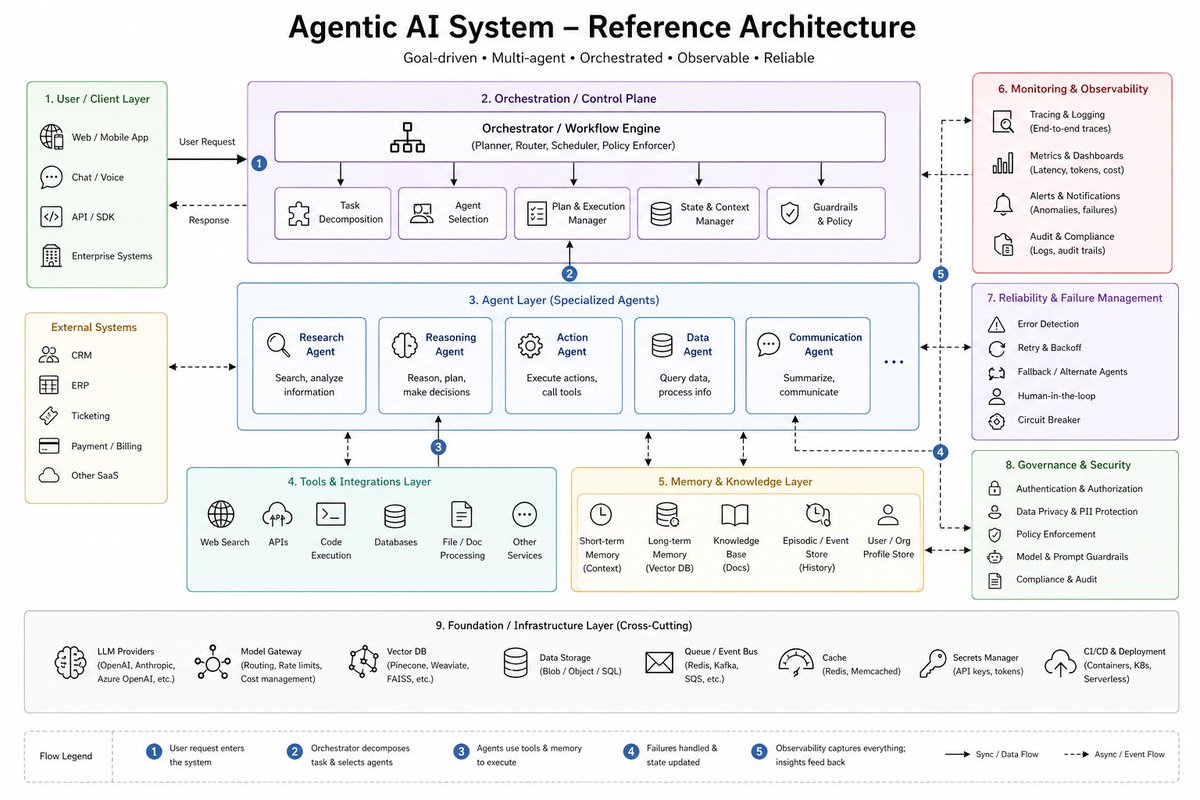
After reading @AnthropicAI blog on Agentic AI. spent some time to create a mental model to understand how to design, and explain Agentic AI architecture
Define a task/goal - what you want agent to do achieve?
1. Orchestration layer : it is your control panel
3. Agents layer: this layers made of agents (multi /specialised)
4. tools: your tools are made of this layer (web search, DB, APIs etc)
5. memory: this is the brain to store information - long or short term etc.
6. monitoring : This is the most crucial to monitor each and every step
7. Reliability & failure management: identify errors, retry, fallback, involve human
8. Governance and security: compliance, audit, auth etc.