Advocate of the High Court of Kenya|| Tech law || Politics || Entrepreneur||Researcher|| Christian||Technocrat|| Private Law ||Insurance Law || THIGOH GLOBAL ™
"This court recognizes that there exists relationships where couples cohabit with no intention whatsoever of contracting a marriage... As such, courts should shy away from imposing ‘marriage’ on unwilling persons."
https://t.co/yW0i6Xbw3m
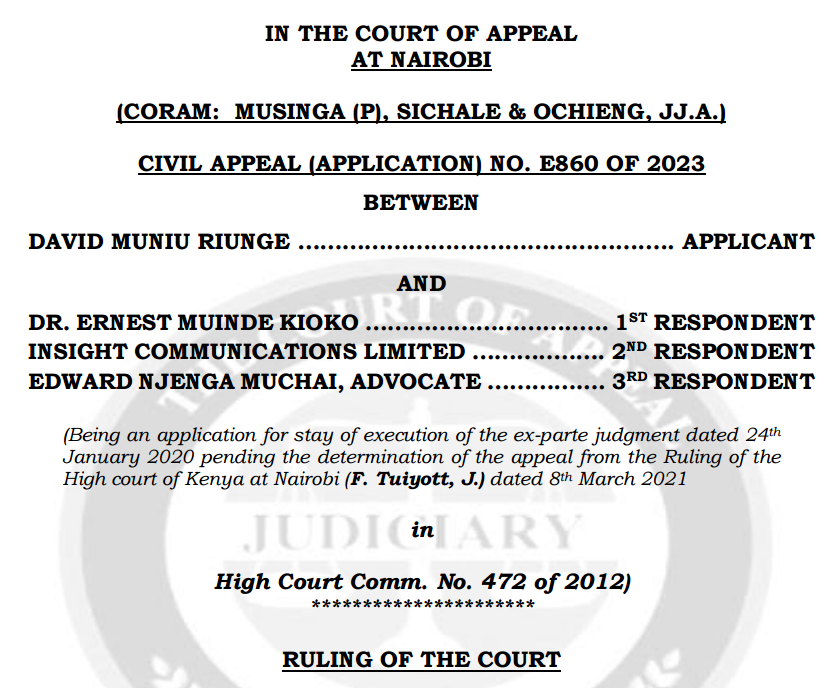
DAVID RIUNGE v DR. KIOKO
CIV APPEAL (APP) E860/2023
Stay of execution pending appeal may be granted where execution involving committing the Applicant to Civil jail would render the appeal nugatory because loss of freedom cannot be adequately compensated if the appeal succeeds.
Law students, I won’t say you are ignoring my posts, but the silence is getting a little too loud. Here is a judgment from the Environment & Land Court.
Court emphasizes threshold for proving adverse possession
John Otieno Obade & 299 Others & 10 Others v Kirima & 60 Others (Environment & Land Case Civil Suit [1257] Of [2014] & 252 Of [2011] & Environment & Land Case 509 & 850 Of [2014] & [1496] & [1318] Of [2013] (Consolidated)) [2023] KEELC 20868 (KLR)
Full judgment: https://t.co/196cfkQwt1
Brief facts
This case, commonly referred to as the Kirima Land Case, involved the consolidation of six suits related to disputes over land parcels Nos 5908/8 and 6852/2, which were registered in the name of the late Gerishon Kamau Kirima.
In ELC Suit No 1257 of 2014 (O.S.), John Otieno Obade, on his own behalf and on behalf of 299 others, sought, among other things, a declaration that they were the rightful owners of a portion of L.R. No 6825/2, known as Kirima Njiru Farm, measuring 80 acres and located in the Njiru area of Nairobi City County.
In ELC Suit No 252 of 2011 (O.S.), the Kamatuto Self-Help Group, consisting of 1,310 people, sought a permanent injunction to restrain the defendants from trespassing on and demolishing their houses, which were built on 160 acres of L.R. No 5908/8. They also asked the Court to declare them entitled to the 160 acres of land they occupied.
In ELC Suit No 509 of 2014, the plaintiffs claimed they were the beneficial owners and occupants of a parcel of land in Njiru District, commonly referred to as Naridai Muoroto Scheme, which the Government of Kenya owned through the County Government of Nairobi. Initially comprising 215 people but growing to 2,000, the plaintiffs, who had been landless, stated that between 1990 and 1994, the government settled them on the 500-acre property, where they acquired squatter rights. They sought a Court declaration of their exclusive and unimpeded right to possess and occupy the land.
Geoffrey Mungai Thiong’o, the 8th defendant in ELC Suit No 509 of 2014, denied the plaintiffs’ claims, arguing that he was the beneficial owner of the land, having purchased it from the late G.K. Kirima. He asserted that the land was privately owned, contrary to the plaintiffs’ claims.
In ELC Suit No 1496 of 2013, the plaintiffs, as administrators of the estate of the late Gerishon Kamau Kirima, claimed that L.R. No 5908/8 belonged to the deceased’s estate. They alleged that the defendants had trespassed on the property without their knowledge, consent, or authority. They sought orders restraining the defendants from further trespassing and requiring them to remove any illegal structures and building materials placed on the property.
Similarly, in ELC Suit No 1318 of 2013, the plaintiffs, also administrators of the estate of Gerishon Kamau Kirima, claimed that L.R. No 5908/8 was part of the estate they were administering. They sought to bar the defendants from trespassing on the land.
Finally, in ELC Suit No 850 of 2014, the plaintiff claimed ownership of L.R. Nos 5908/679, 680, and 681 in the Njiru area, having purchased the properties from the late G.K. Kirima between 2007 and 2010 following the subdivision of L.R. No 5908/8. He asserted that he had been issued with original deed plans for the properties and had taken possession, securing them with a barbed wire fence.
Issues
i. Whether the applicants had established a case for adverse possession.
ii. Whether Naridai Self Help Group had a valid interest in the portion of land referred to as Naridai Muoroto Scheme owned by the Government of Kenya through the County Government of Nairobi.
iii. Whether the applicants were entitled to the reliefs sought.
iv. Who was to bear the costs of the case.
Holding
1. The plaintiffs in ELC Suit No 1257 of 2014 (O.S.) had failed to tender evidence as to when and how each of them entered the suit property and which portion of L.R. 6825/2 they were occupying. To prove adverse possession, they should have provided evidence indicating when each of them entered the suit property, how they entered thereon, and which part of the property they occupied.
2. In the absence of a specific year or date when each of the claimants entered the suit property, it was not possible to determine whether each of the plaintiffs in ELC Suit No 1257 OF 2014 (O.S.) had been in occupation for the 14 years as claimed.
3. The plaintiffs in ELC Suit No 1257 OF 2014 (O.S.) had thus failed to establish adverse possession and were thus not entitled to the orders they sought.
4. In relation to ELC Suit No 252 of 2011 (O.S.), the Court too found that there was no evidence that each of the 1310 of Kamatutho Self Help Group had occupied the suit property for a period of 12 years as of 2011 when that case was filed. The Court also found no evidence that each of the members of the said Self-Help Group was in occupation of the suit property, more specifically, the 160 acres that they were claiming.
5. The applicants in ELC Suit No 252 of 2011 (O.S.) had, therefore, failed to prove adverse possession and were thus not entitled to the reliefs sought.
6. In ELC Suit No 509 of 2014, the Court found that the evidence on record had indicated that the portion of land referred to as Naridai Muoroto Scheme was part of L.R. No 5908/8 measuring 499 acres that was owned by the late G.K. Kirima and John Gerishon Kirima. The said land was, therefore, not available for allocation to the plaintiffs therein either by the Government of Kenya or by the then Nairobi City Council.
7. The Court issued the restraining orders sought in ELC Suit No 1496 of 2013 in favour of the estate of the late G.K. Kirima and as against the defendants who were members of Naridai Self Help Group since the said defendants had failed to establish their claim as set out in ELC Suit No 509 of 2014.
8. In ELC Suit No 1318 of 2013, the Court found that the defendants had not acquired a valid title to the portion of the suit property that they had occupied and which they were developing since the Naridai Self Help Group that had donated that land to them had not acquired any valid title thereto which they could donate.
9. The defendants in ELC Suit No 1318 of 2013 were, therefore, trespassers with respect to the land they occupied and had no right to continue possession.
10. In ELC No 850 of 2014, the Court found the plaintiff to have proved that he validly bought the parcels of land in question from the late G.K. Kirima and was, therefore, entitled to a peaceful occupation and enjoyment of the same.
ELC Suit No 1257 of 2014 dismissed with costs and the plaintiffs in possession given until December 31, 2023, to vacate; ELC Suit No 252 of 2011 dismissed with costs; ELC Suit No 509 of 2014 dismissed with costs and plaintiffs given until December 31, 2023, to vacate; Teresia Wairimu and Anne Wangari Kirima as administrators of the deceased’s estate directed to within 90 days complete the sale of various parcels of land to named defendants in ELC Suit No 509 of 2014; each party in ELC Suit No 509 of 2014 to bear its own costs.
The 2025 High Court judgment in Muhanda v LP Holdings Ltd, delivered by Lady Justice Helene Namisi, has clarified the jurisdiction of landlord-tenant disputes in the #SmallClaimsCourt. It overturns parts of the 2022 precedent set by the late Justice David Majanja in Christoffersen v Sehmi. Let me explain
In Christoffersen, Justice Majanja ruled that claims for rent arrears were outside the SCC's jurisdiction. This was because rent wasn't considered a "contract for goods/services" or "money held and received" under Section 12(1) of the Small Claims Court Act. He was of the strong opinion that courts can't stretch their jurisdiction on account of innovation by litigants.
However Justice Namisi, in Muhanda drew a crucial distinction: Rent arrears are still outside the court’s jurisdiction but refund of rent deposits is a "contract for money held and received" and within the SCC's scope. This means that the Small Claims Court can now listen to refund disputes, provided they fit the "money held and received" category as these are post-tenancy disputes.
The judgment validates what I've said before; that the law in Small Claims Court is not set in stone and even the strongest precedents can be revisited in light of fairness and clarity. But it takes lawyers who refuse to abide by the fallacy of "the law is very clear" or the "law is settled" to make it happen.
Court has ruled that state corporations can be garnished. Courts can now direct that money held by third parties (usually banks) be seized to satisfy a debt owed by a state corporation.
This means that if a state corporation, such as a pension fund or the National Bank of Kenya, owes you money, and you know the bank where they hold their accounts, you can initiate garnishee proceedings against them. This legal process and order would allow the bank to transfer the owed funds directly to you from the corporation's account, ensuring you receive payment.
This marks a significant shift, allowing creditors to recover debts owed by these entities, which were previously shielded by government immunity. The decision, which aligns with principles of accountability and financial responsibility, means that state-owned firms can now face the same legal consequences as private businesses for failing to meet financial obligations. This could influence how state corporations manage their liabilities and debts moving forward.
I've seen opinions saying Dr Khaminwa needs to exit law now owing to today's activities and events. My view is rather different, the spectre of what we saw today is underlying a bigger problem. That of the use of SENIORITY TO BASTARDIZE & GET AWAY with it. Be sure that the one to which it was done-SC GITHU does it all the time to the Young Counsel & so are the condescending comments of seniors like Wanyama to the Young Counsel on this app and in court. I've seen them. I don't begrudge Senior Khaminwa, he has his place in Kenyan Legal History, equally SC Githu & others who have contributed tremendously to our Jurisprudence.
My Plea is one. If the power we exhibit always flows from the AUTHORITY of our ABRASICENESS with juniors, then we are weak. It should be that when I meet and talk to a senior, the respect is NATURAL not coerced by virtue of years as is now.
That I cannot speak because I didn't begin practice in 1977 or I've not began at all is a FALLACY in this Era
Comments made by SC Ojienda today like 'because 'we' are the only Prof/SCs here the argument must be correct' are good jests but they mirror the CLAIM OF MONOPOLY of legal knowledge which is antithetical to the design and Fibre of the Law itself.
What happened today must not happen again if Honour is to be ascribed to the Legal Profession. The difference is that if happened among seniors who see other seniors as juniors, how much more BULYING happens to the very juniors, yes real juniors if that was Prof Githu SC.
Village boy.
Signed & dated.
How to Attach and Freeze a Bank or Mpesa Account of Your Debtor: The Garnishee Process
The garnishee process is a legally recognized and efficient method of enforcing a judgment, allowing you to recover debts owed by a judgment debtor by targeting the debtor's financial assets. This process is only available once judgment has been entered in your favour, and you have reached the execution stage of the judgment.
Typically, the most common form of executing a judgment involves attaching the movable property and assets of the debtor through auctioneers. However, an equally effective and often swifter method of execution is provided for under the law, known as Garnishee Proceedings. This method allows creditors to compel financial institutions that hold funds for the debtor—such as banks, microfinance institutions, or mobile money platforms like Mpesa—to disclose and release those funds to satisfy the debt.
To initiate garnishee proceedings, you will file an application under a certificate of urgency, requesting the court to attach the debtor’s financial accounts. It is advisable to first seek ex parte interim orders—which means that the application is heard in the absence of the debtor—asking the court to issue a garnishee order nisi. This initial order freezes the debtor’s accounts, preventing any withdrawals or transfers. You must catch them unawares.
Once the garnishee order nisi is issued, it should be served on the headquarters of the bank or financial institution holding the debtor’s funds. The bank will freeze the account within hours of receiving the order. You will also serve the institution with a Hearing Notice, requiring them to appear in court to disclose the balance and the statements of the debtor’s accounts.
At the hearing, the court will review the matter and, upon satisfaction, issue a garnishee order absolute, directing the financial institution to release the attached funds to you. The court will also give directions regarding the costs of the proceedings, ensuring that the debt recovery process is not only effective but also expedient.
This method is particularly useful for creditors seeking a direct and straightforward means of recovering money owed to them, bypassing the often cumbersome process of attaching movable assets by way of auction.
Conservatory order issued staying the resolution by the Senate impeaching the Deputy President of Kenya and the appointment of his replacement, until October 24, 2024.
https://t.co/dypPYofDkb
If you need to recover rent arrears from an ex-tenant or security deposit from an ex-landlord using the #SmallClaimsCourt, the decision in Ng’ang’a v Matheri https://t.co/Tuv8xlsTkQ is godsend.
Hint: Get an acknowledgement of the debt before filing your claim.
I've analyzed 7 of the petitions surrounding the impeachment of Deputy President which have raised questions on procedural fairness, public participation & legal thresholds. If these issues aren't addressed, Kenya could face a significant constitutional crisis. Let me explain🧵
OVER-SPENDING! Not insufficient tax!
Stop what you are doing and watch this video.
Then retweet widely.
Ruto must watch it.
Your MPs must watch it.
Raila must watch it.
Your friends must watch it.
#OccupyParliament Jimi Wanjigi Nuru Okanga JKUAT China Pritty Vishy
I once successfully defended a case where employees of a local bank were hurriedly arrested and charged in court for theft of funds. Often, this particular bank pins theft to employees for insurance compensation even when there is no cogent evidence. They mask the fact that their core IT system is deeply vulnerable and susceptible to hacking by experienced IT folks. They blame employees but dont want to follow the paper-trail. When money gets stolen, it is channelled to other banks and withdrawn.
In Kenya, you can't open a bank account without documentation. Therefore, it is easy to trace back the theft by tracing the beneficiaries . In my case, bank, Banking Fraud simply refused to follow up the beneficiaries and crack the case. It arrested one of the beneficiaries in Eldoret when he was making a last substantial cash withdrawal, but when he jumped bail-they didn't bother to enforce the warrants of arrest. On this basis, I asked the magistrate to acquit the bank employees.
Therefore, when I see IT related theft being reported in the media and it runs into billions, I just laugh. There is a lot that goes on behind the scene; cover up, shoddy investigations, and camouflage of the actual beneficiaries of the theft. But I pity insurance companies that are eventually asked to make the compensation.
My brother @quincygitahi unfortunately power corrupts morals and everyone has a prize tag around their neck. The president recently unlocked a new theory, get the main seat first, then buy off the MPs to create a strong majority that'll support your agenda however toxic.
The president has very little power without parliament. We must ensure the next house is filled with fresh radical blood. Any ill agenda by whoever will be president must fail. I once told this to @gichaga_kingori
High High court declares that the entire Social Health Insurance Fund Act, 2023; Digital Health Act, 2023 and Primary Health Act, 2023 are all unconstitutional, in (Constitutional Petition E473 of 2023) [2024] KEHC 8255 (KLR). Read more in https://t.co/sdr1Qao9pr
Folks,
The much awaited Supplementary Budget I 2024/25 has dropped.
Now that Finance Bill 2024 was withdrawn, focus has shifted to the much talked about budget rationalisation to align the 2024/25 spending plan with the downgraded revenue forecast.
The Supplementary Estimates have been transmitted to the Clerk of the National Assembly, see quoted tweet.
A 🧵
This video of Crystal Asige should be the Most Shared video in the whole of Africa. How on Earth does Senator Crystal Asige Shares the same floor withe the likes of Karen Nyamu?
This should be TRENDING!