Author 'TWILIGHT OF AMERICAN SANITY, A PSYCHIATRIST ANALYZES THE AGE OF TRUMP'
'SAVING NORMAL'
Chair, DSM-IV Task Force.
Former Chair, Duke Dept of Psychiatry
"Know Thyself".
Countertransference is also a problem/opportunity in every form of therapy.
Major reason for dropouts/ stalemates/bad outcomes.
I recommend all therapists have at least some personal therapy to shed light on their blind spots/protect their patients from them.
'Transference' is problem & opportunity in every form of therapy.
Different schools describe it with local jargon/suggest different techniques for managing it.
Every therapist, regardless of orientation, must recognize transference/have skills to make it an asset,not liability.
'Transference' is problem & opportunity in every form of therapy.
Different schools describe it with local jargon/suggest different techniques for managing it.
Every therapist, regardless of orientation, must recognize transference/have skills to make it an asset,not liability.
How to say you're doing transference work without saying you're doing transference work:
"in DBT, therapy-interfering behaviors are not considered to be obstacles to be avoided... 👇👇👇
@AllenFrancesMD@DrGipps@DrWinarick
Steve's optimism is right on- self-destructive perfectionism is one of the best targets of psychotherapy. Learning that the excellent is the enemy of the good enough brings liberation from that punishing inner voice. Repeated 'corrective emotional experiences' seal the deal.
For some people it quiets significantly. For others it persists but loses its authority. Both outcomes are genuinely possible, and both are worth something.
What tends to change most reliably is not the presence of the voice but its grip on your behavior. How much it decides what you try, what you say, what you let yourself want. That shift, from a voice that runs your life to a voice that's just part of the background, is significant enough to be worth pursuing regardless of whether it ever fully goes quiet. In my experience with both research and practice, that shift is available to almost everyone who works at it genuinely.
What would you want to ask? Write it in the comments below.
#psychologicalflexibility
#ACT
#ACTtherapy
"Social Media" is better labelled "Antisocial Media" for all the harms it does.
Important for all clinical assessments to include possible role in creating/worsening/perpetuating psychiatric symptoms.
Excellent brief summary;
How does social media affect #mentalhealth, & what should clinicians be paying attention to?
My new paper reviews the core risks, underlying mechanisms, & clinical implications of social media use.
Read more 👇
https://t.co/dGDC72cKrQ
#SocialMediaResearch#DigitalMentalHealth
DSM diagnosis can also be destructive if it:
1)is wrong
2)leads to needless/harmful treatment
3)promotes stigma
4)reduces expectations
5)creates hopelessness
6)has no expiration date
7)is rushed/unempathic
What we therapists need to know about chatbots.
Beware:
1)Chatbots are marketed to replace human mental health clinicians
2)Customers- insurance cos/health systems
3)Chatbots help some patients/seriously harm others
My suggestions how to make chatbots our assistants/not rivals:
New season of the Evolving Psychiatry podcast is starting, released every Sunday, 12 episodes in the works! Kicking off with the renowned @AllenFrancesMD
https://t.co/HVzfKox3vd
Pope Leo is my hero because he provides moral compass re:
1)Dangers of AI
2)Christ loves poor & migrants
3)Disowns Christian nationalists/Hegseth warmongers
4)Trump=false prophet
5)We are custodians of environment/all of God's creatures
6)Love not Hate https://t.co/DdO6brVc0W
I have long been disgusted by the autism industry. The massive fraud described in this article is straight out stealing medical & mental health services from kids. https://t.co/eWkrzqEdOI
I recommend coin flips to rumminators who cant make decisions
Why?
1)50/50 questions torture most
2)If there were clear right answer answer they'd know it
3)Deciding usually works better than ruminating
Exceptions: People contemplate self-destructive & impulsive acts.
My personal truths as a clinical psychologist:
#278 Rumination often disguises itself as problem-solving.
*A lot of people think they are “working on” a problem when they are really just stuck inside it.
They replay the argument in the shower. Rehearse conversations while driving. Lie awake at 2 a.m. trying to finally “figure it all out.” They call it thinking, but a lot of the time it’s really anxiety searching for certainty that isn’t there.
Real problem-solving usually moves you somewhere: toward a decision, a conversation, a plan, or acceptance. Rumination just loops endlessly. Same thoughts. Same fears. Same emotional drain.
You can see it after breakups, embarrassing moments, medical scares, political arguments, or parenting mistakes. The mind keeps insisting, “If I go over this one more time, maybe I’ll finally feel okay.”
But replaying the same thoughts rarely brings relief. More often, it leaves people feeling more helpless, ashamed, resentful, or afraid.
Sometimes the healthiest response is not more thinking. Sometimes it’s sleep. A walk. A phone call. Action. Prayer. Letting uncertainty exist without treating it like a crisis.
At some point, you have to stop interrogating the thought and start returning to your life.
Finding: Healthy people who use chatbots a lot were not harmed by them.
Not that reassuring because of folie-a-chatbot: (suicidal/psychotic/anorexic symptoms triggered de novo or in patients with pre-existing psych disorder.
Include chatbot use in all differential diagnoses.
Psychotherapy integration into 1 unified whole has failed.
Instead 50 different techniques compete with each other.
Bad for patients/limiting for therapists/freezes field in past.
Competion from chatbot therapists forces us to up our game.
Here's how:
https://t.co/bTHJvONFuW
De-diagnosing is even harder than deprescribing.
Once on chart, wrong diagnoses haunt patients for life & cause wrong treatments/reduced expectations/stigma/dumb polydiagnosis.
I wish psychiatric diagnoses could be written in pencil- much better to under than over diagnose.
Deprescribing is:
1) the only fad in psychiatry I have ever supported
2) the only thing RFK Jr ever got right
3) long overdue to overcome the current massive overmedication of the general population & mindless polypharmacy of psychiatric patients.
6 most over-used terms o hate are:
"On the autistic spectrum"
"ADHD"
"A little bit bipolar"
"Trauma-informed therapy"
"Multiple personality"
"Borderline"
Any psych diagnosis or treatment that suddenly becomes extremely popular is a fad likely to do much more harm than good.
I'm appalled how often patient records are littered with wrong/extremely harmful psych diagnoses-& how hard it is to get health systems to remove them.
Too bad diagnoses cant be written in pencil/easily erased.
Lesson: Whenever in doubt under-diagnose or don't diagnose at all.
Doctor burnout begins early in training because hospitals brutally abuse young MDs as slave labor.
Creates culture of overwork/underliving.
Hard to be good doc without hard work, but impossible to be good doc if you're burnt out from working impossibly long hours.
& most are:
Medicine idealizes self-sacrifice.
The expectation is you never turn your back on work.
Overnight call, weekend shifts, responding to messages during your lunch break and documenting at night.
Truth is this ferocious pace is not sustainable or healthy.
Acknowledging this reality does not mean you lack a strong work ethic.
It means you are more than a physician.
You are a human being with additional interests and responsibilities.
Don’t let the system gaslight you into thinking otherwise.
Chatbots provide best window into how humans think.
They are biomimicry creations copying our brain hardware/software/training.
We're both statistical probability machines but with different strengths & weaknesses.
Fascinating stuff (with my grandson):
https://t.co/qDhqNmF5qj
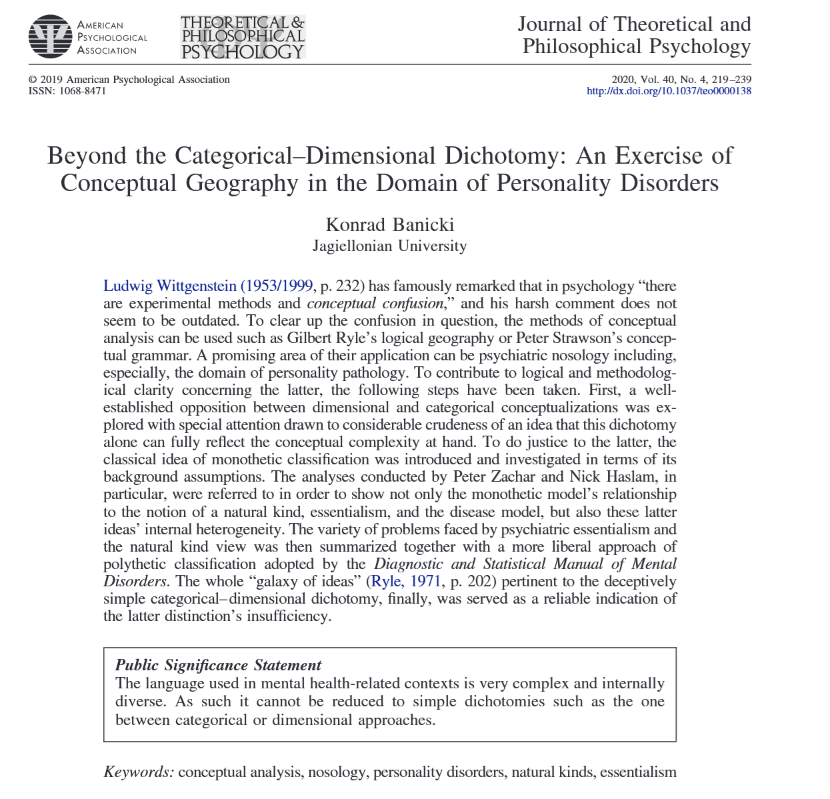
After writing final draft of DSM-III Personality Disorders section, I published a 1980 paper suggesting it should soon be replaced with much more accurate dimensional system.
It hasn't happened yet because:
1) no consensus on which dimensions
2)clinicians think in names/not #s.
In case anybody wants to take a look...
"Beyond the categorical–dimensional dichotomy: An exercise of conceptual geography in the domain of personality disorders"
https://t.co/ywyOFqFKaF
@AllenFrancesMD@awaisaftab@philpsychpsy@aapp_PhilPsych
"Autism" was too narrowly defined before DSM4- rate 1/3000.
We introduced "Aspergers" expecting to triple the rate- instead wild jump to 1/150.
DSM5 introduced "Autism Spectrum"- rate now 1/30.
It is easy to start diagnostic fads/Impossibe to end them once they gain momentum.
@AllenFrancesMD Example of something I feel should be reverted/narrowed: Autisms 1-2-3 vs Aspergers and related "neurodivergencies". Unspectrum the spectrum, and 90% of the illness identity politics go away, if you zoom out.
It's very easy to make mistakes in psychiatric diagnosis/very hard to correct them.
True both on DSM level & with each patient.
DSM6 stupid idea- if done at all should narrow definitions of disorders.
A careless diagnosis made on a patient's worst day can haunt for a lifetime.
@AllenFrancesMD I see this point, and agree, but do make a suggestion: Instead of DSM-6, we should possibly consider deconstructing to DSM-4 or so, and reconstructing anything institutionally compromised about this already. Undo the damage, correct, continue.