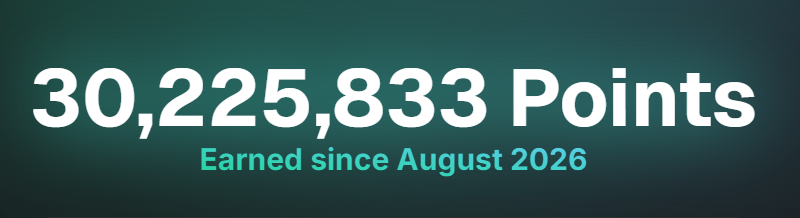
I went from basically zero to 30M+ @xStocksFi points in less than 2 weeks.
The main driver: YT STRCx on @pendle_fi.
I currently hold ~6.7k YT and have spent the last couple of weeks digging into the mechanics, liquidity and point system.
Here’s what I found 🧵
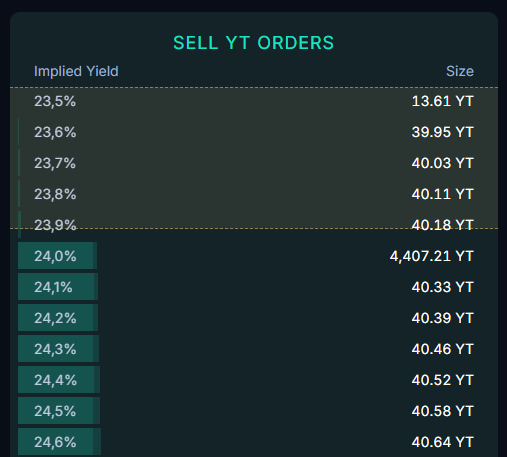
@DuckWeider@xStocksFi@Ondo Sometimes the spread in the order book can be negative due to commissions for market orders, u can read the Pendle help for more information about this. In general, limit orders are triggered instantly when the required counter‑market order arrives
How I’m thinking about a potential @xStocksFi token valuation
The cleanest comp is probably @Ondo.
Ondo is a broader RWA ecosystem, so comparing total TVL directly isn’t fair: roughly $3.8B vs ~$800M for xStocks.
But if you isolate tokenized equities, the picture gets much closer:
• both are around ~$800M in tokenized-stock AUM
• xStocks has a broader stock/ETF catalog
• xStocks also has very strong reported trading volume + deep DeFi integrations
So I don’t think giving xStocks a huge discount to ONDO makes much sense if a token actually launches.
ONDO currently trades around ~$3.9B FDV.
My rough range for xStocks would be:
$1.5–3B FDV
Not because xStocks = Ondo, but because the stock side of both ecosystems is already in a similar weight class.
The bigger question is allocation.
Kraken/Payward will obviously want to retain most of the economics, so I’d expect something like 3–5% of supply for an initial xPoints reward, maybe ~7% on the generous side - not some old-school 20–30% mega-airdrop.
That would imply roughly $50–150M of reward value in my base range.
Now combine that with final Season 1 supply.
My working range is roughly:
~50B xPoints if Dec 16 matters
~80–100B if Season 1 runs into Q1 2027
Funny enough, that keeps pulling the math back toward roughly:
~$1,000 per 1M xPoints
Not a prediction - just a useful central scenario.
At my current YT economics, that would be roughly 5-10x on the point acquisition cost.
Of course the real risks are elsewhere: no token, small allocation, compliance, non-linear rewards, or simply getting nothing and etc.
So yes, there’s hopium here.
But at least it’s hopium with comps and math behind it 😅
If you’re just getting started with xStocks, my referral gives you a 20% xPoints boost:
https://t.co/3jsVyEx85T
Your xPoints balance means very little without the denominator
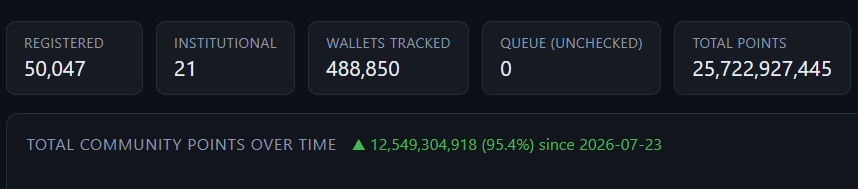
@xStocksFi is currently at ~25.7B total xPoints.
The system is adding roughly 250M points/day now, versus ~225–230M/day on average since late July.
So the emission rate is growing - but not explosively.
If the old Dec 16 Season 1 date ends up being relevant, a simple extrapolation gets us somewhere around 48-52B total points.
If Season 1 gets extended by another ~3 months and issuance grows toward 300-350M/day, we’re closer to 75-85B in March 2027.
That’s why I’m currently using 50–100B total points as my practical range.
And this changes how I look at my own position.
If I end this YT around 300M xPoints, that would represent:
• 0.60% of 50B
• 0.46% of 65B
• 0.375% of 80B
• 0.30% of 100B
Cost per 1M points is useful.
But the more important metric over time is:
cost per share of the final point supply.
That’s the number I’m watching now ✍️
Btw, if you’re just getting started with xStocks, my referral gives you a 20% xPoints boost:
https://t.co/3jsVyExFVr
Why I probably won’t auto-roll into the next YT after this one
I still like my current YT STRCx position @pendle_fi
But I probably won’t blindly roll into the next YT after expiry.
The reason is simple:
The next contract may overlap with the end of Season 1.
If @xStocksFi announces a snapshot / season end / reward structure while that YT is live, the market could reprice the remaining point stream very fast.
And that’s the risk I don’t want to take blindly.
My current plan after this YT:
• move into something more conservative - likely STRCx lending, a small loop, or maybe an out-of-range LP
• keep farming points
• keep xBoost / streak alive
• wait for clarity around Season 1
• only then decide whether the next YT is worth buying
I’m not trying to maximize points at any cost.
I’m trying to maximize risk-adjusted cost per point.
That distinction matters.
How much does 1M @xStocksFi points actually cost?
This is probably the most important question in the whole farm.
Not “how many points can I get?”
But:
How much capital do I need to generate them, and how much money do I actually burn per 1M points?
Because depending on the strategy, the difference is well over 100x.
I ran the numbers across spot, lending, LP and Pendle YT (@pendle_fi).
Here’s the math.
—
First, a few assumptions.
To compare everything on equal terms, I originally modelled an ~83 day farming window.
For the bonus layer I used:
20% referral boost
10% Telegram boost
~1.4x average xBoost over the period
~+100% average contribution from the daily spin
The spin is obviously the least predictable variable here. It can be 0%, 300%, 1000% etc., so +100% is just a working long-term assumption, not a fact.
The point is not to predict the exact final number.
The point is to compare the relative cost of each strategy. And that part gets interesting very quickly.
One important distinction before we start:
📌 For spot, lending and LP, these numbers represent capital deployed — not capital burned. You still own the underlying position.
📌 YT is different because it decays toward zero at maturity.
So I’m comparing capital efficiency first, and then looking separately at the actual net cost of YT.
—
SPOT
Base earning rate is 0.1 xPoints per $1 per day.
Over 83 days:
$1 of capital → 8.3 base points.
After referral + Telegram + average xBoost + my spin assumption, that comes out to roughly 30.7 points per $1 of capital over the full period.
So to generate 1M xPoints passively through spot, you would need roughly:
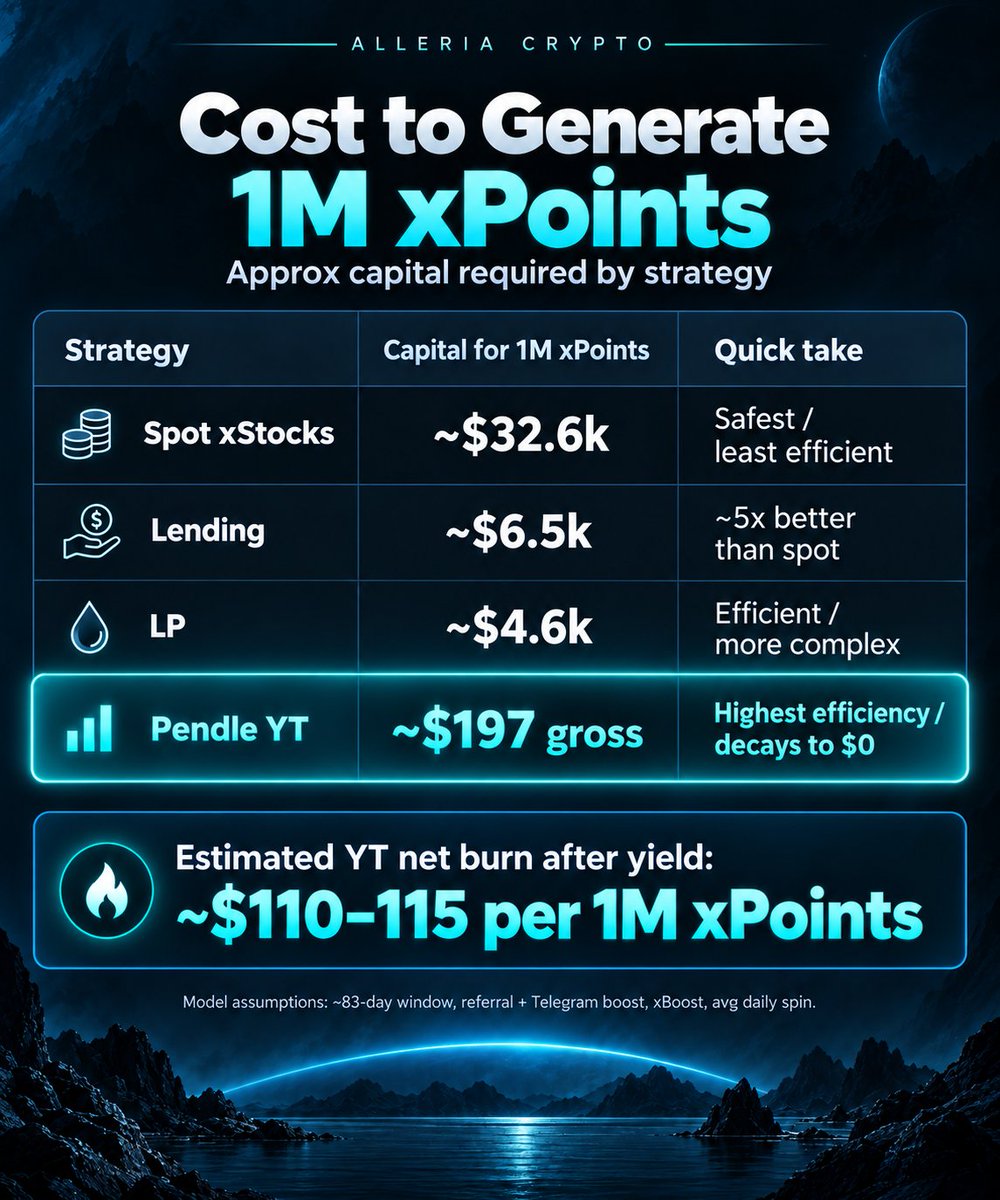
~$32,600 of capital sitting there for the whole period.
Low complexity, low point efficiency. Pretty straightforward.
—
LENDING
Lending gets a 5x multiplier versus spot.
Same assumptions, same period.
So instead of ~$32.6k, you need roughly:
~$6,500 of capital to target the same 1M points.
Already much better.
And if you loop the position, capital efficiency can improve further, obviously with additional liquidation / protocol / leverage risk.
—
LP
Liquidity positions get roughly a 7x multiplier versus spot.
That brings the required xStocks-side exposure down to around:
~$4,600 per 1M points.
Important nuance: that does NOT necessarily mean only $4.6k of total capital.
In a conventional 50/50 LP, total deployed capital would be closer to ~$9.2k, since the other half sits on the paired side. An out-of-range setup can look different.
This can still be very attractive, especially for someone who does NOT want to burn capital in YT.
You also take LP-specific risks: price movement, range management, pool risk, etc.
From a passive capital-efficiency perspective, LP is still one of the better options.
—
Now the fun part.
PENDLE YT.
This is where the math gets stupid.
YT STRCx gives you the yield + xStocks points of 1 STRCx until maturity.
But the YT itself costs only a fraction of 1 STRCx because it decays to zero at expiry.
So you are effectively buying leveraged exposure to the future point stream.
At the time of my original calculation, the stack looked roughly like this:
2x xStocks boost for Pendle
5x because the position is treated as lending
~16.5x effective YT leverage
That is around 165x versus plain spot.
So instead of deploying ~$32,600 in spot to target 1M xPoints over the same window…
the model required only about:
~$197 of YT upfront.
Unlike spot, though, this capital is actually being consumed as YT decays toward zero.
And even that is not the real cost.
STRCx currently distributes yield to YT holders as well.
So part of what you spend on YT comes back through distributions before maturity.
Under the assumptions I was using at the time, roughly 40-45% of the YT spend could come back through yield.
That brings the estimated net burn for 1M points closer to:
~$110-115.
That is the number I actually care about.
Not the headline multiplier.
Not “wow 165x”.
The cost per 1M points.
—
This is also why I personally chose YT.
For context, I currently hold ~6.7k YT STRCx and I’m at 36M+ xPoints.
So I’m not modelling this from the sidelines.
This is the position I’m actually running with my own capital.
And my main metric is still the same:
cost per 1M points.
If that cost becomes unattractive, I stop adding.
If liquidity gives me another unusually cheap entry, I may add.
Simple.
—
Now let’s play with the potential reward side.
This is NOT a prediction. Just scenario analysis.
Let’s assume:
xStocks eventually distributes some kind of reward broadly based on accumulated points.
Let’s also assume a hypothetical $1B FDV, with 5% of the token supply allocated to the initial reward pool.
At that FDV, the initial reward allocation would be worth roughly $50M.
If total xPoints end around 50B:
1M points ≈ $1,000 of reward value.
If total xPoints end around 100B:
1M points ≈ $500.
Now compare that with the rough ~$110-115 net cost per 1M points through YT under my model.
That is why I find the risk/reward interesting.
At 50B total points, that’s roughly 8–9x on the estimated net YT cost.
At 100B, roughly 4–4.5x.
Again: IF the reward exists, IF distribution is broadly linear by points, IF the FDV assumption is reasonable, IF 5% is actually allocated, IF YT is treated normally, etc.
There are a lot of “ifs”.
That’s crypto.
—
And there are real risks.
📌 YT goes to zero at maturity.
📌 The points could end up being worth much less than expected.
📌 The program can be extended.
📌 The final point supply can inflate heavily.
📌 The reward allocation can be smaller than expected.
📌 YT could receive a different coefficient.
📌 There is smart contract risk, protocol risk, liquidity risk and potentially compliance/KYC risk.
I’m comfortable with that personally.
But “high point multiplier” does NOT mean free money.
You are paying for those points.
The whole game is figuring out how much.
—
My current ranking for xStocks farming is pretty simple:
Spot = safest / least efficient.
Lending = much better efficiency without burning YT.
LP = probably the most interesting passive option for larger capital.
Pendle YT = by far the most aggressive and capital-efficient option I’ve found, but you are explicitly spending capital to buy points + future yield.
Different tools for different risk profiles.
For me, YT still wins.
Not because it gives the most points.
Because so far it gives me the best cost per point.
That distinction matters.
I’ll keep posting my real numbers as the position develops: points, xBoost, distributions, YT PnL and eventually the final ROI.
If you’re farming xStocks anyway, my referral gives you a 20% xPoints boost:
https://t.co/3jsVyExFVr
More real-position research soon ⚡ I’ll keep posting the numbers as they come in.
36.7M @xStocksFi xPoints.
+5.7M today. xBoost → 1.2x.
Been working on a deeper breakdown of the math behind farming 1M xPoints across spot, lending, LP and @pendle_fi YT.
Dropping later today ⚡
I went from basically zero to 30M+ @xStocksFi points in less than 2 weeks.
The main driver: YT STRCx on @pendle_fi.
I currently hold ~6.7k YT and have spent the last couple of weeks digging into the mechanics, liquidity and point system.
Here’s what I found 🧵
I’ll keep posting the real numbers: points, dividends, xBoost, Pendle liquidity, cost per 1M points and eventually the final ROI.
If you’re joining @xStocksFi, my referral gives you a 20% points boost:
https://t.co/NAoqGJGTj2
More research soon ⚡
My thesis is simple:
I’m not trying to maximize points at any cost.
I care about the cost per 1M points.
If the marginal cost gets too high, I stop adding.
Right now my initial YT position still looks unusually efficient, so my base case is to keep it simple and let it work.