We understand most early-stage founders don’t have time or money for fancy investor conferences because they’re too busy putting every minute & dollar into building a great product for raving customers.
If you’re this founder, we want to hear from you!
Pitch training has always been the market pushing founders to compensate for investor laziness.
Ultimately, it's the investor's job to recognise potential in the founder and their idea, not the founder's job to sell it to them. The founder is the customer.
And it turns out that pitch training and competitions emphasize a number of factors that aren't predictive of company success.
Generally, the process is a silly distraction from working on the things that matter.
(credit to @dharrisindc for the chart)
A year and a half ago, Blended Blue was just an idea.
This week, the first bottles officially came off the line in Mexico, and the first 400 cases are now headed to California.
Building a consumer brand is brutal. People see the bottle. They don’t see the years of risk, fundraising, logistics, delays, and grind behind it.
Proud to be part of this with my friend Charles Durazo (“Tequila Charles”), one of the co-founders behind Clase Azul.
Now we’re bringing one of the first blended tequilas to market and taking another swing at reinventing the luxury tequila category.
Big thank you to @MattWilsonYYC , @AlliedVC , and an incredible investor group that helped bring this thing to life.
Let’s go.
When raising, remember that you only need one yes.
21/22 VCs passed on the early Anthropic round.
The biggest outcomes are often contrarian, and usually sound ridiculous before the rest of the world catches up.
Class 2 of MS&E 435 - Economics of AI Inference - is live! The Groq story alone was worth the class. Why did Nvidia paid $20B for Groq?
TLDR: It wasn't about building a better GPU. Groq's deterministic, SRAM-heavy chip disaggregated the decode layer. Same power footprint, 2.5x more tokens.
Big thanks to @altcap and @sundeep for doing this with our class.
This 40 minute lecture at Stanford by Apoorv Agarwal on the Economics of AI supercycle is worth a watch
Apoorv is currently a Partner at Altimeter and is directly involved in some of their key AI investments, including OpenAI and Glean
Still find it incredible that the internet gives us access to this level of information directly. A course I will definitely be following along
Sourced from MS&E 435 Stanford University
one of the best sales advice we picked up during YC is the "McKinsey Model"
a lot of deals at early-stage startups die for the same reason:
your champion is afraid to advocate for your product
if they push for it internally and it doesn't work out, their job is on the line
so they never come back to you and hit you with the "we need to align internally first"
that's why you need to be their McKinsey consultant: instead of them pitching, you personally take the blame
after every demo, send them:
- a one-pager
- a security doc
- an ROI calculator with their numbers
- useful context/overview of your industry that can help with what they're struggling with right now
- a pre-written slack message they can forward
make it as easy as possible for your champion to forward your material without them feeling responsible for integrating your solution or "fighting" for it
1/ They’re building something genuinely new.
Not a slightly better version of what exists. A product or service so novel that the competition can’t replicate it — or even understand it.
That gap in comprehension? That’s the moat.
Most companies are building better mousetraps.
A few are starting revolutions.
The difference is worth years of your life.
— Inspired by Tony Fadell, Build
3/ The technology can actually deliver.
Vision is cheap. What matters is whether the tech holds up — not just in the product, but across the infrastructure, platforms, and systems that have to support it at scale.
5/ They make you think: “Why hasn’t anyone said it this way before?”
The framing is fresh. The insight is obvious in hindsight. You feel slightly stupid for not seeing it sooner.
That’s the tell.
2/ They’re solving a real pain point.
Not a VC pitch pain point. An actual problem that real people run into every single day.
And the market for that problem already exists. You’re not waiting for demand — you’re waiting for the solution.
Tony Fadell built the iPod, invented the Nest thermostat, and has backed 200+ startups.
When he talks about which companies are worth your time — you listen.
Here’s his framework for spotting a revolution before it happens: 🧵
Two founders joined our community this month, a week apart.
One bootstrapped a company to $50M+ over 13 years with 300 employees.
The other built a $7.5M company by 24 with brand partnerships at Disney and Microsoft.
Both wrote nearly identical lines in their introductions:
"I've been heads down building with no network around me."
Different stages. Different industries. Same loneliness.
The most common thing successful founders have in common isn't ambition. It's isolation.
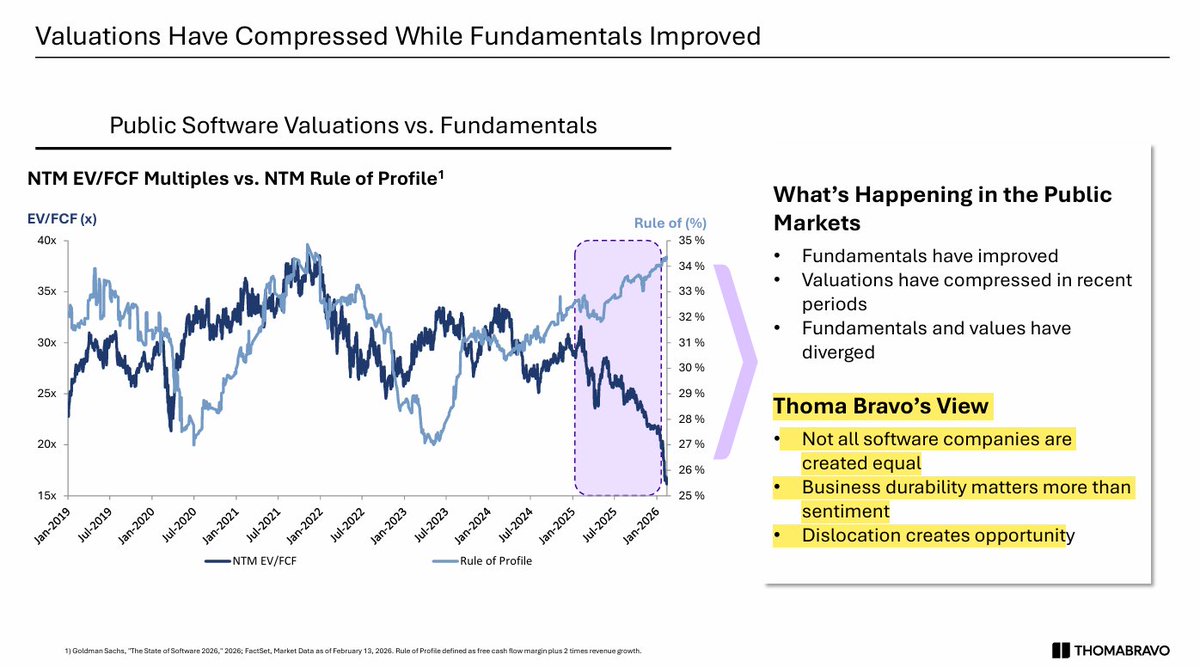
BREAKING: Thoma Bravo just released their LP meeting slides.
The world's largest software PE firm thinks the market has it completely wrong on software right now.
Public markets are panic-selling software based on AI fear.
Here's what they're seeing:
one thing vancouver is missing is builder density
so instead of complaining, i’m doing something about it
bringing together some of the most ambitious founders and engineers in vancouver this week
if you want in dm me
attention all Canadian builders (in SF and in 🍁)
-we're hosting a 🇨🇦 demo night at our new SF HQ
-we're picking 2 Canadian builders to fly out for free
if you want a free trip to sf comment what you're working on, i'll dm you
march 26th nice people, nice food and nice demos