Saudi Arabia is messaging that it is doubling down as the Houthis advance farther than any point since 2015. But will that do anything to address the fragmentation plaguing government forces? I fear it could only get worse, with Saudi-STC tensions undermining the defense of Aden
War in #Yemen#SITREP | Saudi Arabia appears to be signaling that military operations and pressure against the Houthis will continue, with little indication of an immediate shift toward de-escalation talks, despite this week’s major setbacks in Yemen.
A day after @diralwatan, @SouthArmed, @alamalikah, and @nrfyemen redeployed from previously held positions around Bab al-Mandab, Dhubab, al-Mudharabah, and Ras al-Arah, effectively cementing Houthi control over the southern Red Sea corridor, its strategic islands, and the Bab al-Mandab Strait, while extending their access to the Gulf of Aden through southwestern Lahj, King Salman removed Lt. Gen. Fahd al-Salman as commander of the Saudi-led Joint Forces Command. Al-Salman also chairs Yemen’s Supreme Military Committee and has overseen coalition military operations in the country. King Salman temporarily assigned command of the Joint Forces to Gen. Fayyadh bin Hamed al-Ruwaili, Chief of the General Staff of the Saudi Armed Forces, in addition to his existing responsibilities.
Al-Ruwaili, born in Turaif in 1958, is a career Air Force officer and former fighter pilot who has served as Saudi Arabia’s Chief of the General Staff since February 2018. A graduate of King Faisal Air Academy, he completed advanced flight training in Florida and earned master’s degrees in military science and strategic studies from U.S. military institutions. He previously commanded King Fahd Air Base in Taif before becoming commander of the Royal Saudi Air Force in 2012.
@BashaReport assessment is that Riyadh is responding to the setbacks by placing coalition operations under a more senior military commander rather than signaling an immediate move toward negotiations. Al-Ruwaili’s aviation background, seniority, and longstanding position at the top of the Saudi military establishment suggest an effort to strengthen command and control and maintain military pressure on the Houthis. However, the appointment is explicitly temporary, and whether it leads to changes in coalition strategy, operational tempo, or military support to Yemeni government forces remains to be seen.
Saudi Arabia moves Joint Forces Command (JFC) under Chief of General Staff Fayyad al-Ruwaili, moving al-Salman to an MoD advisory role.
Amid recent Houthi gains & sustained military pressure, the reshuffle indicates recognition of operational strains and elevated military attention to Yemen. Military operations continue.
Dual command could better integrate strategic planning, force mobilisation and operational execution, strengthen C2, improve resource allocation and accelerate decisions timelines.
The real test is whether JFC and Yemeni Armed Forces can overcome command-and-control challenges, establish integrated operational planning and pursue two three objectives:
🔹Halt further Houthi expansion and stabilise the Lahj–Aden front (containment)
🔹Regain the military initiative, reverse Houthi gains, secure Aden, break the siege of Taiz and restore government positions along the Tihama coast (reversal)
🔹Make tangible military gains in Al-Jawf—Marib Axis to improve strategic depth and demonstrate military competence (advance)
A change of command matters when translate into a coherent campaign and measurable battlefield gains. Success would show a strategic reset!
The Yemeni government-aligned forces announced their withdrawal from Dhubab and Bab al-Mandab, which marks a significant shift in the military balance along Yemen’s western coast.
With the Houthis consolidating control over Mokha and the mainland approaches to the strait, their strategic position has strengthened, potentially expanding their ability to influence maritime security dynamics in the Red Sea.
The withdrawal also raises questions about the sustainability of government defensive positions, coordination among anti-Houthi forces, and the broader trajectory of the conflict.
Beyond its immediate military implications, this development could reshape negotiating leverage and regional security calculations.
Map here is an illustrative synthesis rather than a precise, independently verified frontline map, and using it to just highlight how Houthi now control western lands overseeing Red Sea.
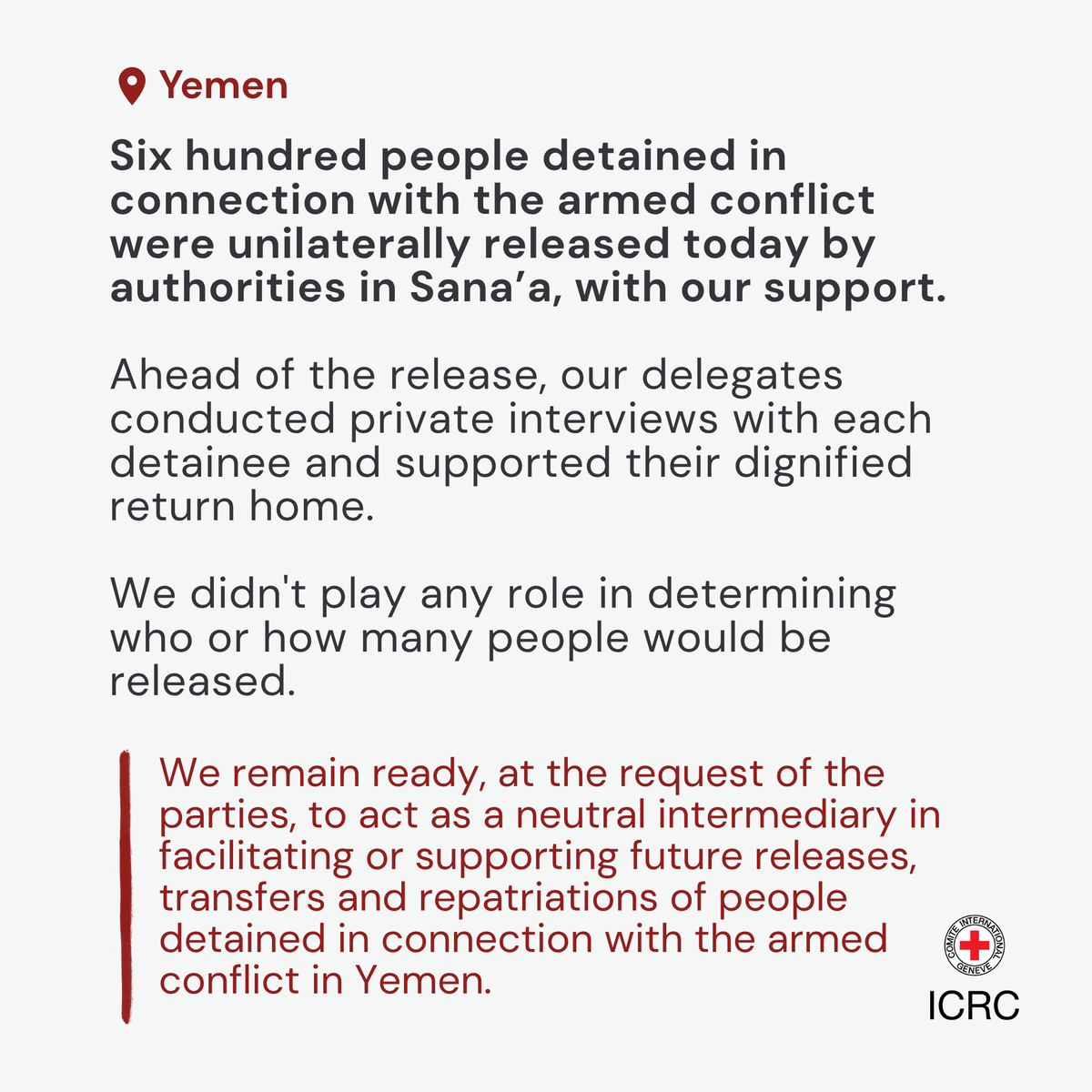
#Yemen | Six hundred people detained in connection with the armed conflict were unilaterally released by authorities in Sana’a, with the support of our teams today.
Read more: https://t.co/3Rjd32Wizx
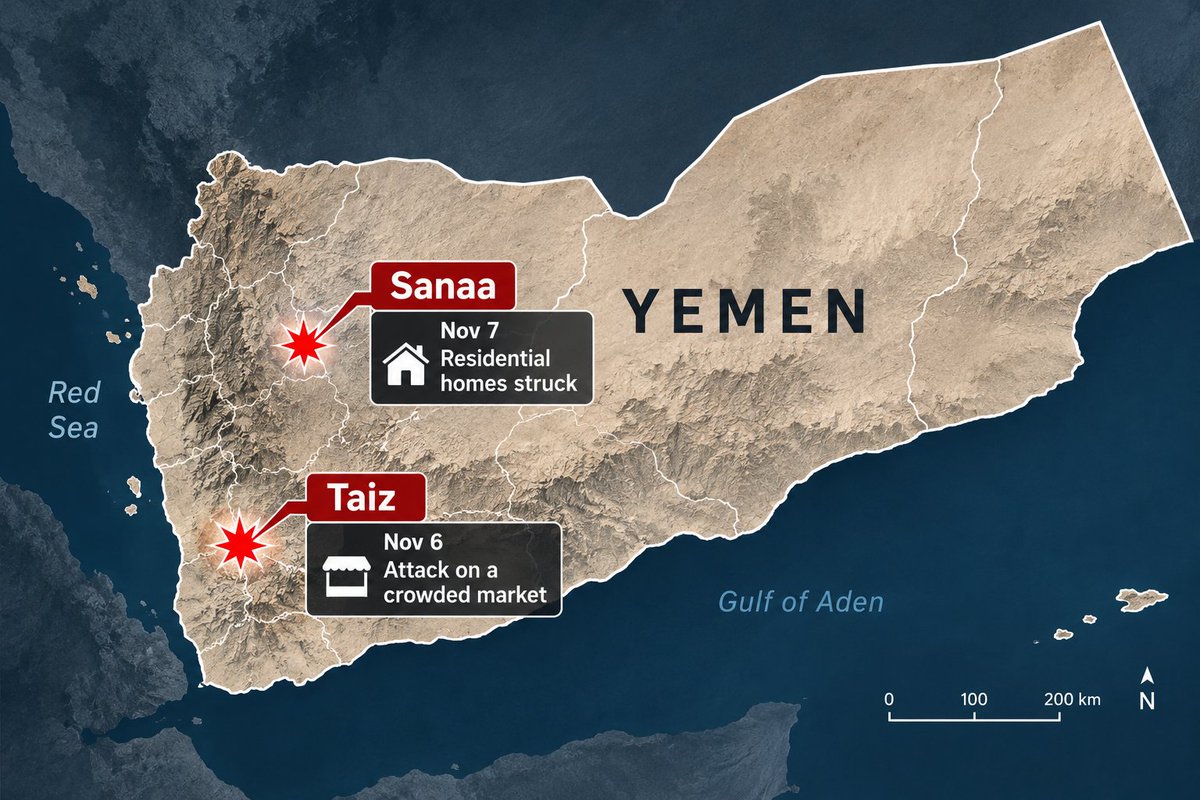
The footage emerging from Yemen is absolutely horrifying. In just 48 hours, two devastating attacks on a crowded market in Taiz and residential homes near Sanaa have reportedly killed dozens of civilians. The images of dead children pulled from the rubble, shattered bodies, and grieving families are unbearable.
Footage also appears to show double-tap strikes hitting first responders rushing to rescue victims.
Whatever the competing claims over responsibility, nothing can justify the killing of innocent civilians. These scenes demand more than condemnation. They demand an urgent, independent investigation, accountability, and an end to the impunity that has made Yemeni lives so tragically expendable.
Charting the Middle East 📈📉📊
This installment by Josiane Atallah highlights the importance of early warning systems, emergency communications, and community-based warning mechanisms amid recurrent surges of conflict in the region. https://t.co/vWDAv1TZke
CHART OF THE DAY: Considering the US-Iran war, and the attacks by the Houthis of Yemen against Saudi oil tankers in the Red Sea, this chart may surprise. Against the odds, container ships traffic across the Suez Canal has experimented a notable recovery year-to-date.
As @BashaReport alludes, this is likely a prelude to renewed restrictions on imports through Hudaydah port. A dynamic that defined the pre-truce period of the Yemen war is repeating itself, but this time the US - who publicly and privately pushed back on restrictions on food and fuel - is leading it's own blockade across the Gulf, and the Houthis are seeking to impose their own blockade on Saudi Arabia. The Yemen war deepens and all involved will be worse off.
We all know what is coming next!
Yemen’s internationally recognized government is moving to cut off a major Houthi revenue stream.
On October 29, the National Committee for Regulating and Financing Imports issued Decision No. 8 of 2026, requiring customs duties, taxes, and other fees on imported goods arriving at Houthi-controlled ports to be collected in advance.
Importers must pay these charges in full before banks can process foreign currency transfers to finance their imports.
On November 4, the Aden Chamber of Commerce circulated the decision to traders, companies, and commercial establishments.
The measure aims to deny the Houthis customs and tax revenues from imports passing through ports under their control, while shifting revenue collection to government authorities.
Fully agree with @MAlmadhaji's comments here that the challenge facing the Saudis is much bigger than the reported $50bn demands - if Riyadh could buy their way out of the Houthi problem, they would have already.
https://t.co/8iUoMCON8u
We all know what is coming next!
Yemen’s internationally recognized government is moving to cut off a major Houthi revenue stream.
On October 29, the National Committee for Regulating and Financing Imports issued Decision No. 8 of 2026, requiring customs duties, taxes, and other fees on imported goods arriving at Houthi-controlled ports to be collected in advance.
Importers must pay these charges in full before banks can process foreign currency transfers to finance their imports.
On November 4, the Aden Chamber of Commerce circulated the decision to traders, companies, and commercial establishments.
The measure aims to deny the Houthis customs and tax revenues from imports passing through ports under their control, while shifting revenue collection to government authorities.
Update as of November 3, 2026:
This infographic highlights the scale and impact of Houthi attacks targeting civilian objects in the Kingdom of Saudi Arabia since the truce was breached on July 13, 2026, through November 3, 2026. A total of 102 attacks have been recorded.
The attacks have resulted in 23 fatalities and 483 injuries, including 12 attacks targeting airports, 10 targeting energy infrastructure, and 13 targeting civilian facilities.
The infographic also illustrates the daily distribution of attacks by day of the week.
#SaudiArabia #Houthi
Gulf countries are being forced to find their own solutions with Iran. There is a way to translate this into a ceasefire that reduces the consequences of the war for everyone, while allowing Tehran and Washington to save face. Nate Swanson and I describe what this could look like in our latest for Foreign Affairs
It’s unclear yet if all of these diplomatic efforts from Saudi Arabia Turkey Pakistan and Egypt alongside mediation from Qatar and Oman will stop the march to another round of war, but we should make no mistake— no Gulf or Arab country is championing another round of kinetic military activity or hoping that this one will get the job done.
Flurry of Diplomacy in Iran as Regional Countries Try to Stave Off War https://t.co/Cmnvr87yhL via @NYTimes
This may be obvious, but using Houthi attacks to justify an elevated travel advisory across the Middle East feels very much like a cover. I am skeptical the Houthis would attack any country not actively involved in operations inside Yemen, at least for now.
The Department of State has updated its Travel Advisories for Americans in the Middle East to reflect the threat of increased Iranian-supported Houthi regional aggression. Review the full text of the updated Travel Advisories at https://t.co/XzfZgIw9CL
When the Houthis took over Sana’a in 2014, one of the most shocking experiences for me was watching colleagues I had known and worked alongside for years, people committed to human rights, democracy, and international institutions, so quickly embrace Houthi narratives.
It was even more disturbing in 2015 to see people I deeply admired and respected justify the Houthi military offensive against Aden, repeating the claim that the group was merely fighting ISIS. Years of professional commitment to human rights and democratic principles seemed to disappear with a click of a button.
Today, amid renewed regional escalations, I am witnessing something disturbingly familiar. Social media influencers and activists are increasingly adopting Houthi narratives, seemingly convinced that the group represents resistance, Arab identity, and solidarity with Palestine.
What troubles me is not simply political disagreement. It is how easily ideological narratives can override critical thinking, historical memory, and principles that people once defended.
I can understand how people outside Yemen, unfamiliar with the country’s history and the realities of Houthi rule, might be misled by carefully constructed Houthi propaganda. But what I find truly puzzling is watching Yemenis who have witnessed this history unfold from the beginning, who know the group’s record of atrocities, repression, and human rights abuses, suddenly embrace the very narratives they once challenged.
How does someone who has witnessed years of suffering, arbitrary detention, enforced disappearances, persecution, and the destruction of democratic and civic space by the Houthis suddenly see these perpetrators as symbols of liberation and resistance?
Perhaps the most disturbing power of propaganda is not that it convinces those who do not know the facts, but that it persuades those who know them to look away.
Erik, it is clear to me you are not interested in engaging in a good faith conversation about this, and that you have ignored the actual substance of my testimony, which states quite clearly that the US should 1) resist calls to participate in a new military campaign to defeat the Houthis, 2) resume aid to Yemen, and 3) resume diplomatic efforts to end the war.
There are lots of people calling for US intervention in Yemen and rejecting the idea of negotiations with the Houthis right now, so I encourage you to focus your efforts on them.
And another reminder - you also cannot solve the Yemen conflict without the Yemen Government being part of negotiations. The trend (in Washington) of viewing this solely as a Saud conflict is a troubling one that ultimately just undermines Yemeni agency
I'm seeing lots of suggestions that the Yemen conflict could be solved if the Saudis and the Houthis just started talking. I fully agree that a negotiated agreement is the only way out of the current mess, but the issue is not the absence of channels between the parties - it is the absence of a zone of agreement