Claude Tag is a strong signal:
The next AI interface is not a blank chat box.
It is the context layer behind the work:
people, projects, decisions, docs, issues, and follow-ups.
Agents don’t become useful just by getting better prompts.
They become useful when they inherit the context of the work.
Introducing Claude Tag, a new way for teams to work with Claude.
In Slack, Claude joins as a team member with access to the channels and tools you choose. Tag Claude in and delegate tasks to it while you focus on other work.
OpenLoomi v0.6.1 is mostly about reducing friction.
Installation is clearer with RPM links, updated Homebrew packaging, and OS-prefixed release artifacts.
Builders also get early CLI groundwork: a one-shot skeleton, update-check preflight, and cleaner entry naming.
Small update, clear direction: easier to install, automate, and extend.
https://t.co/t7Sk3aWyhb
@cyrilXBT Great framing.
The part most loop discussions skip is the memory layer.
If each cycle can't retrieve the last cycle's decisions, failures, and context, it's not really evolving. It's restarting.
We wrote about this from the personal-agent angle:
https://t.co/IoKsBiYEl0
The best loops don’t just run again.
They carry forward the right memory, update context, and make the next run smarter.
That’s where loop engineering gets interesting for personal agents:
https://t.co/IoKsBiYEl0
OpenLoomi takes a different path: build a global context, then retrieve the right pieces when needed. Open source, inspectable, designed for better accuracy and fewer tokens. Try it: https://t.co/Kg8Xq5SxT8
Your AI assistant doesn't need a bigger memory.
It needs a garbage collector.
Most memory systems just keep appending context and hope retrieval will sort it out later.
That works until stale notes, old decisions, and random leftovers start showing up like facts.
Useful memory needs time, decay, and a way to separate signal from residue.
That's a big part of what we're building in OpenLoomi: local-first, inspectable memory for AI agents.
Repo: https://t.co/t7Sk3aW0rD
"Local-first" should not be a marketing word.
For AI memory, it should mean:
- raw work data stays local
- remembered items are inspectable
- source links are visible
- users can delete or override memory
- model choice is separate from data ownership
Trust needs architecture, not vibes.
Repo: https://t.co/t7Sk3aWyhb
OpenLoomi v0.6.1 is out.
Not a flashy release, but a very real one.
We added memory consolidation diagnostics, independent Kokoro and Whisper voice plugins, safer tool-call handling in text messages, better email fallback, and support for generate-reply.
Small things, but they matter when you're building an AI mate that has to survive real work instead of just demos.
Grateful to Nan for the memory diagnostics work, Krish Shah for the voice plugin contribution, and Peefy for keeping the release moving.
Open source gets real when people start touching the boring edges.
https://t.co/Z7acwsNGjO
Build log, Jun 18: OpenLoomi v0.6.1 added a saveUserMemory MCP tool.
The useful detail: memories are saved as markdown under ~/.openloomi/data/memory/{userId}/{category}/.
That makes the memory layer easier to inspect, reason about, and extend.
Also in the release: email fallback when time-filtered sync returns nothing, and more flexible AI-provider routing for reply generation.
https://t.co/t7Sk3aWyhb
I used to think the hard part of agents was getting the loop to run.
Perceive, reason, act, feedback, repeat.
That part is getting easier.
The harder part is making the next loop smarter than the last one.
If the decision from yesterday does not become part of today's reasoning, the system is not really collaborating with you. It is just restarting politely.
That is why memory should not feel like a hard drive.
It should feel like a context: decisions, failed paths, timelines, tool habits, project state, and why the last run changed the next one.
A good loop does not repeat.
It moves the work forward.
https://t.co/kuq9fx5rXp
A local model with no long-term memory still starts from zero.
The missing layer is durable private memory: projects, people, decisions, open loops, and time.
That memory should live where the user can inspect it. Not hidden inside another cloud black box.
Repo: https://t.co/t7Sk3aWyhb
Bad AI memory is not just missing context.
It is stale context showing up at the wrong time, with too much confidence.
Every durable memory item should have: source, timestamp, scope, validation state, and a way to be deleted or superseded.
Repo: https://t.co/Kg8Xq5SxT8
This is exactly why agent infrastructure is getting interesting.
Frameworks make agents easier to build.
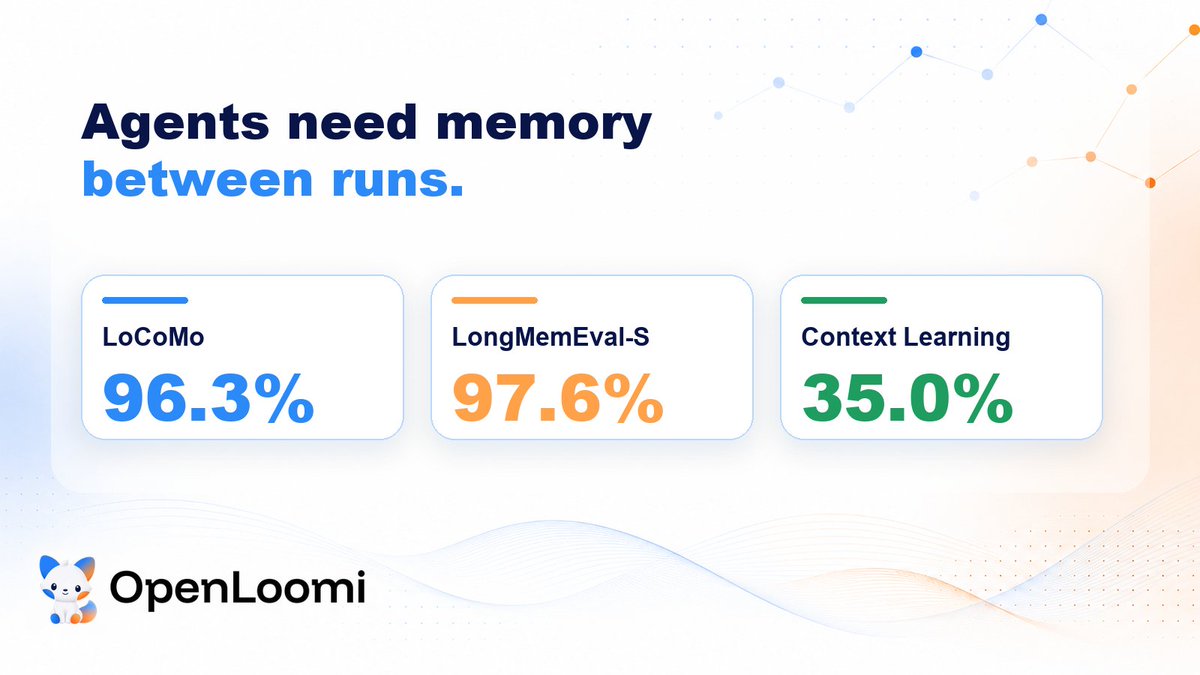
But useful agents also need memory between runs.
We’ve been benchmarking OpenLoomi on long-conversation memory and context-learning tasks:
LoCoMo 96.3%, LongMemEval-S 97.6%, Context Learning 35.0%.
Open-source, local-first work memory for AI agents:
https://t.co/t7Sk3aWyhb
OpenLoomi v0.6.0 is live.
In the last 24h, we shipped new skill workflows, standalone Kokoro + Whisper voice plugins, Anthropic-compatible providers, better memory diagnostics, macOS 13+ docs, and CI release polish.
Less setup. More extensible AI work memory.
https://t.co/t7Sk3aWyhb
"Own your learning loop" is the right thing.
A learning loop doesn't own much if every run starts from a blank state.
The decisions, dead ends, preferences, and context that made the next run faster than the last should not live in someone's memory or a buried log.
The loop is real with the memory layer.
RAG finds the relevant chunk.
Work memory has to answer harder questions:
- is this still true?
- what changed since then?
- was it a decision or noise?
- should it surface now, or stay quiet?
That is the layer we are building in OpenLoomi: local-first, inspectable memory for AI work agents.
Repo: https://t.co/t7Sk3aW0rD
@wang_myun Think of it like a code graph, but for work context.
OpenLoomi builds a context graph before the AI call: files, decisions, tasks, feedback, and relationships.
So the agent retrieves the right context up front instead of spending tokens rebuilding it.
Anthropic's Claude Code credit pause is a reminder:
agent cost is not just pricing.
Agents get expensive when they rebuild context from scratch.
OpenLoomi gives agents open-source work memory: less repeated context, more reusable memory.
https://t.co/GD3KTv0rbZ