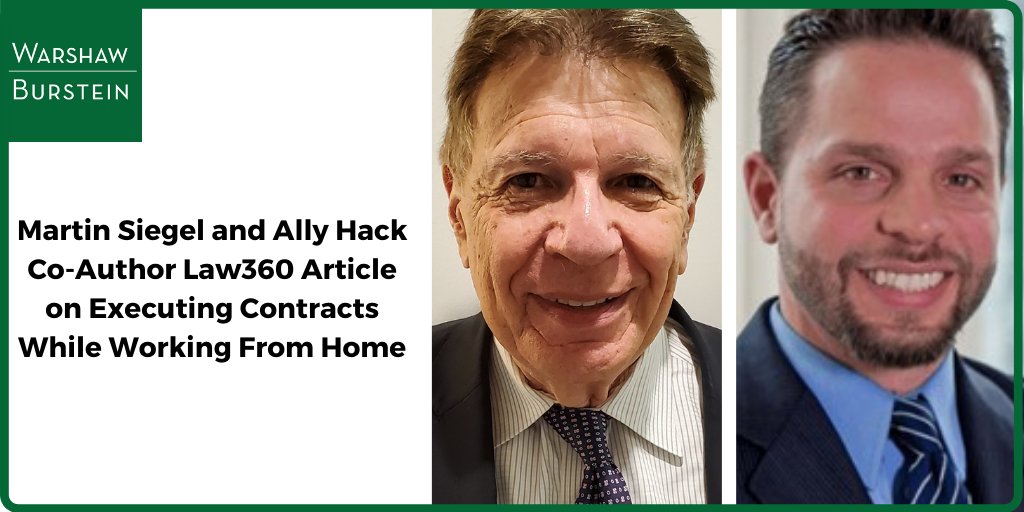
@WarshawBurstein@Law360 It was an honor and pleasure working with my partner and good friend on this article, which we hope will benefit those of us who are continuing to work remotely.
In a 4 to 3 decision, the New York Court of appeals upheld, as not against public policy, a tenant’s waiver of its right to a Yellowstone Injunction as long as the lease provided tenant with a forum to litigate its dispute. #yellowstone#landlords#tenants#commercialleases
Here’s the clause upheld by the court: “Tenant waives its right to bring a declaratory judgment action with respect to any provision of this Lease or with respect to any notice sent pursuant to the provisions of this Lease . . . [I]t is the intention of the parties hereto that
Here’s the clause upheld by the court: “Tenant waives its right to bring a declaratory judgment action with respect to any provision of this Lease or with respect to any notice sent pursuant to the provisions of this Lease . . . [I]t is the intention of the parties hereto that
In a 4 to 3 decision, the New York Court of appeals upheld, as not against public policy, a tenant’s waiver of its right to a Yellowstone Injunction as long as the lease provided tenant with a forum to litigate its dispute. #yellowstone#landlords#tenants#commercialleases
A landlord can now be liable for failing to promptly address racial discrimination in its building, created by a tenant targeting another, where landlord knew of the discriminatory conduct and had the power to do something to stop it. See Francis v Kings Park Manor (2d Cir 2019)
A landlord can now be liable for failing to promptly address racial discrimination in its building, created by a tenant targeting another, where landlord knew of the discriminatory conduct and had the power to do something to stop it. See Francis v Kings Park Manor (2d Cir 2019)
Condominium and Cooperative Boards should take note: proper exercise of the Business Judgment Rule means making decisions and taking actions that “lawfully and legitimately further corporate purposes”. Segev v. 262 N 9 LLC (Sup. Ct. N.Y. Co. March 20, 2019) #coops#condos
Condominium and Cooperative Boards should take note: proper exercise of the Business Judgment Rule means making decisions and taking actions that “lawfully and legitimately further corporate purposes”. Segev v. 262 N 9 LLC (Sup. Ct. N.Y. Co. March 20, 2019) #coops#condos
Piercing the Corporate Veil ensures collection of money judgments post-suit. Pierce when: (1)a corporation and its owner operate as a single economic entity and (2)injustice or unfairness occurs through acts involving the corporate structure. #piercingthecorporateveil#alterego
Make sure your contracts contain reasonable punishment for late payment. Provisions for late fees amounting to 10% of the debt, daily charges amounting to 17% of the debt, and annual charges amounting to 365% of the debt -- were all struck by NY Courts as excessive. #latefees
FYI, the lack of a certificate of occupancy in a residential building in NYC could cost owners big bucks. Without it, the owner can’t sue for unpaid rent. MDL 302
A Contractor can “lien” a building for improvements performed if the building owner was an affirmative factor in procuring said improvements, or assents to said building improvements expecting to reap the benefits. Owner’s passive acquiescence/knowledge isn’t enough. #NYLienLaw
A Contractor can “lien” a building for improvements performed if the building owner was an affirmative factor in procuring said improvements, or assents to said building improvements expecting to reap the benefits. Owner’s passive acquiescence/knowledge isn’t enough. #NYLienLaw
FYI, the lack of a certificate of occupancy in a residential building in NYC could cost owners big bucks. Without it, the owner can’t sue for unpaid rent. MDL 302