More reach, more freedom, more done. Dual-arm robots and an open-source stack for physical AI. Built and shipped. CA: 0x95E9DfD1E55A9Ea24E458115A30eBC6776d843D0
$ALMOND is live on @ponsdotfamily
CA: 0x95E9DfD1E55A9Ea24E458115A30eBC6776d843D0
ALMOND IS BUILDING THE FUTURE OF PHYSICAL AI.
From dual-arm robots to real-world data collection, Almond is creating the hardware and software stack that allows AI to learn, control, and perform physical tasks.
This project is built around that vision — bringing Almond’s robotics ecosystem and Physical AI concept to the community.
New here? The short version:
Axol is a dual-arm robot for physical AI work. 7-DOF per arm, 860mm reach, 6.5kg peak payload, 500Hz control.
2× GMSL2 for cameras, USB-C for CAN, XT90 for power. Open-source SDK, VR teleop included.
From $9,499, in stock, assembled in San Francisco.
$ALMOND
WHY ALMOND?
AI is no longer limited to screens.
The next step is machines that can see, learn, move, manipulate objects, and operate in the real world.
That’s the vision behind Physical AI — and that’s the idea we’re bringing to $ALMOND.
CA:0x95E9DfD1E55A9Ea24E458115A30eBC6776d843D0
CA IS LIVE.
$ALMOND is now officially launched.
The idea is simple: bring the concept of Physical AI, robotics, and real-world machine intelligence into a community-driven project.
Now we build from here.
A robot, a mobile base, and a data collection rig, configured your way.
Axol — from $9,499. The complete dual-arm robot.
Jelly Mobile — $7,999. Powered base, 2.4 kWh battery, 610mm lift, 600×600mm footprint, fits through standard doors.
Mantis UMI — from $1,799 for a pair. Handheld data collection grippers.
All in stock.
Why area, not reach, is the number to look at: workspace grows with the square of the arm. A 43% longer arm is not 43% more room, it is about twice as much.
That is the difference between a cell you design around the robot and one where the robot just fits.
How far can it actually reach?
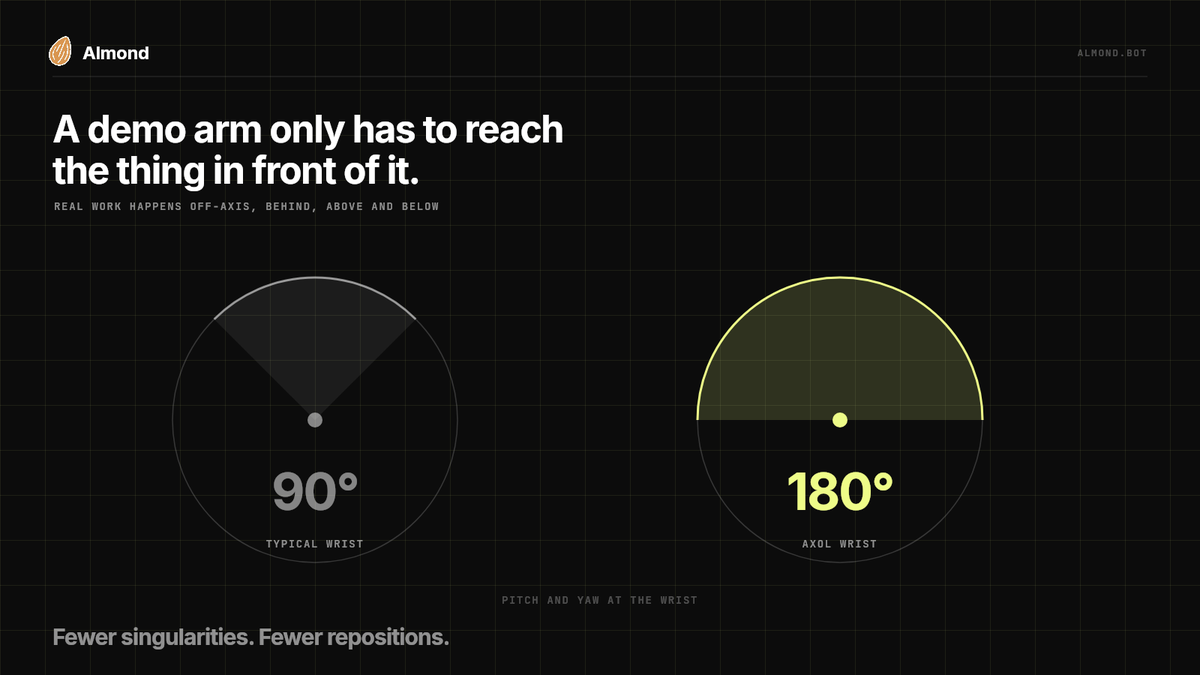
A comparable dual-arm platform sweeps about 600mm per arm. Axol sweeps 860mm, with full 180° pitch and yaw at the wrist.
That is roughly double the reachable area, with fewer singularities and fewer repositions — more workspace for the same footprint.
More Reach. More Freedom. More Done.
Most robot arms are built to look good in a clip.
They reach the one object placed in front of them, at the one angle the camera likes. Move the task off-axis and the arm runs out of wrist, hits a singularity, and has to reposition the whole base.
Real work does not stay in frame.