Come and visit London’s Home of Trophies. 🏆
Book your Stadium Tour at Stamford Bridge now. ⭐️⭐Come and visit London’s Home of Trophies. 🏆
Book your Stadium Tour at Stamford Bridge now. ⭐️⭐Come and visit London’s Home of Trophies. 🏆
Book your Stadium Tour at Stamford Bridge now. ⭐️⭐Come and visit London’s Home of Trophies. 🏆
Book your Stadium Tour at Stamford Bridge now. ⭐️⭐Come and visit London’s Home of Trophies. 🏆
Book your Stadium Tour at Stamford Bridge now. ⭐️⭐Come and visit London’s Home of Trophies. 🏆
Book your Stadium Tour at Stamford Bridge now. ⭐️⭐️
Introducing $LA: the token powering decentralized proof generation and verifiable AI across the Lagrange Prover Network
From provable AI inferences (DeepProve) to rollup scalability, $LA powers a self-sustaining economy where proof demand drives token demand 👉 https://t.co/xCU6FZTX9S
1. What is $LA?
$LA is the native token of Lagrange — a utility token designed to fuel cryptographic proof generation in the Lagrange Prover Network (LPN).
Think of it as the gas that powers:
⚙️ ZK Rollups
🤖 Verifiable AI (DeepProve)
🧱 Modular Execution Layers
2. Tokenomics Highlights
Here’s how $LA creates value in the ecosystem:
🔹 Client Fees: Clients pay for proofs in ETH, USDC, or $LA → fees convert into $LA and are paid to provers
🔹 Emissions: 4% annual emission → distributed based on proof output
🔹 Staking: Token holders stake or delegate to provers → helps direct emissions and lock supply
🧠 Passive holders don’t earn — it’s a utility-driven system.
3. Distribution
🪙 Total Supply: 1,000,000,000 $LA
📦 Early contributors/investors: 1-year lock, then 2-year linear unlock
🌱 Community & Ecosystem allocations start with the TGE registration
Lagrange @lagrangedev Announces $LA
the token powering verifiable AI & decentralized proof generation.
Here’s a full guide on how to register for the airdrop 👇
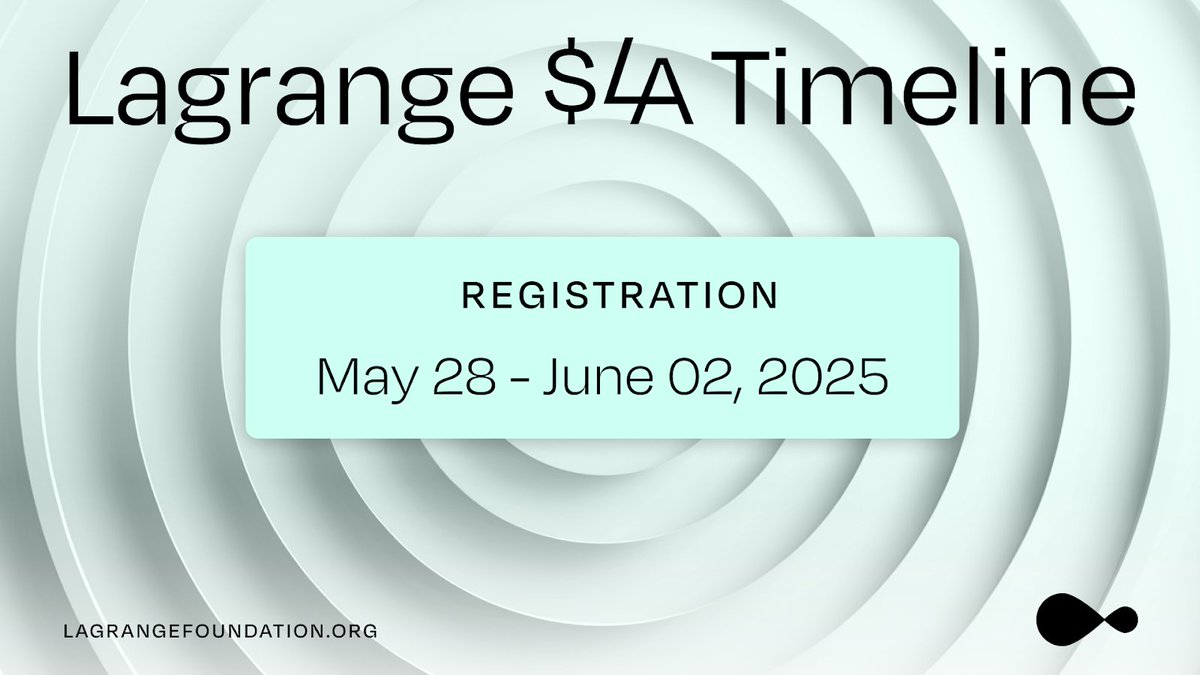
🗓️Registration opens: May 28, 2025
⏳ Deadline: June 2, 2025
🔗 https://t.co/QhNiGWDNtB
1. Connect Wallet or X (Twitter)
- Head to the official portal and connect either your EVM wallet (MetaMask, WalletConnect, etc.) or your X account.
⚠️ Double-check the URL to avoid scams.
2. Check Eligibility
- Once connected, the system will tell you if you're eligible.
✅ If yes → proceed
❌ If not → you’re out this round.
3. Choose Network + Wallet
- Pick ONE network to receive your tokens:
Ethereum, Base, Arbitrum, Optimism, Polygon, Scroll, Gnosis, or Solana.
Provide a wallet address that matches the network you chose.
4. Verify Identity (Proof of Uniqueness)
- This step ensures you're a real human and not farming with 10 wallets.
You’ll be redirected to Privado ID for a biometric check (face scan).
Don’t close the original registration tab during this.
5. Finalize Your Registration
- After passing PoU, go back to the portal and hit Confirm.
⚠️ Only the first registration per person counts.
No edits after submission.
6. Wait for TGE
- Once registered, stay tuned for the Token Generation Event (TGE) to claim your $LA.
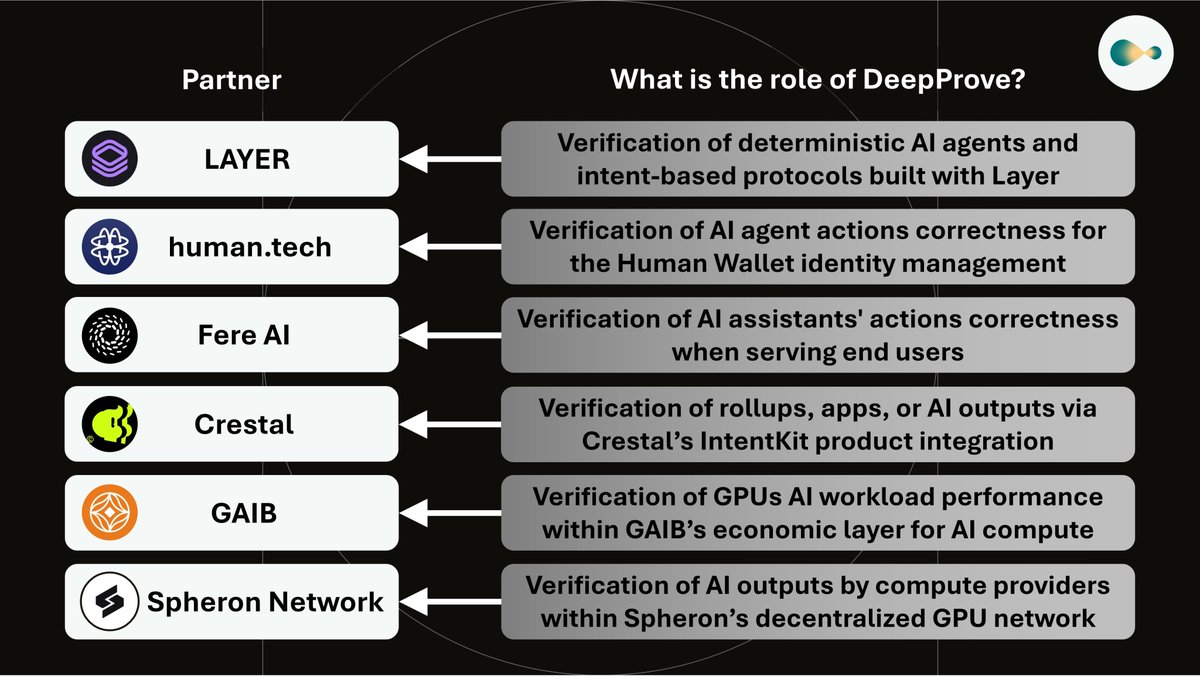
Even more @lagrangedev DeepProve partnerships coming your way! ⚔️⚔️⚔️
Back in March, Lagrange has announced #DeepProve - a zkML (zero knowledge machine learning) library that generates proofs for #AI inferences. Let's examine some of the latest partnerships in this thread 👇🧵.
What makes @N1Chain different?
1. Developers can build using any language, including TypeScript, Python, C++, Rust, etc.
2. Millisecond latency and 100k+ TPS per app.
3. N1’s architecture scales horizontally, meaning every app gets its own dedicated environment, scaling independently with no shared compute bottlenecks.
Bonus: We're bringing vibecoding onchain with Gen1. Build onchain apps without writing any code.
Here’s a diagram of N1’s execution setup. The circles labeled app0, app1, and app2 are individual processes. The gate app routes assets between those processes and N1
Original:
9. The gate app is a special program that handles bridging assets from the L1 and routing them to the correct app in the L2 network.
Explanation:
The gate app is like a traffic controller. It moves assets from Layer 1 into the right app on Layer 2.
Original:
10. This greatly simplifies the network’s topology and enables immediate liquidity between apps, on the order of seconds.
Explanation:
This setup keeps the network clean and straightforward. It also means apps can move assets between each other almost instantly within seconds.
I’m Reading N1 Docs So You Don’t Have To - Ep4
N1's Execution Layer
Original:
1. N1 is completely agnostic to the execution environment.
Explanation:
N1 doesn’t care what you run on it. Bring whatever setup you want, it’s built to handle it.
Original:
2. We encourage developers to get creative and think of specializations to squeeze more performance out, such as lightning networks or specialized exchanges.
Explanation:
If you’re building on N1, don’t hold back. If speed or specific features matter, go custom—build your own payment layer, a turbocharged exchange, whatever fits.
Original:
3. Nonetheless, N1 provides a default execution environment which we describe here.
Explanation:
Don’t want to build your own setup from scratch? No problem. N1 comes with a ready-made execution environment.
Original:
4. Within this execution environment, we support a multitude of different virtual machines, including TypeScript and Solidity.
Explanation:
The default setup supports multiple VMs out of the box. You can write in TypeScript or Solidity, use what you already know.
Original:
5. N1’s default execution environment is an asynchronous network of virtual machines, which we term processes.
Explanation:
N1 runs apps as a bunch of separate VMs called processes. They’re asynchronous—meaning they don’t wait around for each other.
Original:
6. Each process can run a variety of different virtual machines and can send and receive messages from any other process in the network through ordered channels.
Explanation:
These processes can run different languages, and they talk to each other through structured message pipes. The messages arrive in order, so there’s no chaos.
Original:
7. For example, one process could be a perpetuals exchange built in TypeScript and another could be some Solidity smart contract, both of which are able to inter-operate through messages.
Explanation:
You could have a derivatives exchange in TypeScript talking to a Solidity smart contract. Doesn’t matter, they can trade messages and work together.
Original:
8. The benefit of this approach is that there is no state contention. Each app operates independently and at its own pace, for more flexibility in performance.
Explanation:
No apps fighting over the same state. Everything runs on its own clock, which means faster, smoother execution without bottlenecks.