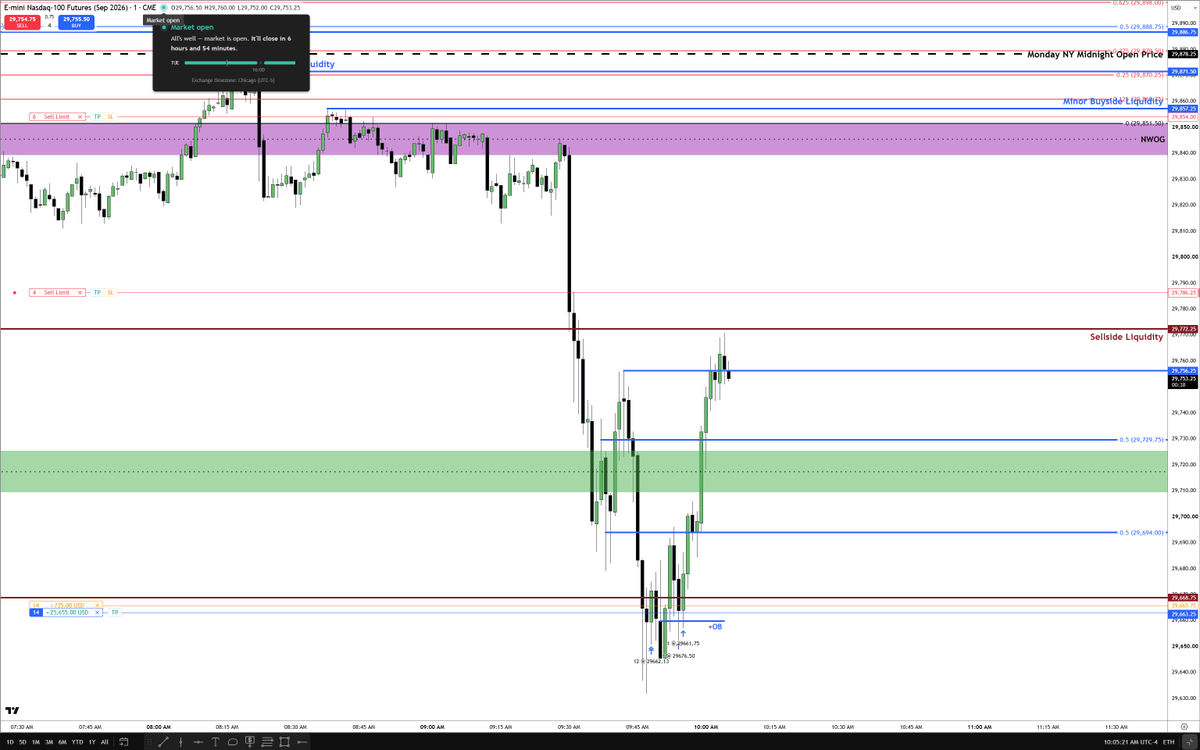
I like to start my trading session by taking some scalps in 15s charts so I can see not only of price respect my levels but If I am in tune with the delivery. Then I like to hunt for larger swings. Prove that, it really helps in the first stages of your career.
@rajas8310 If you use the sequence of 21 circles take the macro closest to it, note that I said the closest one; so it can also be before of the starting time.
Use standard deviation and grade the zones that comes out. Look how price behaves around those quadrants/levels.
Thank me later.
@SihleIan003@I_Am_The_ICT So people who are working on the sequence inside the logo can know if the open they are using is the correct one or not and my way to frame price levels/ zones and quadrants.
@Alo_Trades You restrict inefficient placement 100% of the time.Cutting water from older sprinklers degrades the core liquidity you already rely on. Punishing your best market makers to accommodate toxic, low-probability order bloat is an infrastructure death spiral. Protect the engine.
@Alo_Trades Every firm plugs into the exact same plumbing—the order book—and processes the same flash floods of data at the exact same millisecond. To avoid drowning, their algorithms independently execute the identical math required to shut their valves and sprint to higher ground.
@Alo_Trades The HFT dilemma: You use a broad roller to cover the market garden, but the liquidity is mostly air bubbles. The winners aren’t those who spray the most water, but those who re-quote the gap the exact millisecond the bubble pops.