Dear beloved sports-loving Nigerian youths,
After watching the performances of Davido, Burna Boy, and Rema at the opening of the 2026 World Cup—at a time when Nigeria, the giant of Africa, is absent—I felt a measure of consolation. This was reinforced by the fact that many Nigerians playing for clubs worldwide are representing other countries. Felix Nmecha, for instance, set a record by scoring the fastest goal at six minutes for Germany. I write to you therefore, knowing that this country belongs to you, the youth.
You are more of stakeholders in Nigeria’s future than I am. I am 64 years old; by God’s grace, much of my journey is behind me, while yours lies ahead.
It is therefore imperative that you rise to the challenge by obtaining your PVC, your most powerful tool for driving the change you desire.
In the last three years alone, over 15 million Nigerians have turned 18—enough to decide who becomes President, Governor, Senator, Member of the House, or Local Government Chairman. Indeed, enough to shape the nation’s future.
I know many of you are sceptical about politics and political parties. I understand why, but scepticism must not become surrender.
You do not need to belong to any party or wait for anyone to organise you. Organise yourselves in your streets, campuses, communities, workplaces, churches, mosques, and social groups. Mobilise, debate, demand accountability, and take part in choosing those you wish to entrust with leadership.
If you are organised and wish to hear directly from me, invite me. I will come and share my plans for you and our nation.
Do not sit on the sidelines while others decide your future.
I appeal to you to register and vote. Your vote can shape who becomes the next President of our country.
My young friends, this is your country. Take it back.
A New Nigeria is POssible. -PO
I do not think many Gen Z Africans have seen an African leader this confident, articulate, and eloquent on the world stage.
Imagine, just imagine for a second, that it was Bola Tinubu, Yoweri Museveni, Cyril Ramaphosa, Paul Biya, Teodoro Obiang, Denis Sassou Nguesso, Emmerson Mnangagwa, or Alassane Ouattara sitting there. The shame I felt while even writing this paragraph 🙈
Just look at the admiration on the faces of the parliament members. Look at how they listened to him. You need to see the respect in that room and how confidently they asked him questions because they knew he could answer clearly and intelligently.
This is what happens when competent leaders are given a chance.
Peter Obi is not just the man Nigeria needs. He represents the kind of leadership Africa desperately needs if we are ever going to regain respect on the global stage.
A leader who can speak clearly, think clearly, answer questions without embarrassing himself, and represent his people without making the continent look like a retirement home for tired politicians.
This is why most career African politicians do not want him to succeed. His presence alone exposes them. His clarity exposes their emptiness. His competence exposes their mediocrity.
Peter Obi is the standard they are afraid of.
Circulate this video of Peter Obi’s address at the European Union across all platforms. Share it on WhatsApp groups! Let Nigerians see what it means to represent their country abroad.
Not Tinubu, whose every outing abroad brings us embarrassment and shame!✍️
We will continue to debunk the false allegations against His Excellency, Peter Obi. From the claim that he demolished a mosque, when evidence shows that he supported and built one, to the misinformation surrounding the ID card issue, we will continue to present the facts.
As we have always done, we will challenge falsehoods and expose every malicious attempt to tarnish his integrity and reputation. Truth remains constant, and no amount of propaganda can change it.
A New Nigeria is Possible, and Nigeria will be OK.
In 2023 the Kwankwansiyya movement gave us a blueprint on how to protect our votes with what they did in Kano.
Simple, come out in our thousands, escort INEC staffs from unit to final collation, to avoid “any story that touch” along the way.
State visits by Leaders are not tourism, and diplomacy is not a fashion parade. Every foreign trip undertaken by a government must deliver measurable benefits to the people, including investments, technology transfer, trade agreements, factory expansion, industrial partnerships, and job creation.
During President Trump’s recent visit to China, the American delegation reportedly included a few top government officials, and many of the biggest figures in global business and technology:
Consequently, huge trade deals worth several billion dollars including about 200 Boeing orders were achieved.
The list of the entourage included
1. Donald J. Trump – President of the United States
2. Marco Rubio – Secretary of State
3. Pete Hegseth – Secretary of Defence
4. Elon Musk – CEO, Tesla & SpaceX
5. Jensen Huang – CEO, Nvidia
6. Tim Cook – CEO, Apple
7. Larry Fink – CEO, BlackRock
8. Stephen Schwarzman – CEO, Blackstone
9. Kelly Ortberg – CEO, Boeing
10. Brian Sikes – CEO, Cargill
11. Jane Fraser – CEO, Citigroup
12. Larry Culp – CEO, General Electric
13. David Solomon – CEO, Goldman Sachs
14. Sanjay Mehrotra – CEO, Micron Technology
15.Cristiano Amon – CEO, Qualcomm
16. Dina P. McCormick – President of Meta
17. Ryan McInerney – CEO, Visa
18. Michael Miebach – President, Mastercard
19. Jim Anderson – CEO, Coherent
20. Jacob Thaysen – CEO, Illumina
That is how serious nations approach diplomacy, by aligning foreign policy with economic expansion, industrial growth, innovation, and national productivity.
I hope that lessons can be learned from these recent visits comparing them with the President of Nigeria’s recent state visit to the United Kingdom.
A large entourage of politicians, aides, and government officials travelled, yet Nigerians are still asking a simple question: what exactly did Nigeria bring home?
Which factories are coming to Nigeria?
What power, technology, manufacturing, agricultural, or industrial agreements were secured?
How many direct jobs will this visit create for Nigerian youths?
What investments were attracted?
What measurable economic outcomes can the ordinary Nigerian point to?
The delegation reportedly included:
1. President Bola Tinubu
2. Senator (Mrs) Tinubu
3.12 governors
4.9 ministers
5.7 members of the National Assembly
6. Over 20 senior State House staff
7. Over 30 security personnel
8. Over 10 domestic staff
9. Several supporters and associates
It is not enough to ride horses, wear matching uniforms, attend royal banquets, and release glossy photographs. Symbolism without substance cannot feed hungry citizens.
Today, Nigeria is in decline, battling serious insecurity, food insecurity, unemployment, a weakened naira, declining industrial productivity, and worsening poverty.
At a time when millions of Nigerians struggle daily to afford food and survive economic hardship, every kobo spent on foreign trips must produce tangible national value: investments, factories, jobs, exports, infrastructure, and economic opportunities.
Nigeria needs leadership that is focused less on optics and more on productivity; less on ceremony and more on measurable economic results.
A New Nigeria is POssible. -PO
"Some men change their party for the sake of their principles; others change their principles for the sake of their party." Winston Churchill
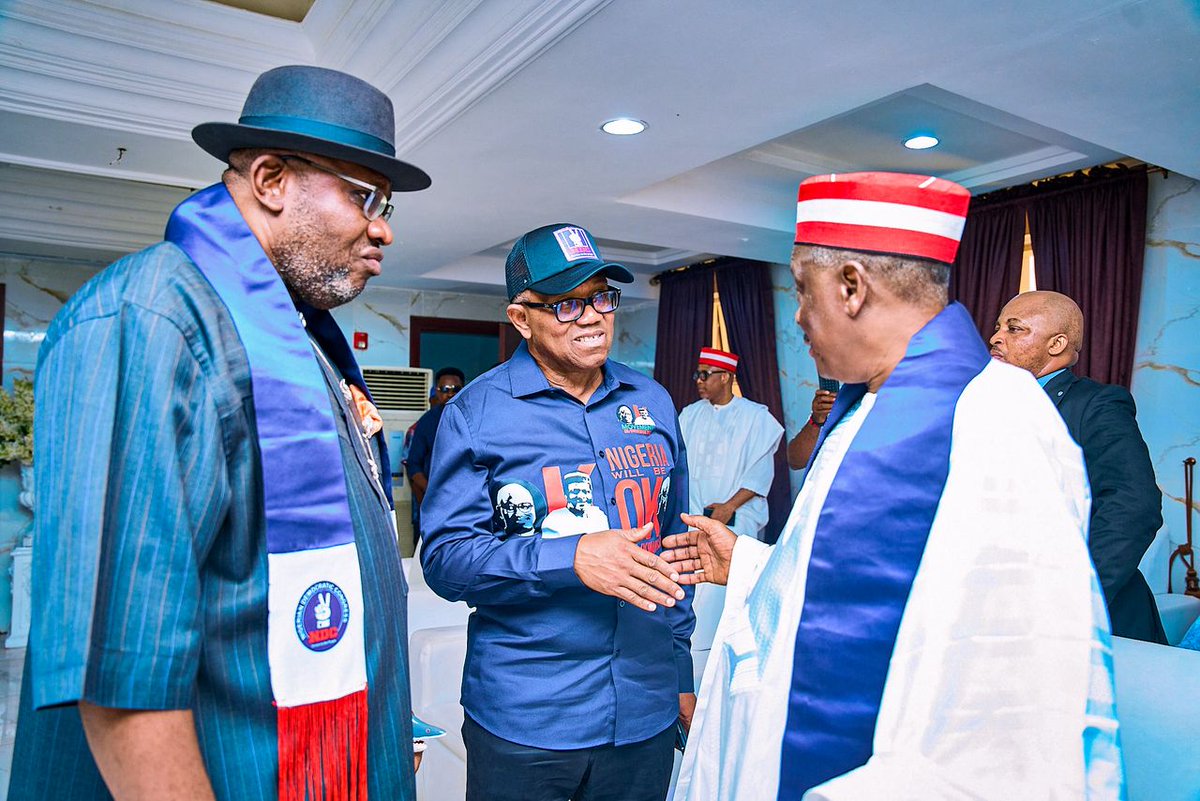
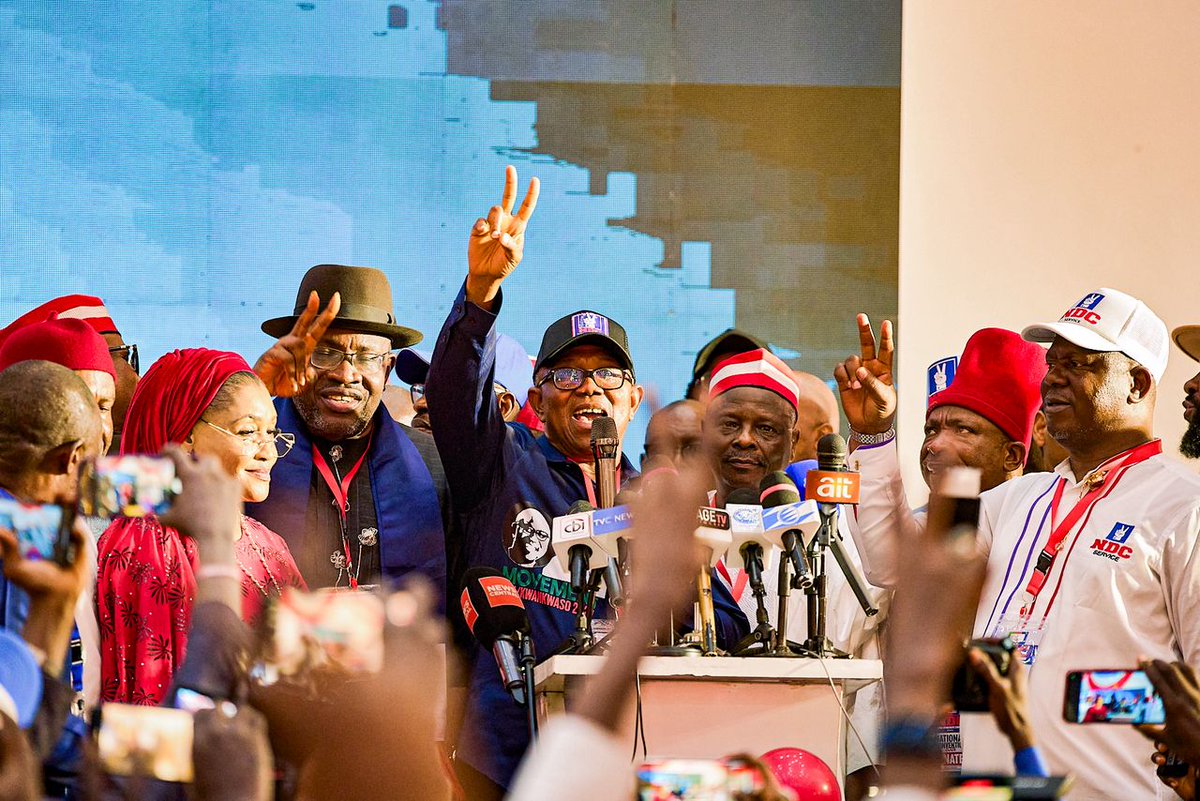
Today, May 9th, I attended the 1st convention of my latest party, the Nigeria Democratic Congress (NDC) in Abuja, Nigeria. The convention was successful and continued to show the resilience of Nigerians to change
I express my sincere appreciation and gratitude to the NDC family, led by the distinguished Senator Henry Seriake Dickson, for inviting us and for the generosity of spirit with which they have accommodated us at this critical moment in our national journey.
I also wish to express profound gratitude to the African Democratic Congress(ADC), particularly Distinguished Senator David Mark, for providing a democratic platform and showing uncommon understanding when the ongoing litigation forced us out of the Labour Party and the New Nigeria People's Party, NNPP respectively. That spirit of solidarity must remain the foundation upon which a better Nigeria will be built.
Today, the most painful aspect of our political existence is that many who once benefited from democratic governance have now become willing accessories to the destruction of democracy itself. Those who once fought for justice now openly celebrate electoral injustice. Those who once spoke against impunity now defend coercion, manipulation, intimidation, and outright political gangsterism, especially against opposition voices. What we are witnessing is not politics; it is a systematic assault on democracy and the will of the people.
Nigeria today stands at a dangerous crossroads. Our democracy is under severe threat. Our nation is drifting without direction, and our people are passing through immense suffering. Across the world, Nigeria is increasingly described as a failing and disgraced nation. This is not the destiny God ordained for our great country. It was not always so, and it must never be allowed to remain so.
Across virtually every recognised indicator of good governance - accountability, political stability, rule of law, control of corruption, government effectiveness, regulatory quality, and the separation of powers - Nigeria continues to record alarming failures. The institutions that should protect the people are weakening daily, while the burden on ordinary citizens grows heavier with each passing moment.
Today, over 140 million Nigerians live in multidimensional poverty. Tens of millions of young people remain unemployed or underemployed. Inflation continues to crush families. Businesses are shutting down. Farmers can no longer safely access their farms. Communities live in fear. In this month alone, hundreds of innocent Nigerians have lost their lives to insecurity, while many others have been kidnapped, displaced, or thrown deeper into poverty.
The most heartbreaking question confronting us is this: Who consoles the grieving mother whose child was abducted on the way to school? Who speaks for the father who can no longer feed his family despite working every day? Who defends the young Nigerian whose dreams have been destroyed by a nation that rewards connections over competence and corruption over character?
Our present tragedy is not accidental. It is the direct consequence of years of deliberate sabotage by a political class that prospers by dividing the people and weakening the nation. Nigeria is not a poor country; rather, we are being looted into poverty. We have abundant human and natural resources, yet we remain trapped in deprivation because leadership has failed to place the common good above personal interest.
Our choice as a people is therefore clear: whether to surrender to despair and national decline, or to summon the courage to rescue our country and rebuild it on the foundations of unity, equity, justice, competence, and productivity.