Low-latency machine readable news feed for Economic and Commodity Data for the USA, Canada, UK, Europe & Asia. Contact us for a trial [email protected] !
Global Markets Week Ahead: Eurozone June Flash CPI, ECB Sintra Forum, US June NFP & Key Emerging Market Moves (June 29–July 3, 2026)
Markets enter the final week of June with high-impact central bank commentary and inflation data that could reshape rate expectations across developed and emerging economies. Focus centers on Eurozone flash inflation, the ECB Sintra Forum, and the US June Nonfarm Payrolls (NFP) report.
Monday–Wednesday: Eurozone June Flash Inflation – Headline Drop Expected, Core in FocusThe Eurozone releases June flash CPI figures across three days, with major economies (Germany, France, Italy, Spain) reporting Monday and Tuesday, followed by the Netherlands and bloc-wide aggregates on Wednesday, July https://t.co/87GkE5Dedr declines in energy prices following the US-Iran MOU are set to pull headline inflation lower. Bloomberg consensus stands at 3.0% y/y (from 3.17% prior), with most forecasts clustered between 2.8%–3.2%.
Core inflation remains the key watchpoint for ECB officials. Consensus expects core to hold steady at 2.6% y/y. Markets will scrutinize indirect effects from the energy shock on goods and food prices. A softer-than-expected print could accelerate the recent unwinding of rate hike pricing, while a hotter reading may temper expectations of a “one-and-done” ECB response.
Rate Pricing Update: Markets have already removed around 17bp of hikes this week. Pricing now reflects one additional 25bp hike by year-end, with a 65% probability of a September move.
Monday–Wednesday: ECB Sintra Forum – Policymaker Reactions to Lower Energy PricesThe ECB’s annual central banking forum in Sintra runs June 29–July 1. Senior officials from major developed and emerging market central banks will speak, with additional commentary likely from sidelines.
Key questions include:Whether ECB Governing Council members acknowledge that the 2–3 hikes priced into June projections may no longer be necessary.
Reactions to the sharp pullback in energy prices post US-Iran MOU.
June flash inflation data will land while the forum is underway, adding real-time relevance. On Wednesday, Fed’s Kevin Warsh joins a high-profile panel with ECB’s Lagarde, BoE’s Bailey, and BoC’s Macklem. Warsh’s recent hawkish tone suggests limited appetite for near-term cuts.
Tuesday: BanRep (Colombia) Expected to Resume Hiking CycleColombia’s BanRep is widely expected to deliver a 50bp hike to 11.75% on Tuesday, resuming tightening after an unexpected pause in April. The hold was driven by consensus-building ahead of the presidential election. With inflation still above target and market-favorite Abelardo de la Espriella winning the election, a renewed hike is viewed as likely — though likely another split decision.
Tuesday/Wednesday/Friday: China June PMI ReleasesChina’s key activity gauges include official PMIs (state-owned heavy) and RatingDog PMIs (more reflective of private/exporter activity).
Official PMIs: Expected to hover near the 50-mark.
RatingDog Manufacturing PMI: Forecast at 51.9 (from 51.8), signaling continued expansion.
RatingDog Services PMI: Expected to remain strong after last month’s robust 54.4 reading.
Wednesday: Japan Q2 Tankan SurveyThe Bank of Japan’s Tankan survey offers fresh insight into corporate sentiment. Large manufacturers are expected to remain buoyant on strong exports and domestic demand, despite higher oil prices. Price-related indicators should continue pointing to long-term inflation expectations above 2%, supporting further BOJ tightening. Officials are likely to place greater weight on financial conditions in the September Tankan.
Thursday: US June Nonfarm Payrolls (NFP) – Early Release Due to July 4 HolidayUS focus shifts to Thursday’s June employment report, released a day early ahead of Independence Day.Consensus: +113k nonfarm payrolls (after +172k in May), with private payrolls around +124k.
Unemployment rate: Expected to hold at 4.3%.
Recent high-frequency data (ADP, jobless claims) show some softening but remain at solid levels.
Fed Chair Kevin Warsh has emphasized price stability over labor market concerns, potentially limiting market reaction unless the print deviates significantly. Last month’s stronger-than-expected May data triggered a notable hawkish shift, serving as a reminder that surprises still matter.
Bottom Line: Next week delivers a dense calendar blending inflation prints, central bank dialogue, and employment data. Outcomes will influence final positioning into the July FOMC and ECB meetings, with energy price dynamics and core inflation trends remaining the dominant themes. Stay tuned for real-time updates and fast analysis as the data lands.
The European Central Bank raised interest rates by 25 basis points for the first time since September 2023 on Thursday, and said it would continue to set policy on a meeting-by-meeting, data-dependent basis as it monitors the inflationary spillover of the Iran conflict.
President Christine Lagarde said the rate increase did not mark the start of a tightening cycle, and that the ECB is not on a pre-set path. Nor should the move be seen as an insurance hike to address inflation coming from the Middle East crisis.
The biggest risk to the ECB would have been to allow inflation to rise in the absence of tightening, making it harder to bring back to target later, she said.
The rate increase was unanimously approved and leaves the ECB “well positioned to navigate uncertainty,” Lagarde said.
“Given the level of uncertainty, we will decide on a meeting-by-meeting basis … it will be what it will be,” she said.
Previous hopes that the oil shock from the closure of the Strait of Hormuz would prove short-lived have been disappointed, Lagarde noted.
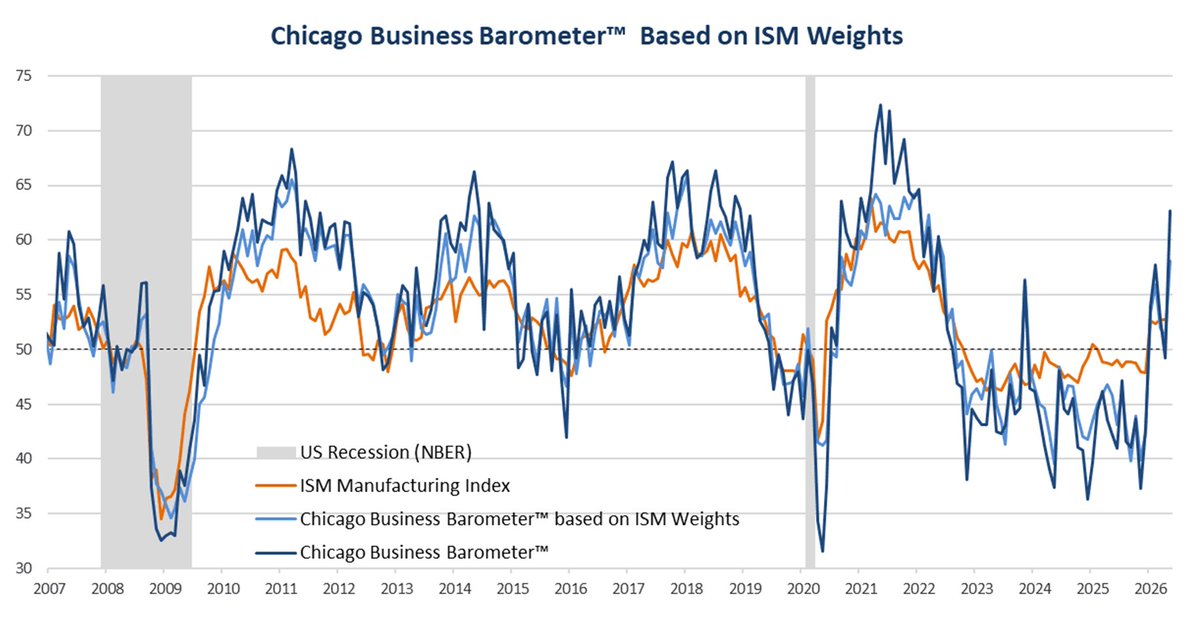
The Chicago Business Barometer™, produced with MNI, climbed 13.5 points to 62.7 in May. The Barometer is now at its highest since January 2022, and back in expansionary territory after one month below the neutral 50 mark. This was the joint second-largest monthly increase in the Barometer since its inception in February 1967 (only July 2020 saw a bigger monthly jump).
LONDON - The Bank of England's Monetary Policy Committee held its policy rate at 3.75% on Thursday against a backdrop of war in the Middle East which it said will push up inflation, though the magnitude and duration of that effect remains unclear.
"Preliminary staff estimates, based on energy price developments in the run-up to this meeting, indicated that CPI inflation was now likely to be between 3 and 3-½% over the next couple of quarters," the Bank said in the published minutes for the March meeting. CPI had been expected to fall back to the 2% target from April.
While recognising that "monetary policy cannot influence global energy prices," the MPC committed to "[ensuring] that the economic adjustment to them occurs in a way that achieves the 2% target sustainably."
Markets interpreted the guidance as a hawkish pivot, but Governor Andrew Bailey said in a later pooled interview that he would "caution against reaching any strong conclusions about us raising interest rates," echoing Alan Taylor who said in his comments that it was "inappropriate to infer a directional shift from this meeting".
The MPC emphasised that it was "ready to act as necessary to ensure that CPI inflation remains on track to meet the 2% target in the medium term."
The Federal Reserve is widely expected Wednesday to keep benchmark rates in a 3.5-3.75% range for a second straight meeting as officials monitor the Iran war for threats to both their price stability and maximum employment goals.
After three cuts late last year to buy insurance for a cooling labor market, the Fed faces a stagflationary shock that will likely delay further downward moves. Oil prices have surged, on top of the latest PCE inflation report that showed core inflation sticky at 3.1% in January.
Updated economic projections could show slightly higher inflation and unemployment for the year, though the median projection among FOMC members will likely stay at one cut for 2026, former Fed officials told MNI.
"This is the most unappetizing central bank problem, which is the likelihood that both the labor market weakens and that inflation goes up. And the problem is that it's not quite unclear at this point how long the hostilities in the Persian Gulf are going to continue," former Boston Fed President Eric Rosengren told MNI.
"I expect the FOMC to stay on hold. Unless there becomes a little bit more certainty during the war, it's a very difficult position for the Fed to make decisions."
Global Economic Calendar: Key Events Week of February 9, 2026 – Delayed US Jobs & CPI, Japan & Thailand Election Results, China Data
As markets digest today's snap election outcomes in Japan and Thailand, the week ahead features delayed key US data releases—including the January 2026 nonfarm payrolls and CPI—alongside Eurozone GDP confirmation, China lending/inflation figures, and central bank decisions in Peru and Russia. These events could influence global monetary policy expectations, currency movements, and equity trends.
Japan Snap Election Results: Landslide Victory for PM Sanae Takaichi
Japan held its snap general election for the House of Representatives on February 8, 2026. Prime Minister Sanae Takaichi, Japan's first female PM since taking office in October 2025 after winning the LDP presidency, called the vote to secure a stronger mandate.
Outcome: The Liberal Democratic Party (LDP) secured a historic supermajority, winning around 316 seats (projections from NHK and others), well above the 233 needed for a majority and approaching two-thirds (for overriding the upper house).
Implications: This emboldens Takaichi's agenda, including robust foreign policy, "responsible proactive fiscal policy," defense spending increases, and economic reforms. Markets may see reduced political risk, supporting yen stability and JGB dynamics.
The result affirms strong public support for Takaichi's conservative stance amid regional tensions.
Thailand General Election: Ruling Bhumjaithai Party Leads
Thailand's snap election on February 8, 2026, elected all 500 House of Representatives members amid ongoing political turbulence post-2023.
Outcome: Preliminary results show the conservative Bhumjaithai Party (led by PM Anutin Charnvirakul) commanding a lead with around 194 seats projected, ahead of rivals like the People's Party.
Context: Follows court interventions, a border conflict with Cambodia, and shifting coalitions. The result suggests continuity for conservative governance, potentially easing short-term instability risks.
Developed Markets: Key Data Releases
Wednesday – US January 2026 Labour Market Report (Nonfarm Payrolls)
Delayed due to prior factors, this release includes benchmark revisions.
Forecasts: Nonfarm payrolls ~70k–80k (up from December's 50k), though soft indicators suggest downside risks. Unemployment rate expected at 4.4% (from 4.38%).
Details: Preliminary benchmark revision ~ -700k to -911k (aligning with Fed commentary). Focus on unemployment, claims, and underlying trends amid mixed signals.
Market Impact: Crucial for Fed policy views; softer data could reinforce rate cut expectations.
Friday – Eurozone Q4 2025 GDP Second Reading
Expected to confirm flash 0.3% q/q growth (above 0.2% consensus).
Additional Insights: First employment and productivity data. Eurosystem estimates: employment +0.2% q/q, real productivity +0.5% y/y.
Context: ECB's Lagarde highlighted AI investment potential for productivity, though effects on inflation may lag.
Friday – US January 2026 CPI Report
January captures significant annual price resets (~20% of yearly changes).
Consensus: Headline and core CPI +0.3% m/m.
Background: Follows softer December; watch food/energy, seasonal adjustments, and y/y trends (headline at recent lows).
Emerging Markets: Highlights
Through the Week – China Lending and Inflation Data
New loans/aggregate financing: Positive outlook for January due to fiscal support and calendar effects.
Inflation: PPI ~ -1.5% y/y (improving from -1.9%); CPI ~0.4% y/y (down from December's 0.8%).
Focus: Private sector demand, housing sentiment recovery.
Thursday – BCRP Interest Rate Decision (Peru)
Expected unchanged at 4.25% (fifth hold). Inflation nearing 2% target; data-dependent stance persists.
Friday – CBR Interest Rate Decision (Russia)
Likely unchanged at 16%, per majority analyst views. Hawkish signals amid tax hikes, January inflation acceleration; minority see 50bps cut.
This week blends political resolutions in Asia with critical delayed US macro data. Traders should monitor reactions to Japan/Thailand results and US releases for volatility in FX, bonds, and equities.
Key Economic Events This Week: February 2026
Developed Markets: Key Events and Expectations
US Treasury Quarterly Refunding (Monday, February 2, and Wednesday, February 4)
The US Treasury kicks off its February 2026 Quarterly Refunding on Monday, February 2 (3:00 PM ET) with an update on financing needs for Q1 (Jan-Mar) and Q2 (Apr-Jun) 2026. Expectations point to steady borrowing projections for the current quarter. The main focus arrives on Wednesday, February 4 (8:30 AM ET), with the full announcement. Markets are watching for any tweaks to guidance on future nominal coupon and floating-rate note (FRN) auction sizes. The Treasury has maintained a "regular and predictable" approach, with the prevailing view that coupon sizes will stay unchanged for several quarters. Recent precedent includes a surprise hint at potential future increases, but significant changes now would be unexpected. Consensus leans toward the next upsizing in late 2026 (split between November 2026 and February 2027), with risks tilted toward a delay.
RBA Interest Rate Decision (Tuesday, February 3)
The Reserve Bank of Australia (RBA) meets amid a resilient labor market and stronger-than-expected Q4 2025 inflation. Sell-side consensus anticipates a 25 basis point hike, lifting the cash rate from 3.60% to 3.85%. Market pricing (via OIS) reflects over 65-70% odds of this move, with year-end 2026 implied rates around 4.10% (suggesting roughly two hikes total, including February). The trimmed mean CPI has trended higher since mid-2025 and sits above the 2-3% target band. Attention will shift to forward guidance on any additional tightening needed to anchor inflation.
Eurozone January Flash Inflation and ECB Decision (Wednesday, February 4 Flash CPI; Thursday, February 5 ECB)
Eurozone flash January HICP headline inflation is forecasted at 1.7% y/y (down from 1.9%), with core at 2.2% y/y (from 2.3%). Recent country-level data (Germany, Spain, Belgium) showed some upside surprises in headline but encouraging core disinflation, including services price resets. This could position core below the ECB's Q1 2026 projection of 2.4%. The ECB is expected to hold its deposit rate at 2.00% (within its neutral 1.75-2.25% range) and maintain a data-dependent, meeting-by-meeting stance. President Lagarde's press conference will balance dovish factors (Euro strength, short-lived US geopolitical uncertainty, services disinflation) against hawkish ones (solid Q4 GDP at 0.3% q/q). Markets price modest easing (~6.5 bps) by September 2026, but a string of dovish surprises would be needed for more cuts.
New Zealand Q4 Labour Market Data (Wednesday, February 4)
Markets expect unemployment steady at 5.3% (matching RBNZ's November forecast), with employment rising 0.3% q/q (still negative y/y). Focus is on recovery signals amid improving growth in late 2025/early 2026. RBNZ pricing remains flat near-term but prices ~2 hikes by year-end (from 2.25%). A very strong report could shift expectations earlier, though labor market lags suggest gradual improvement.
Bank of England Decision (Thursday, February 5)
The BoE is widely expected to hold Bank Rate at 3.75%, with unchanged guidance. This quarterly meeting draws attention to the Agents' Annual Pay Survey (guiding 2026 wage stickiness, early signs ~3.5%) and individual MPC comments (especially from Governor Bailey, Breeden, and Ramsden). Vote split may be 7-2 or 6-3. Dovish hints toward a March cut would matter; otherwise, markets favor April or later (negligible February odds, ~4 bps by March, first full cut July).
US January Nonfarm Payrolls Report (Friday, February 6)
Potential government shutdown risks could affect BLS release, shifting focus to ISM surveys and ADP (expected ~45k, recent tracking lower). Consensus forecasts ~65k payroll gains (similar to recent soft prints implying near-zero trend after revisions). Unemployment is seen at 4.4% (from 4.38%). Annual benchmark revisions (preliminary -911k, likely -700-800k) arrive here. Alternative indicators are mixed, with claims favorable but consumer sentiment weak.
Emerging Markets: Central Bank Decisions
NBP Decision (Poland – Wednesday, February 4)
The National Bank of Poland faces a binary choice: hold or 25 bps cut. Strong December activity, labor data, and 2025 GDP reduce easing urgency, but benign inflation preserves dovish bias.
CNB Decision (Czechia – Thursday, February 5)
The Czech National Bank is expected to hold the two-week repo rate steady at 3.50%, despite recent dovish comments. Markets will watch tone and the new macro forecast closely for easing hints.
Banxico Decision (Mexico – Thursday, February 5)
Banxico is anticipated to hold at 7.00%, pausing its easing cycle amid persistent core inflation concerns. Weak growth keeps future cuts possible (consensus eyes May next), with assessments ongoing.
RBI Decision (India – Friday, February 6)
Near-unanimous consensus expects no change, balancing robust growth and subdued inflation post-125 bps cumulative cuts since early 2025. Focus: transmission of prior easing, liquidity management (including FX support), and external risks (weak Rupee, global trade). Rates likely steady through 2026 end, with swaps pricing late-year hikes.
This week's lineup—spanning US refunding details, multiple rate decisions, inflation prints, and labor data—offers critical insights into global monetary policy trajectories amid evolving inflation and growth dynamics. Stay tuned for updates as events unfold.
NBH likely holds base rate at 6.5% this week amid sticky services inflation (up to 6.8% last month). But eyes possible 25bp cut in Feb if Jan data softens. Downside risks from weak growth + margin caps (may extend past Feb). Upside: wage hikes, taxes, election spending ahead. Data-driven caution mode on. #Hungary #Rates #Inflation #MNB #HungaryRates
CHINA UPDATE -
China's PBOC likely to cut policy rates in Q2 2026, per CITIC's Ming Ming—recent targeted rate cuts create space for broader easing. RRR cut odds lower after big Jan liquidity injection, but maturing deposits could boost bank margins for more cuts. #ChinaEconomy
Economy set for solid 2026 start, but sustained recovery needs deeper reforms + policy coordination—ex-SAFE official Guan Tao stresses boosting consumption, real estate upgrades, ultra-long bonds for trade-ins/equipment, and early 2026 project funding. #ChinaGrowth
Anhui Province shines: 2025 GDP +5.5%, tops nation in auto & NEV output (3.69M vehicles, 1.79M NEVs). Imports/exports >1T yuan (+17.3% YoY), "new three" exports doubled, laptops +13.6%. But fixed asset investment -9.2% (tertiary weak). Memory chips +130%.
While AlphaFlash is a global leader in low-latency macro economic events, our weekly Oil headlines on Wednesday 3rd December 2025 saw the AlphaFlash feed deliver data in less than a second.
Contact us for a trial! #EIA#Energy#Oilfutures
Weekly Economic Highlights (Thanksgiving-shortened week, Nov 2025)
US Data (Tue–Wed, Nov 25–26)
Tuesday: Delayed September retail sales & PPI. Consensus expects solid nominal retail growth; PPI gives update on input-cost pressures.
Wednesday: Weekly jobless claims. Special focus on continuing claims (covers Nov payroll reference week) – key labour-market clue ahead of Dec 9–10 FOMC (latest UR at 4.44%).
Wednesday, Nov 26
RBNZ (New Zealand): Widely expected 25 bp cut to 2.25% (below neutral). Data since October in line with soft recovery; no 50 bp repeat likely. New staff forecasts + press conference; OCR path again in spotlight.
UK Budget: Potentially the biggest domestic event of the year with long-term fiscal and political implications. High uncertainty on measures; sell-side expects ~£8 bn gilt remit increase + £2 bn extra T-bill sales.
Thursday, Nov 27
Japan month-end data (released Friday 28th JST): Focus on November Tokyo CPI (expected ~3% y/y, little change). Also retail sales, jobless rate (jobs market still tight), and October industrial production.
BOK (South Korea): Expected to hold rates. Property-price concerns (esp. Seoul), improving growth outlook, and inflation stabilising near 2% argue for pause. Board bias on future cuts will be watched (last meeting majority still saw cut within 3 months).
Friday, Nov 28
Eurozone flash Nov inflation previews: National data from France, Spain, Germany, Italy.Early consensus: Headline HICP mixed → possible slight EZ-wide rise to ~2.2% y/y (from 2.1%).
Core likely unchanged around 2.4%.
Key for ECB policy: dovish members need early signs of undershoot toward sub-2% in 2026+; OIS currently price only ~40% chance of one more cut this cycle.
Overall, a relatively quiet week due to US Thanksgiving, with central-bank decisions (RBNZ, BOK), UK fiscal event, and early European inflation reads as the main market movers.
WASHINGTON - U.S. service sector growth will get a boost from expected Federal Reserve interest rate cuts starting this month.
The ISM composite increased 1.9ppt to 50.8 last month to the highest since February, above market expectations and the neutral threshold of 50. The composition of the report was strong, as the business activity index increased 2.4ppts to 55.0, new orders jumped 5.7ppts to 56.0, and employment edged up 0.1pt to 46.5.
SUPPORT FOR CUTS
Miller said the data he is seeing generally and in the ISM survey "gives a lot of support to a cautious, stepwise reduction in the Fed rates. Our numbers are certainly supportive of, don't go too fast, but go." (See: MNI POLICY: Fed Takes Measured Approach To Post-September Cuts)
In August, it appears that firms were stockpiling to beat tariffs, not to satisfy a sustained pickup in demand. The new orders subindex jumped 5.7ppts.
"I was surprised at how much the new orders jumped up," Miller said. "I can't convincingly say that it'll be a sustained increase."
"All I can say is with the commentary that I got that it seemed about getting ahead of tariffs, getting ahead of price increases that are being agreed to as a result of tariffs and some of the holiday season activity," he added.
Want the fastest release of US CPI, NFP and FOMC data direct to your desktop often seconds faster that other news providers along with comprehensive sub-components?
Try the new AlphaFlash select:
The Week Ahead
Tuesday - NBH Decision (Hungary): The National Bank of Hungary is expected to maintain its base rate at 6.50%, adopting a cautious and hawkish stance due to persistent above-target inflation, emphasizing price stability.
Thursday - BOK Decision (South Korea): The Bank of Korea is likely to keep rates unchanged on August 28, driven by rising Seoul property prices (+1.2% MoM in July) and global tariff uncertainties. Despite an easing cycle started in October 2024, strict mortgage regulations and housing market conditions will guide future rate cuts.
Thursday - BSP Decision (Philippines): The Bangko Sentral ng Pilipinas is expected to cut rates on August 28 to support growth, as inflation remains subdued and global uncertainties persist, with Governor Remolona signaling further easing.
Thursday/Friday - US Q2 GDP and July PCE: Q2 GDP growth is estimated at 3.0% annualized (up from -0.5% in Q1), but domestic demand weakened (PDFP at 1.2%, slowest since 4Q22). July PCE is expected to show a 0.3% M/M rise in real spending, supported by 0.5% M/M income growth. Core PCE inflation is projected at ~0.3% M/M, with Y/Y at ~2.9%, indicating persistent above-target inflation.
Friday - Japan End of Month Data: Tokyo CPI for August is expected to soften to 2.6% Y/Y (from 2.9%), with core inflation at 3.0% Y/Y. July jobless figures, industrial production, and retail sales will also be released.
Friday - Eurozone Flash Inflation Data: August flash inflation data for Spain, France, Germany, and Italy will precede Eurozone HICP on September 2, expected at 2.1% Y/Y (headline) and 2.2% Y/Y (core). ECB is likely to hold rates at 2.00% in September, with sentiment surveys and consumer expectations also due.Friday - Canada Q2 GDP: Q2 GDP is projected to contract by 0.7% Q/Q annualized (vs. +2.2% in Q1), driven by weaker household consumption and fixed investment. A weak reading may support further rate easing by the Bank of Canada in September.
Today's Jackson Hole Speech:
•A dovish Powell at Jackson Hole acknowledged that "with policy in restrictive territory, the baseline outlook and the shifting balance of risks may warrant adjusting our policy stance". Further, the risks appear to have shifted since the July meeting ("The balance of risks appears to be shifting"), as "downside risks to employment are rising”.
•It follows what had been a succession of on balance patient Fedspeak from FOMC members, including Cleveland Fed’s Hammack (’26 voter) explicitly saying she doesn’t see a cut next month.
•Powell’s remarks have seen Sept cut odds rise 3.5bp to 22bp and cumulative Dec cut odds rise 7.5bp to 55.5bp for little near-term change on the week after a hawkish shift mid-week. Dovish moves are more pronounced further out the curve however.
The Week Ahead:
Tuesday - Canada July CPI Expected: Steady core inflation (3.05% Y/Y), headline below 2% (1.8% vs 1.9% prior).
First of two CPI reports before Bank of Canada's (BOC) Sep 17 decision (~25% chance of rate cut).
BOC held rates in July, citing elevated core inflation and tariff uncertainty. CPI data will be critical.
Wednesday - China LPR Decision Loan Prime Rate (LPR) unlikely to change, preserving bank margins.
PBOC has kept policy rates steady since May, using 7-day reverse repo as main tool.
No urgent need for rate cuts with Q2 GDP meeting expectations.
Wednesday - RBNZ Decision Reserve Bank of New Zealand (RBNZ) likely to cut rates 25bp to 3.0% (neutral midpoint).
Core inflation within 1-3% target, moderating wages, and subdued activity support easing.
Revised outlook to be published.
Wednesday - BI Decision (Indonesia) Bank Indonesia (BI) likely to hold rates at 5.25% after July’s 25bp cut.
Inflation within 1.5-3.5% target; Q2 growth slightly above expectations.
Focus on FX stability; USIDR above Q4 2024 average but down 2.5% from August peak.
Wednesday - UK July CPI Expected: Headline CPI at 3.7% Y/Y (vs 3.58% prior), core at 3.7%, services at 4.8%.
Bank of England (BOE) projects food inflation at 4.74% Y/Y.
Firm inflation could delay rate cuts to December or February.
Wednesday - Riksbank Decision Sweden’s Riksbank likely to hold rates at 2.0%, focus on policy statement.
June/July inflation surprises may temper rate cut expectations, but dovish bias persists.
Weak economic activity could support further easing if inflation uptick is temporary.
Thursday - Eurozone August Flash PMIs Expected: Composite PMI at 50.6 (vs 50.9 prior), manufacturing at 49.5, services at 50.8.
Germany (50.3) and France (48.4) PMIs slightly softer.
Weak PMI and inflation data needed for ECB to consider September rate cut (<10% chance).
Thursday to Saturday - Fed Jackson Hole Symposium Fed Chair Powell speaks Aug 22 on economic outlook and policy framework review.
Focus on potential September rate cut signals and changes to Flexible Average Inflation Targeting.
Updates to Fed’s communication policies, including Dot Plot, expected later.
Friday - Japan July CPI Expected: Headline CPI at 3.1% Y/Y (vs 3.3% prior), ex fresh food at 3.0%, core steady at 3.4%.
Crude oil flows on Enterprise's Texas Seaway pipeline fall, leak reported - rtrs
Enterprise’s operator reported a leak on the system to state regulators and crude oil flows on the Seaway pipeline in Texas fell on Wednesday, four sources said.
The 950,000 b/d Seaway pipeline runs between Cushing, Oklahoma, and the Freeport, Texas, area and connects to the Enterprise Crude Houston (ECHO) terminal, a storage facility in southeast Houston.
A filing with the Texas Commission on Environmental Quality Pipeline said a crude oil leak on part of the Seaway pipeline system in Houston occurred on Tuesday.
WTI crude at East Houston WTC-MEH, also known as MEH, traded a 95-cent/bbl premium to US crude futures CLc1, the strongest since April, and traded as much as a 130-cent/bbl premium to U.S. crude futures this morning, a trader said.
Operations on the pipeline are expected to be restored later on Wednesday, two sources said.
THE WEEK AHEAD:
Monday/Wednesday - US Quarterly RefundingTreasury’s August Refunding starts Monday, July 28, with financing estimates, followed by auction sizes and buyback details on Wednesday, July 30. No changes expected in nominal Treasury coupon sizes, marking six consecutive refundings without increases. Focus on financing needs, buyback program adjustments, and future issuance guidance, with varied analyst expectations.
Tuesday-Friday - Eurozone Q2 Flash GDP, July Flash InflationEurozone Q2 GDP expected at 0.0% (range -0.3% to +0.6%), below ECB’s June forecast. Growth risks tilted downward, but Q1’s 0.6% supported by consumption and investment. Country variations: Spain (0.6%), Italy (0.2%), Germany (-0.1%), France (0.1%). July inflation: core steady at 2.3% Y/Y, headline at 1.9%. ECB data-dependent, with low probability of a September rate cut.
Wednesday - Australia Q2 CPIQ2 CPI critical for RBA’s outlook, with focus on core trimmed mean (forecast 2.7% Y/Y vs. 2.9% prior). A ~3% Y/Y print may keep RBA on hold in August.
Wednesday - BOJ DecisionBOJ rate hike expected in October or January, but a new Japan-US trade deal may bring it forward by improving economic outlook. Uncertainty persists amid global trade talks.
Wednesday - BOC DecisionBank of Canada likely to hold rate at 2.75%. Strong labor data and high core inflation reduce cut expectations. Focus on updated forecasts and Governor Macklem’s comments on US-Canada trade risks.
Wednesday - Fed DecisionFed expected to hold rates at 4.25-4.50%. Focus on signals for fall rate cuts, with two expected by year-end. Dissent likely from Waller and Bowman. Powell to emphasize data dependency.
Wednesday-Friday - US Q2 GDP, June PCE, July NFPsQ2 GDP growth at 2.4% annualized (Atlanta Fed), weaker than earlier 3-4% expectations. June PCE core estimate at 0.28% M/M, with weak consumer spending noted. July nonfarm payrolls forecast at 110k, unemployment at 4.2%, stable but watched for labor market trends.
Emerging MarketsTuesday - BCCh (Chile): Expected 25bp rate cut to 4.75% after holds, supported by weak inflation and activity data.
Wednesday - Copom (Brazil): Selic rate unchanged at 15.00%, with inflation above target and tight labor market.
Thursday - SARB (South Africa): Expected 25bp cut to 7.00%, driven by low inflation and economic support needs.
Thursday - BanRep (Colombia): Likely 25bp rate cut, supported by soft inflation and peso gains, though decision may be split.
Thursday/Friday - China PMIs: Manufacturing PMI likely below 50, services PMI above 50 with potential uptick. S&P Global Manufacturing PMI expected to stay in expansion.