NCRB Data for UPSC Exam
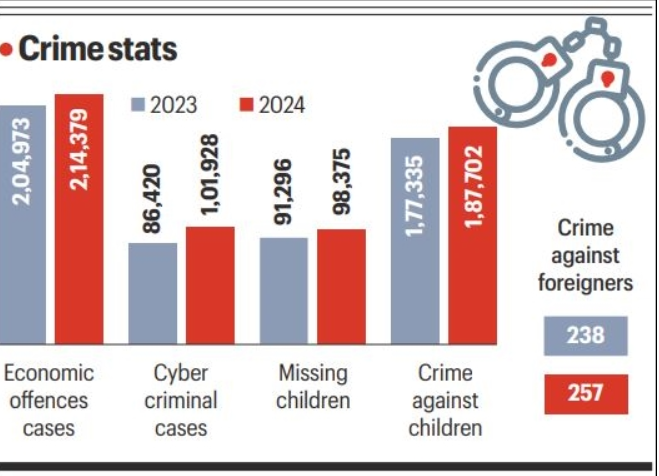
Child safety remained a concern with 98,375 children going missing in 2024 – a 7.8% increase from 91,296 in 2023. These included 75,603 girls, 22,768 boys and four transgender children.
India witnessed an overall decline in crime cases with a 6% dip in 2024, recording 58.85 lakh cases as against 2023’s 62.41 lakh cases, according to the latest data released by the National Crime Records Bureau (NCRB) on 6th May, 2026.
Data for UPSC Exam
Economic offences rose by 4.6% in the period. While 2,04,973 cases were registered in the category in 2023, the figure rose to 2,14,379 in 2024.
NCRB data for UPSC
The NCRB calculates the crime rate on the basis of the number of cases registered per lakh population. It saw a dip during the period – from 448.3 in 2023 to 418.9 in 2024.
Top 20 Reports and Indices for UPSC
#1 Responsible Nations Index (RNI)
#2 Global Terrorism Index 2026
#3 World Happiness Report 2025
#4 Global Peace Index (GPI) 2025
#5 Corruption Perceptions Index (CPI) 2025
#6 Global Risks Report 2026
#7 Climate Change Performance Index 2026
#8 Climate Risk Index (CRI) report
#9 World Water Development Report 2025
#10 Greenhouse Gas Bulletin
#11 Global Tuberculosis Report 2025
#12 Human Development Report 2025
#13 Global Gender Gap Report
#14 SIPRI Report- Trends in International Arms Transfers 2025
#15 Fiscal Health Index 2026
#16 Global Innovation Index 2025
#17 Financial Inclusion Index
#18 Panchayat Advancement Index (PAI) 2.0
#19 Water Bankruptcy Report
#20 Panchayat Devolution Index (PDI)
Panchayat Devolution Index (PDI)
Last year, the Union Ministry of Panchayati Raj released the Panchayat Devolution Index , which is based on a study conducted by the Indian Institute of Public Administration (IIPA).
The index was last published in 2014, and over the past decade, the national average score has increased from 39.92 to 43.89
The IIPA studied 172 panchayats across 68 districts in India to assess the performance of the panchayat system based on six parameters: framework, functions, finances, functionaries, capacity building, and accountability.
Using this data, the IIPA developed the Panchayat Devolution Index .
The index scores states on a scale of 0 to 100. Karnataka, Kerala, and Tamil Nadu ranked highest on the index, while Uttar Pradesh and Bihar showed the most significant improvement.
According to the index, Manipur, Arunachal Pradesh, and Jharkhand are the lowest-scoring states.
Data for UPSC exam
Cyber crimes: It saw an almost 18% jump in the period. A total of 1,01,928 cases were registered under the cyber crimes category, showing an increase of 17.9% from 2023, when 86,420 cases were lodged. The crime rate under this category increased from 6.2 in 2023 to 7.3 in 2024.
Financial Inclusion Index
The Financial Inclusion Index (FI-Index), which captures the extent of financial inclusion across the country, improved to 67 in March 2025 from 64.2 in March 2024, according to the Reserve Bank of India (RBI).
The index captures information on various aspects of financial inclusion in a single value ranging between 0 and 100, where 0 represents complete financial exclusion and 100 indicates full financial inclusion.
The index comprises three broad parameters, access, usage, and quality, having weight 35 per cent, 45 per cent and 20 per cent, respectively.
The FI-Index has been constructed without any base year and as such it reflects cumulative efforts of all stakeholders over the years towards financial inclusion.
Water Bankruptcy Report
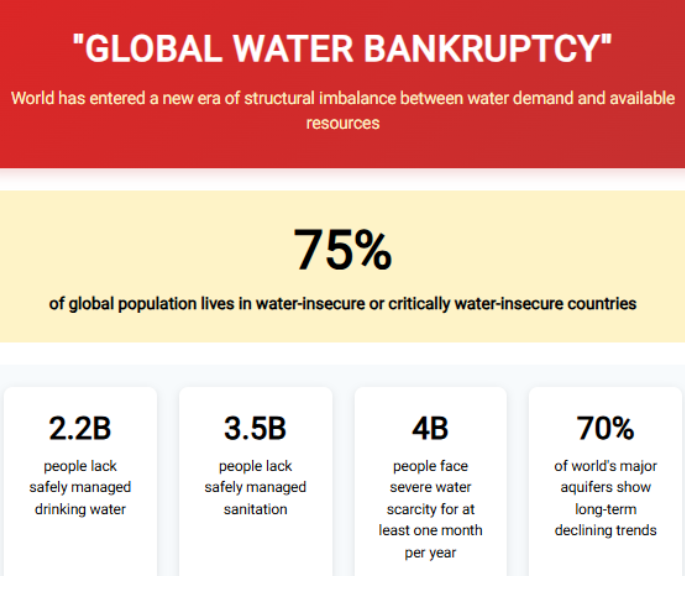
The United Nations University Institute for Water, Environment and Health (UNU-INWEH) has released a new report titled “Global Water Bankruptcy: Living Beyond Our Hydrological Means in the Post-Crisis Era”.
The Report has declared that the world has entered into the era of “global water bankruptcy” due to a structural imbalance between water demand and available resources.
The report calls for effective action to protect water-related natural capital before damages become fully irreversible.
These report become important as we approach the conclusion of the International Decade for Action “Water for Sustainable Development” in 2028 and UN Water Conferences in 2026 and 2028.
Panchayat Advancement Index (PAI) 2.0
The Panchayat Advancement Index (PAI) 2.0 was released by the Ministry of Panchayati Raj. It covers all Gram Panchayats in the country, except West Bengal.
PAI is a multi-dimensional index used to assess the implementation of Localisation of Sustainable Development Goals (LSDGs) across nine broad themes.
Under PAI, the Gram Panchayats have been ranked under five categories based on their score on a scale of 0-100:
Achiever (90-100)
Front Runner’ (75-90)
Performer (60-75)
Aspirant’ (40-60 )
Beginner (below 40).
Among the ‘Front Runner’ panchayats, 943 were in Tripura, which constituted 80 per cent of the state’s total 1,176 rural local bodies.
The state was followed by Kerala, where 10 per cent of its 941 Gram Panchayats have been assessed as ‘Front Runner’.
With 8 per cent of its total 6,794 Gram panchayats assessed as ‘Front Runner’, Odisha stood next.
Global Innovation Index 2025
The Global Innovative Index 2025 published by the World Intellectual Property Organisation (WIPO) shows that R&D growth fell to 2.9 per cent in 2024 and is expected to drop further to 2.3 per cent in 2025.
Switzerland is the world’s most innovative country, followed by Sweden, the United States and others. Europe leads as the most innovative region, with 15 countries in the global top 25.
India is ranked 38 and holds the 1 spot among lower-middle-income economies and in the Central and Southern Asia region. India performs best in Knowledge & Technology Outputs (22) and Market Sophistication (38), while its weakest rankings are in Business Sophistication (64), Infrastructure (61), and Institutions (58).
Fiscal Health Index 2026
NITI Aayog released the Fiscal Health Index (FHI) 2026 for the Financial Year 2023-24. This is the second edition of the FHI, which assesses the state-level fiscal performance in India by expanding coverage to the North-Eastern and Himalayan states and refining indicators to better capture fiscal sustainability.
The FHI continues to use the five fiscal pillars to measure the fiscal health of states.
The five pillars are:
quality of expenditure
revenue mobilisation
fiscal prudence
debt index
debt sustainability.
Odisha remains the top performer, improving its score over the previous year, with Goa and Jharkhand also featuring among the top Achiever states. Gujarat and Maharashtra continue in the top five.
SIPRI Report- Trends in International Arms Transfers 2025
The global volume of major arms transfers between states in 2021–25 was 9.2 per cent higher than in the previous five-year period (2016–20), according to the latest report from the Stockholm International Peace Research Institute (SIPRI).
The five largest suppliers of major arms in 2021–25 were: the USA, France, Russia, Germany and China. These five countries accounted for 70 per cent of all arms exports.
The top five recipients of major arms in 2021–25 were Ukraine, India, Saudi Arabia, Qatar, and Pakistan, which together accounted for 35 per cent of total global arms imports in the period.
The top 3 arms suppliers to India in 2021–25 were Russia (40%), France (29%) and Israel (15%).
Global Gender Gap Report
The 19th edition of the Global Gender Gap Report 2025 was published by the World Economic Forum (WEF) with the global gender gap at 68.8 per cent for 148 countries, marking the strongest annual advancement since the COVID-19 pandemic.
No country has yet achieved full gender parity. Iceland retains the world’s most gender-equal economy for the 16th consecutive year.
India has ranked 131 out of 148 countries, slipping two places from its position last year.
Human Development Report 2025
The latest Human Development Report (HDR) was published by the United Nations Development Programme (UNDP).
Human Development Index (HDI) is composite index that measures average achievement in human development taking into account four indicators:
life expectancy at birth (Sustainable Development Goal 3);
expected years of schooling (SDG 4.3);
mean years of schooling (SDG 4.4);
and gross national income (GNI) per capita (2017 PPP$) (SDG 8.5).
India shows steady upward movement in the HDI rankings, ranking 130 in the 2025 UNDP report.
Global Tuberculosis Report 2025
The World Health Organisation released the Global TB Report 2025. The Report shows that India has achieved only a 21% reduction in new cases and a 28% reduction in deaths between 2015 and 2024.
This does not even come close to the End TB milestones for 2025, a 50% reduction in TB incidence and 75% reduction in TB deaths.
World Water Development Report 2025
On the occasion of the first-ever World Day for Glaciers on March 21, UNESCO released The United Nations World Water Development Report 2025 – Mountains and Glaciers: Water Towers.
According to the UNESCO report, snow cover in nearly all mountain regions has reduced, especially in spring and summer, with an expected further decrease in the coming decades. Snow cover is the total of all the snow and ice on the ground. It includes new snow and previous snow and ice that have not melted.
Climate Risk Index (CRI) report
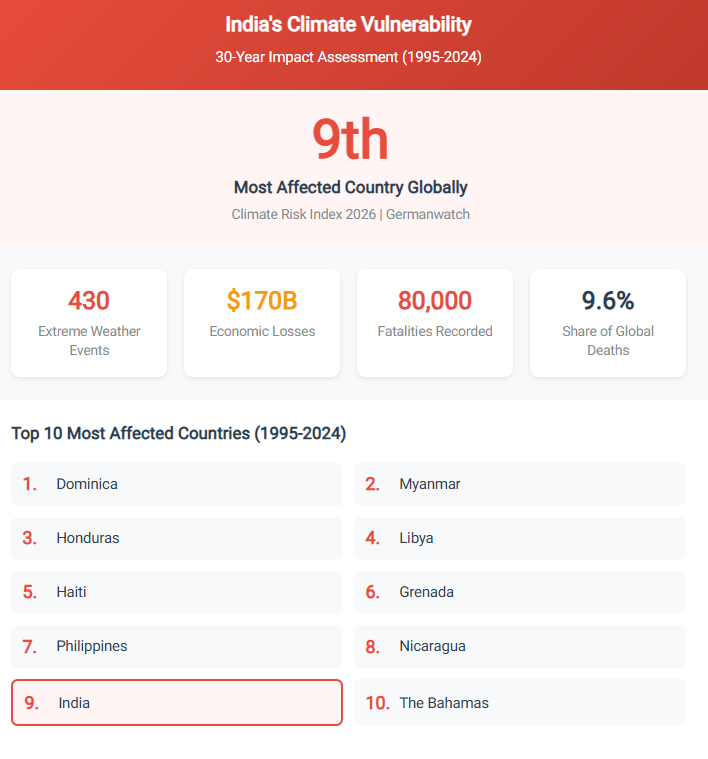
During the COP30 climate conference, the CRI report was released by Germanwatch, a Bonn-based non-governmental organisation.
Published since 2006, the CRI measures the consequences of climate-related extreme weather events’ effect on countries. It ranks countries by their economic and human impacts (fatalities and total affected), with the most affected country ranked highest.
India has been ranked 9th among the countries most affected by climate-related disasters over the last 30 years. The last time this index was prepared, in 2023, India was ranked eighth.
Climate Change Performance Index 2026
The CCPI is an independent monitoring tool that tracks the climate mitigation performance of 63 countries and the EU. The CCPI report is jointly published by Germanwatch, the New Climate Institute, and the Climate Action Network (CAN) International.
The CCPI assesses each country’s performance in four categories:
(i) GHG Emissions (40% of the overall ranking)
(ii) Renewable Energy (20%)
(iii) Energy Use (20%)
(iv) Climate Policy (20%).
According to the CCPI 2026, published at the UN COP30 Climate Summit, the top three places remain vacant, as no country achieved an overall very high rating.
Greenhouse Gas Bulletin
According to the World Meteorological Organisation (WMO) Greenhouse Gas Bulletin, an annual publication, globally averaged surface concentrations of carbon dioxide had increased by 3.5 parts per million from the 2023 levels to reach 423.9 ppm in 2024, a record high.
The year 2024 was also the warmest year ever recorded, with the global average temperature 1.55 degrees Celsius above pre-industrial levels.