GMoi,your STANDARD media’s 5 days a week EXTORTIONIST propaganda HEADLINES on me & my administration’s transformative track record will get you NOTHING & NOWHERE.BLACKMAIL to yield to your GREED? NEVER.Kenya belongs to all Kenyans,not you alone.Jaribu 8 days a week. Do your WORST
My purpose in the game is fulfilled ⭐️
I lived out my childhood dreams, played on the biggest stages, won the biggest trophies. Grateful to God for all of it.
To all my fans, the clubs, my teammates and my family: this will forever be ours. Thank you.
The mission is complete. Now I step into my next calling.
More of the journey to come.
Love,
Divock Origi
In my address titled "The Political Economy of Obedience," delivered last month at the Josef Korbel School of Global Affairs at the University of Denver, I identified five key mechanisms through which African populations have been trained into political compliance. I am sharing a summary here because they explain precisely what we are watching play out in real time every day on this continent.
The first is colonial education. The curriculum inherited from the French, the Brits or the Portugese administration was not designed to produce critical citizens. It was designed to produce a particular kind of political subject. one who understood authority as something to be respected rather than questioned, and who experienced his own political traditions as a source of shame rather than institutional possibility. As I said in Denver, the most effective political prisons are not made of concrete. They are made of curriculum. The Togolese school I attended taught us the genealogy of French kings with more precision than the history of the governance systems that predated French colonial presence on our territory.
The second is the economy of obedience itself. Authoritarian systems endure not primarily through permanent terror but because they structure the relationship between political compliance and material survival so that obedience becomes, for most people most of the time, the rational choice. Access to employment, scholarships, market licenses, import authorizations, health clinic access: none of it politically neutral, all of it conditioned on loyalty. People in these systems do not collaborate with power because they are morally deficient. They collaborate because the scaffolding of their daily lives has been designed to make non-collaboration economically catastrophic.
The third is the family as a site of control. In conditions of economic precarity, the individual who considers a dissident act must calculate not only her own risk but the risk she imposes on her parents, her siblings, her children, her cousins etc. I have watched people of intelligence and moral clarity retreat from political engagement not because they were afraid for themselves but because they could not justify the devastating exposure their activism would bring to their families. The authoritarian state does not need to threaten everyone. It only needs to ensure that the threat to one is visible and comprehensible to all.
The fourth is religion. In many parts of Africa, religious institutions have been deployed, not by their most honest practitioners but by their most politically convenient ones, to transmit a theology of earthly resignation and otherworldly reward that discourages political engagement. The pastoral instruction to render unto Caesar what is Caesar's sits very comfortably with the interests of Caesars who have no intention of rendering anything to anyone. Liberation theology, which in Latin America produced an extraordinary tradition of religiously grounded political resistance, has had a far more contested reception in much of African Christianity and Islam, partly because of the direct entanglement of many religious institutions with state power, which has made spiritual authority and political compliance structurally allied.
The fifth is media. In authoritarian African contexts, state and privately owned media aligned with power do not typically practice crude propaganda. They practice something more subtle and more durable: the selection of what is visible and what is invisible; the framing of social problems as natural phenomena rather than political choices; and the treatment of opposition voices as marginal or foreign-funded. The film industry participates in this discipline in its own way, through the systematic promotion of narratives that depict poverty and wealth as conditions of fate or personal failure, stories in which the distance between the poor and the rich has everything to do with luck, talent or divine favour and nothing to do with power, policy or the deliberate engineering of inequality.
The cumulative effect, over decades, is a population whose political imagination has been narrowed to the point where alternatives are genuinely difficult to conceive, not because the alternatives do not exist, but because the political ecosystem has ensured they remain invisible.
These are the operating manual of authoritarian systems on this continent. And authoritarianism today is not limited to regimes with a known dictator who has held power for decades. It extends equally to regimes that perform a change of leadership through placebo elections conducted every four to five years, producing a new face every eight to ten years while the same system of impunity, patronage and repression remains structurally intact.
I would argue that these are in fact the more dangerous form of authoritarianism because their citizens are deceived into believing they are living under a democracy when they are in reality governed by plutocrats. The citizen under an obvious dictatorship at least knows what he is fighting. The citizen under a rotating plutocracy has been convinced there is nothing to fight at all. He votes, he watches a new face take the oath, and he mistakes the performance of transition for the substance of change. He ends up with no voice, no justice, no agency, and worse, no drive to fight for his own dignity. For one can only fight for liberation after acknowledging one's condition of oppression.
My dear brother, Mau Mau fought against land alienation, police violence and lack of sovereignty. They were not alone. The trade unionists, Dini ya Msambwa and Barsirian arap Manyei were also in colonial detention at the same time. What made the status of the Mau Mau different is that the British decided to also engage in collective punishment of the Kikuyu Embu and Meru and pretend that the struggle was ethnic, not political.
So few Kenyans know that the Maasai, the Kamba and the Luhya participated in the Mau Mau. Chief Mukudi of Samia was detained by the British for administering the Mau Mau oath. I saw ES Atieno Odhiambo mention some Luo soldiers in the Nairobi ranks of the Mau Mau but I lost the reference. I'll keep looking for it.
Independence isn't liberation. It's the management of the colonialist state by Africans.
The whites were not chased out. They are still here. They still own land, plantations, mines and major installations. They gave us CBC. They just got a military agreement in Mombasa which exempts soldiers from prosecution. Wazungu didn't leave. They retreated from visibility, but not from power.
Until the late 1950s, the British had no intention of leaving. In their dream, Kenya was to be a multi-racial state. Shortly after, they aimed to leave in 1975. Then after, they decided to leave in 1963, but before they did that, they needed to ensure that Kenya was left in the hands of the sympathizers, your Lancaster people and the #IwenttoAlliance's.
Whites remained in the independence government, protected by Sir Charles Njonjo of Kabeteshire. Bruce Mackenzie was Ministry of Agriculture. Humphrey Slade the Parliament speaker. Goeffrey Griffin, a former information officer, started Starehe. Carey Francis moved to Pangani High School. In 1972, UoN students were violently suppressed by the police after complaining about the architecture department being staffed by wazungu faculty who were failing the students. Guess who was in charge of Nairobi Provincial Police? James Myles Oswald, who had killed many Mau Mau fighters.
The decision of the British to hand over the state to Africans was forced by the African resistance, of which Mau Mau was a major player. The British realized that it would be too expensive to keep suppressing rebellion, especially because the Mau Mau started to regroup in 1961. Plus the whole pan-African world's imagination was captured by the resistance. It was cheaper for the British to have African elites, your favorite Lancaster guys, rather than settlers, in charge. But overall, the British remained in charge from London.
Forcing the British to hand over the colonial state doesn't mean we were liberated. It just means we got black settlers in charge of the state, instead of white ones.
Reading helps even the best and the brightest.
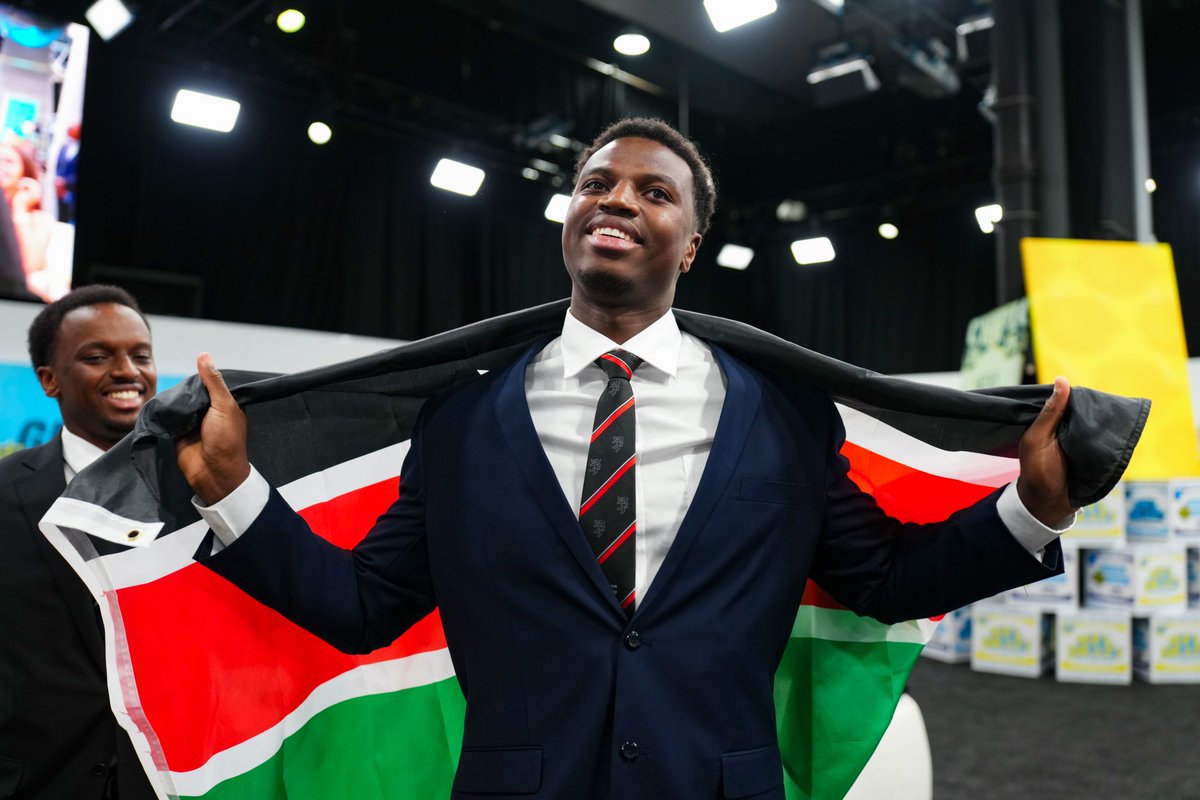
A dream come true for Joshua Weru 🇰🇪
Coming from a rugby background, he will join fellow IPP alum, Uar Bernard 🇳🇬 on the @Eagles, and will currently be the lone Kenyan in the NFL, paving the way for others 🙏
#FlyEaglesFly
HISTORY HAS BEEN MADE 🫨
Sabastian Sawe becomes the first person ever to break the 2-hour barrier in official race conditions, storming to a historic 1:59:30‼️
@KejelchaYomif, on his marathon debut, also breaks 2 hours with a stunning 1:59:41 and @jacobkiplimo2 clocks 2:00:28, also faster than the previous world record 😤