Central banks are about to take centre stage, but the forces driving the dollar, euro, and pound extend well beyond interest rates.
https://t.co/x8j50ebpxK
If history is any precedent, every first-round presidential leader since Brazil returned to direct presidential elections has gone on to win the run-off.
Central banks are about to take centre stage, but the forces driving the dollar, euro, and pound extend well beyond interest rates.
https://t.co/x8j50ebpxK
Hedge funds have been selling global equities this month, with short leverage now in the 99th percentile over five years, per Goldman.
Plenty of fuel for a squeeze if equities find a reason to rally.
@Marco_mmabjj Yeah, CDS are largely an institutional instrument, but that doesn’t make them irrelevant to everyone else. Understanding what the market is pricing in terms of credit risk can be just as useful as trading the instrument itself.
From French sovereign debt to US tech, CDS is finding its way into plenty of market conversations right now.
A good time to understand how the market for credit risk actually works. Our evergreen primer is below.
France worries are all perfectly rational & valid yet the mkt is trading as if the ECB will never provide a backstop…they will, they’ll have to…just as soon as they’ve thought up a new acronym and a way of making it look like they’re not simply bailing out a profligate state…
*FRANCE’S 10-YEAR BOND RISK PREMIUM RISES TO 175 BASIS POINTS
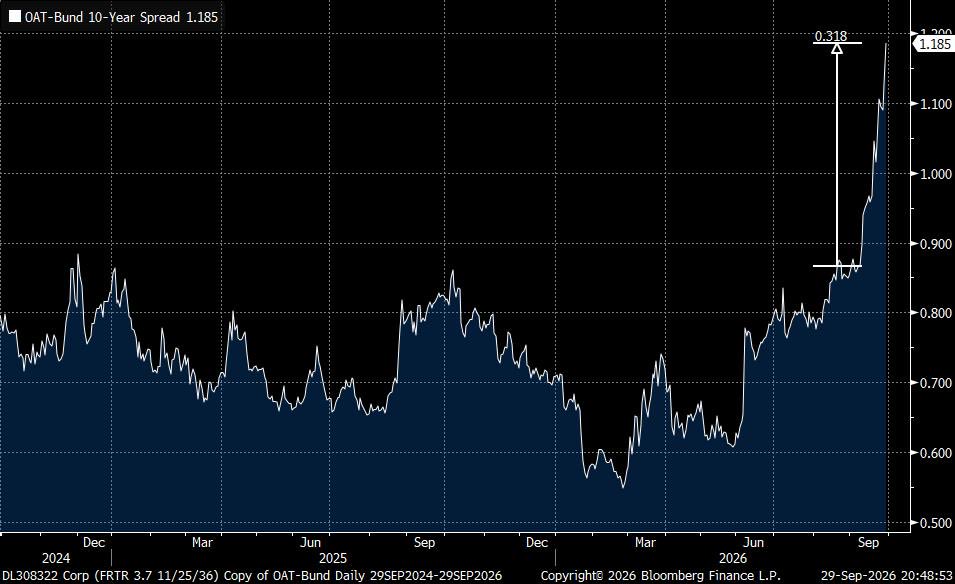
Have to admit, I didn’t see OAT-Bund widening quite this far.
France looked to be in a difficult spot when we put the trade on at 87bps, but the deterioration has been considerably worse than we anticipated.
One of the cleaner macro expressions we’ve had this month (of which there have been many). OAT-Bund was 87bps when we put it on. It’s now 118bps, through 100bps for the first time since 2012.
France had enough idiosyncratic risk to underperform even through a global bond selloff. The fiscal picture hasn’t improved, while the energy move continues to hurt those most exposed in Europe.
The trade is getting crowded and we’re close enough to our 120bp target. Taking it off the book here, which historically is a fairly reliable catalyst for another leg higher. OAT-Bund bulls can thank us later.
What is AI really capable of in bio?
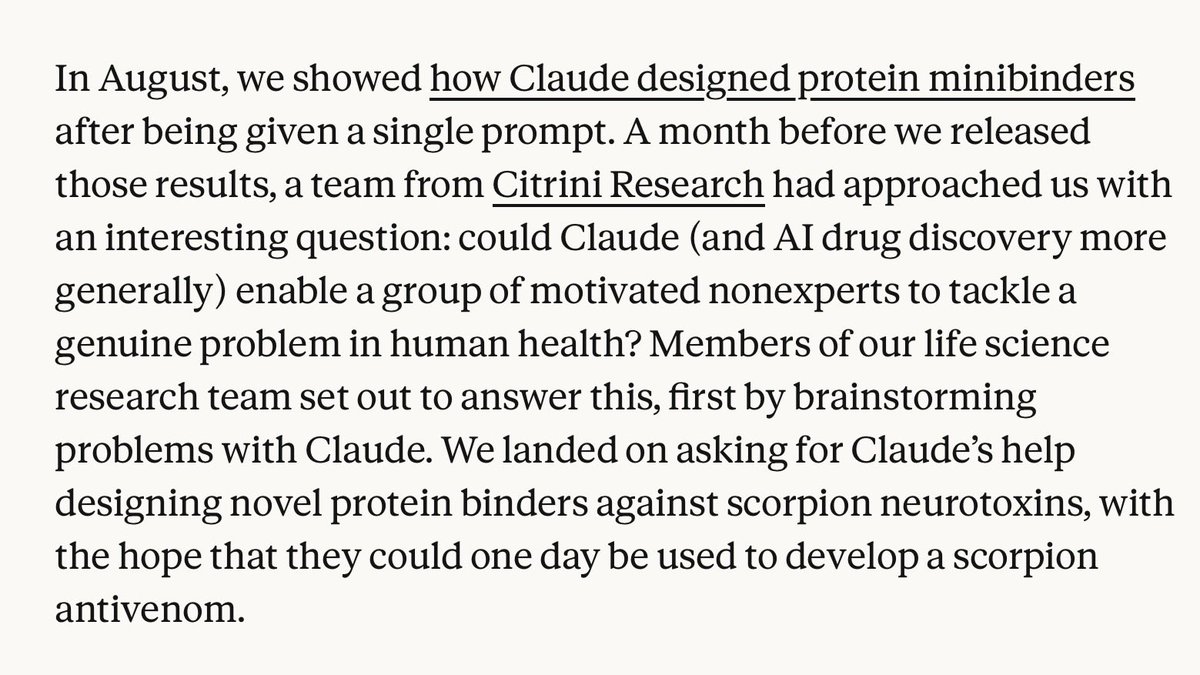
To separate hype from reality, we spent 3 months working firsthand with @AnthropicAI's internal research model to see if it could create an experimental scorpion antivenom.
Introducing Citrini Therapeutics.
https://t.co/VAUBSi7sNy
One thing I’ve been thinking about since reading this is the Outsider Advantage. Expertise isn’t the entry requirement for solving complex problems. AI likely opens this up even more.
One illustration of this came from the oil industry, which had spent years struggling with a problem involving the extraction of thick, viscous oil from storage barges.
The eventual solution came from someone with no particular expertise in oil recovery. A chemist recalled how vibrations were used to help concrete flow during construction and realised the same principle could work with oil.
Eli Lilly also solved a problem with a similar approach, and thus idea became the foundation of InnoCentive, a platform where companies could post problems that had stumped their experts and invite outsiders to solve them. Many successful solutions came from people working in entirely different disciplines.
Expertise can sometimes narrow the way we approach a problem. Outsiders bring different mental models, experiences, and analogies that specialists might never consider. This is all very well explained in David Epstein’s book “Range”, where I first read about it.
Bring this back to Anthropic and Citrini’s experiment, AI could fundamentally change the InnoCentive model.
Previously, outsiders needed to possess some transferable knowledge that happened to be useful. They could contribute an unexpected idea, but turning that idea into a technically viable solution often still required substantial specialist expertise.
AI lowers that barrier, giving outsiders access to technical knowledge, scientific literature, and tools that previously required years of training to use effectively.
I think it has become an interesting possibility that more of the breakouts in the next decade will come from people who were never formally trained in the fields they’re advancing, once again because they see something the experts don’t. The Outsider Advantage.
New on our Science Blog: designing protein binders against scorpion neurotoxins.
Scorpions sting about 1.2m people every year, and antivenoms are often costly or in short supply. Claude has made an early step toward finding new treatments.
https://t.co/l6LgdEqM7I