$CSU Constellation Software just reported Q3, and it's a better quarter than the headline makes it look.
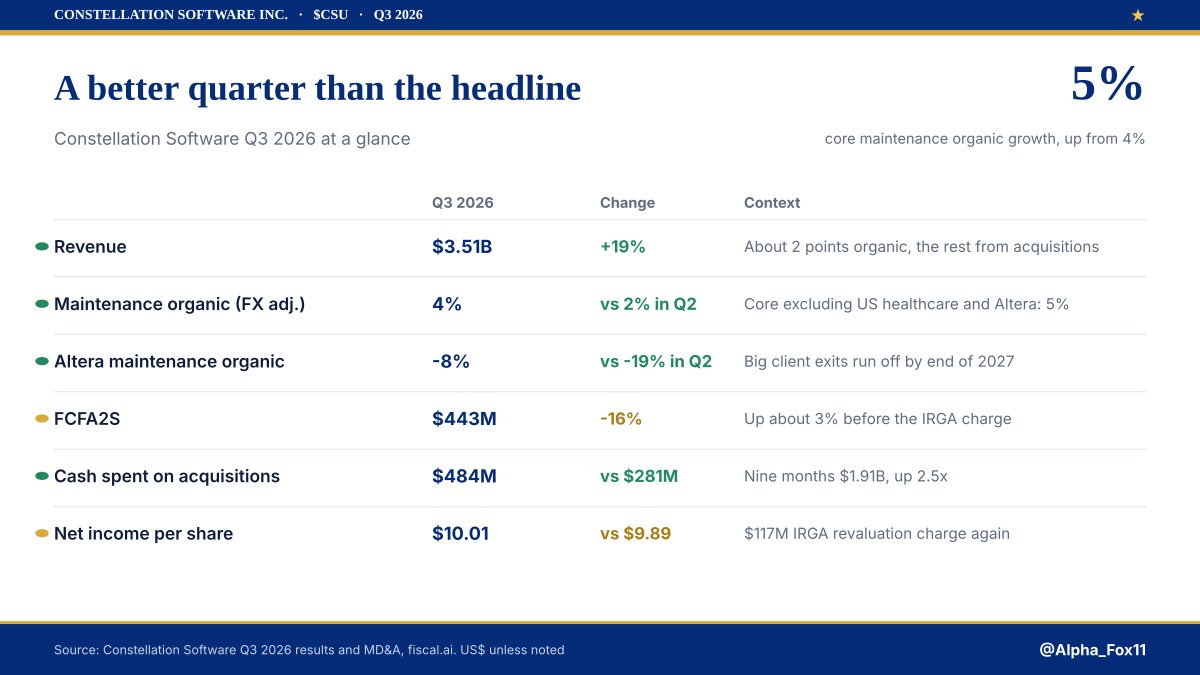
Revenue $3.51B, up 19%. Maintenance organic growth back to 4% after FX, double last quarter. The core business outside US healthcare grew recurring revenue 5%. Altera's bleeding slowed sharply. And they've spent 2.5x more on acquisitions this year than last.
The one ugly number is free cash flow to shareholders, down 16%. That one has a story behind it too. Full breakdown below.
$CSU reports Q3 tonight after the close. Here is what I am watching and where I think it lands.
The setup. Q2 was the quarter that spooked people. Revenue grew 17% to $3.34B but organic growth was only 3%, and 1% once you strip out currency. Altera was the drag again, down 22% organic, and ex Altera the core ran about 2% FX adjusted with recurring revenue at 4%. The stock went from near C$5,000 at its 2025 high to a C$2,196 low in February and the whole debate became "is AI eating vertical market software or not." It has since clawed back to the mid C$3,000s heading into the print.
Four things matter tonight.
1. Organic growth, especially maintenance and recurring ex Altera. Q2 was 4%. Topicus reported Wednesday with 5% organic, which is the same engine in Europe and tells me the core installed base is not eroding. If CSU prints recurring organic at 4% or better, the AI disruption story loses its best talking point. Anything with a 2 handle and the bears get another quarter of oxygen.
2. Capital deployed. They put $893M to work in Q2 and had already announced $818M of deals closed or committed heading into Q3, so the visible 2026 tally was around $2.5B before this quarter even started. I want to see Q3 cash deployed above $700M again. Deployment is the whole thesis. The multiple compressed because people stopped believing the machine could keep finding $2B to $3B a year at 20%+ returns. Prove it can and the multiple comes back.
3. FCFA2S. Q2 was $345M, up 57%, and H1 was $1.08B, up 48%. That growth rate will slow because last year's comps get harder, but anything north of $300M for the quarter keeps them on pace for roughly $1.5B for the year. At a C$3,500 share price that is about a 4% cash yield on a business compounding deployed capital at high teens. That is not a broken stock.
4. Altera and margins. Opex grew faster than revenue in Q2 and the pre amortization margin slipped to about 25%. I want Altera's decline to narrow and margins to hold. If Altera is still down 20% and margins slip again the market will keep treating the company as "great acquirer, weak operator."
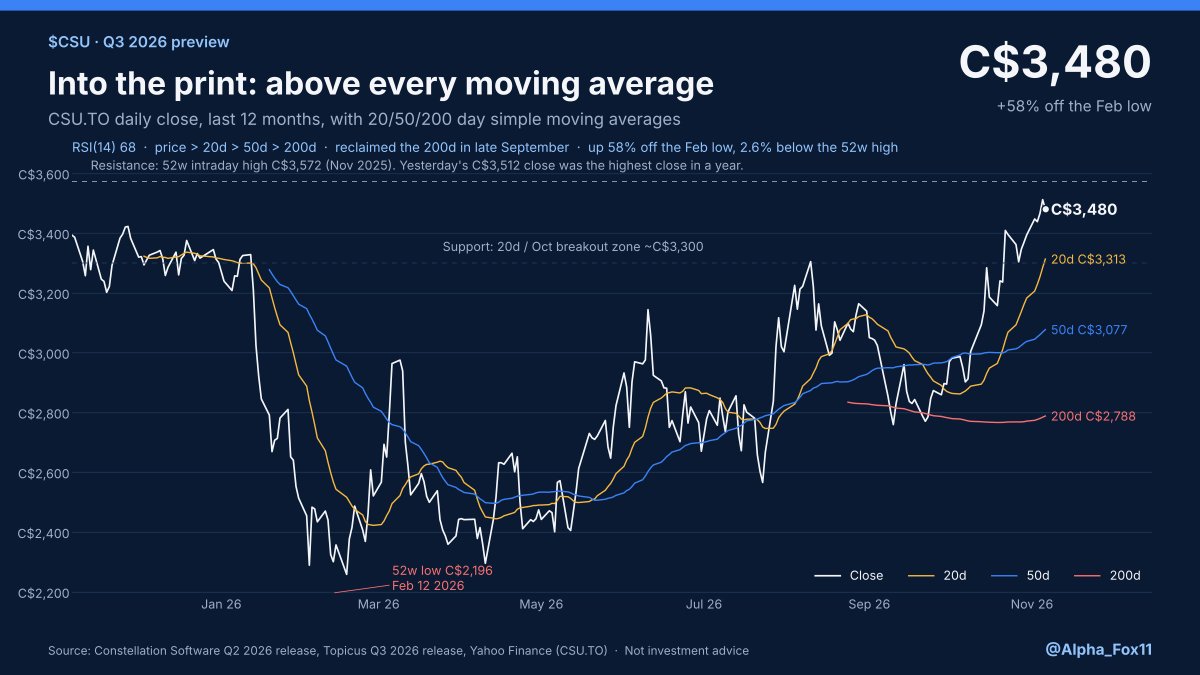
The chart is already leaning bullish. Yesterday's C$3,512 close was the highest in a year, price is stacked above the 20, 50 and 200 day averages, and it reclaimed the 200d back in late September. RSI at 68 says it's extended, so the easy money on the bounce is probably made. The level that matters is C$3,572, last November's high. A clean print clears it and the next real resistance is a long way up. A miss and C$3,300 is the first place buyers show up, with the 50d near C$3,080 below that.
What I think happens. Revenue around $3.5B, up 17 to 18% on the back of H1 deployment. Organic lands at 3 to 4% with recurring at 4 to 5%. FCFA2S beats. The headline EPS will swing around on IRGA and FX noise like it always does and the algos will trade it for ten minutes. Then the market reads the organic line.
My base case is a clean enough print that the recovery continues. The bar has been reset low, the deployment pace is the best in years, and Topicus already showed us the core is fine. I am long and not trimming into it.
My take: a quiet quarter for the business and a loud one for capital deployment. The AI fear hasn't shown up where it would matter most, in maintenance revenue.
What I'm watching: Monday's 8am call with Mark Miller, any color from the Chief AI Officer they appointed in October, whether core organic growth holds at 5%, Altera's runoff, and how much of that $673M pipeline closes in Q4.
$CSU.TO #ConstellationSoftware
$CSU Constellation Software just reported Q3, and it's a better quarter than the headline makes it look.
Revenue $3.51B, up 19%. Maintenance organic growth back to 4% after FX, double last quarter. The core business outside US healthcare grew recurring revenue 5%. Altera's bleeding slowed sharply. And they've spent 2.5x more on acquisitions this year than last.
The one ugly number is free cash flow to shareholders, down 16%. That one has a story behind it too. Full breakdown below.
Bull vs bear.
Bull: recurring growth bounced back, the core outside healthcare is growing 5%, Altera's drag is fading, deal spending is up 2.5x, and the balance sheet is fine. You're paying 27x for a compounder the market paid 49x for last year.
Bear: total organic growth is still only 2%, license and services are shrinking, US healthcare keeps losing customers, sales and G&A costs are outrunning revenue, and the IRGA charge will keep swinging cash flow around as Topicus rises.
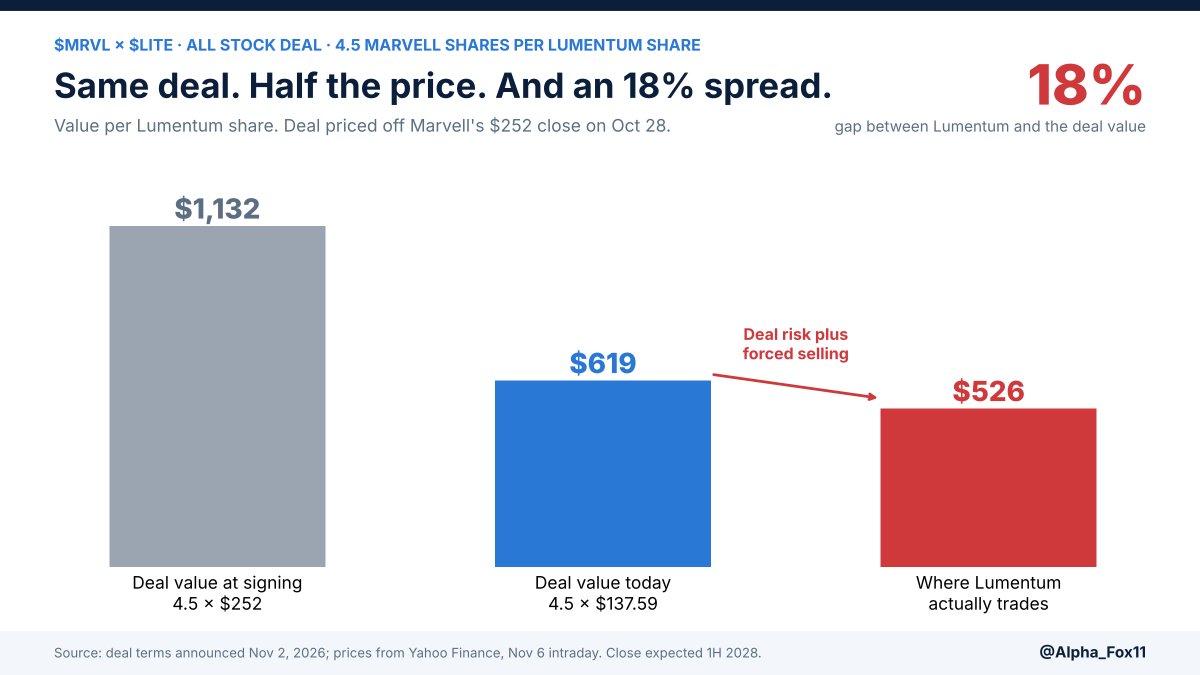
This is crazy, and the arb math makes it even crazier. The deal is fixed at 4.5 Marvell shares per Lumentum share. At $137.59 for Marvell, that's $619 of stock for every Lumentum share, yet Lumentum trades at $526. That's an 18% spread on a signed deal. Part of it is real deal risk with a close not expected until 2028, but part of it is forced selling. Merger arb is usually one of the first trades funds dump in a week like this.
The arb trade: long 1 Lumentum share, short 4.5 Marvell shares. If the deal closes, your Lumentum share turns into exactly the 4.5 Marvell shares you're short, so the two cancel out and you keep the $93 gap, about 18%. Because you're hedged, it doesn't matter where Marvell trades in the meantime. The risk is the deal breaking, because then Lumentum falls back to its standalone value and the hedge stops protecting you.
Great chart, but I would read it the other way. Semis look cheapest on forward earnings right when the earnings are least trustworthy. Nvidia is running a 75% gross margin on chips that customers are still waiting in line for. That is a shortage price, not a number you can underwrite for a decade. In 2015 the multiple was 12x on PC gaming margins that were half of today's. Same P/E, totally different quality of E.
Every chip cycle I have looked at ends the same way. Customers double order, supply catches up, pricing rolls over, and the E disappears while the share price barely moves. The 12x becomes 40x and nothing changed but the earnings. The time these stocks actually look expensive on P/E is at the trough, when inventories are bloated and capex is being cut, and that has been the moment to buy every time.
So a 10 year low on forward P/E is not the market saying cheap. It is the market saying late. The only question is whether the hyperscaler capex cycle is different, because that is what is holding the E up.