12/12
Now put it together.
AST doesn't need to own:
The AI model.
The cloud.
The robot.
The autonomous vehicle.
The terrestrial network.
Or even the end customer.
It just needs to become:
THE SPACE-BASED CONNECTIVITY LAYER BETWEEN THEM.
And this brings me back to where I started.
I THINK THIS MESSAGE SHOULD BE COMMUNICATED LOUD AND CLEAR BY BOTH THE MNOs AND $ASTS.
Not simply:
“We can eliminate dead zones.”
But:
“WE ARE BUILDING THE CONNECTIVITY LAYER THAT CAN EXTEND THE EXISTING MOBILE NETWORK INTO A WORLD OF BILLIONS OF PEOPLE + INTELLIGENT MACHINES.”
That's a very different message.
And potentially a very different TAM.
Because the question isn't simply:
How many people live outside terrestrial coverage?
The bigger question is:
HOW MANY PEOPLE + MACHINES NEED CONNECTIVITY EVERYWHERE?
1/12
$ASTS, $VZ, $T, $TMUS
COMMUNICATION MATTERS. CONNECTIVITY EVEN MORE.
I don't believe better communication from $ASTS or its MNO partners would have prevented this selloff.
There are much bigger forces at work: positioning, risk appetite, execution concerns, competition, short interest, macro, etc.
But that doesn't mean communication shouldn't be a LOT better.
And I'm not talking about more press releases regarding launches or shipments, there are legal limits to what they can disclose.
I'm talking about clearly articulating the size of the opportunity they're building toward.
Because there is a striking difference between how Elon Musk communicates the future of connectivity and how U.S. MNO CEOs communicate satellite D2D.
The MNOs aren't dismissing D2D.
THE PROBLEM IS THAT THE OVERALL MESSAGE IS MUDDLED AT BEST.
11/12
And if we're talking about billions of additional intelligent endpoints, simply reaching them isn't enough.
CAPACITY MATTERS.
AST's spectrum strategy combines partner MNO spectrum with MSS spectrum, targeting ~100 MHz of spectrum access in the U.S. and 60+ MHz globally on a market-by-market basis.
Why is that important?
Because the opportunity could evolve from:
“Can I get a signal here?”
to:
“Can the network support billions of connected people + machines?”
COVERAGE SOLVES GEOGRAPHY.
CAPACITY SOLVES SCALE.
AST's own 2026 materials already identify additional applications including IoT and AI edge compute.
The pieces of a much larger TAM are starting to appear.
$ASTS
On the SpaceX/Grain spectrum news:
VZ was down ~10%. Now ~4%.
T was down ~11%. Now ~4.5%.
TMUS was down ~13%. Now ~6%.
These are the companies the market supposedly decided were directly threatened by SpaceX becoming a major mobile competitor.
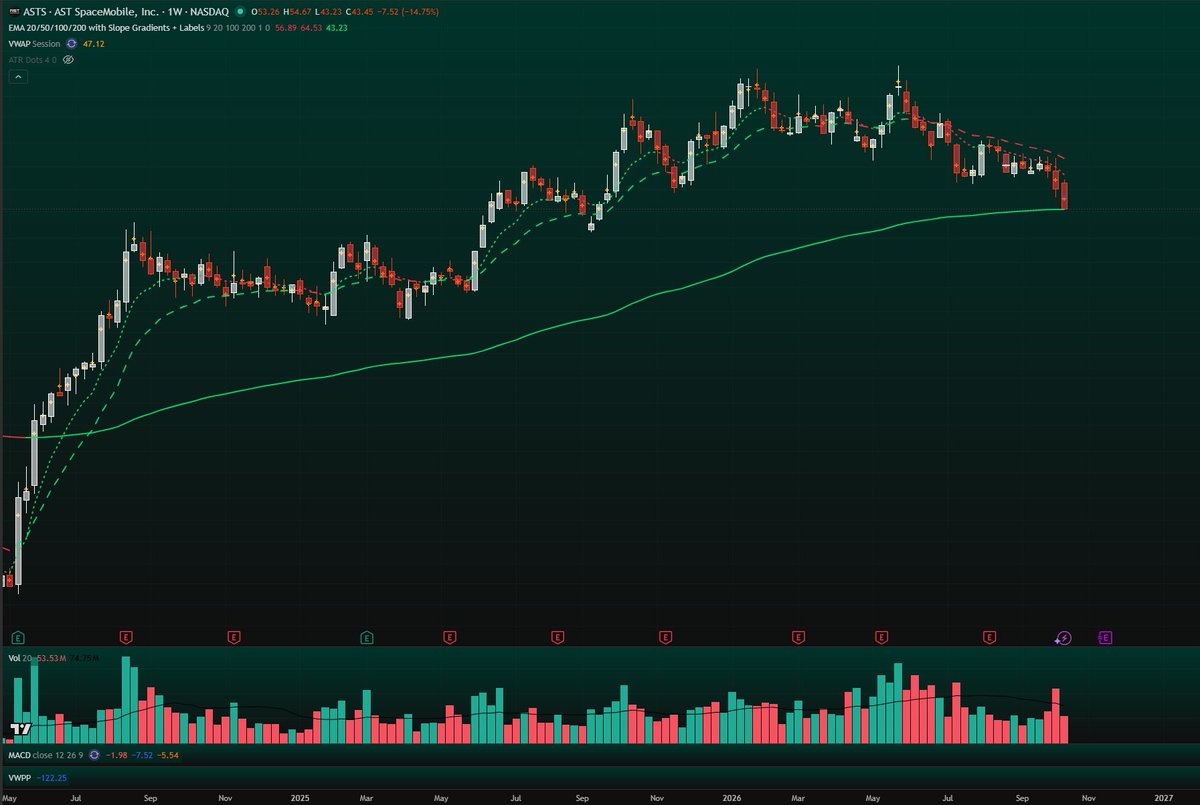
Meanwhile $ASTS — their independent satellite partner and their most important strategic asset in competing with SpaceX — made ANOTHER new low today since announcement and is still down ~27%.
So the companies facing the actual competitive threat recover most of the selloff...
...while the company that potentially becomes MORE strategically important to them because of that threat keeps getting destroyed.
?????????????????????????????????
$ASTS is currently being dominated by structural flows and liquidations rather than fundamentals.
Leveraged ETF rebalancing (mostly ASTX) alone creates roughly 75K shares of same-direction flow for every 1% move in ASTS. Add forced liquidations/deleveraging and you get a powerful feedback loop.
$ASTS
Difficult time to own Space.
First, Space had to make room for the SPCX IPO and the AI trade.
Now we've apparently arrived at:
AI good → yields ↑ → SPY/$QQQ ↑, IWM ↓ → Space↓ (except SPCX, because AI exposure)→ $ASTS ↓
AI bad → yields ↓ → SPY/QQQ↓/IWM maybe ↑ → Space still ↓ (SPCX ↓ on AI + today's RKLB delay)→ $ASTS ↓
AI really bad → all hell breaks loose → everything ↓
So we've successfully constructed a regime where $ASTS goes down regardless of the input. 😂
Oh and meanwhile, Ron Baron sees Starlink worth ~$15T in 10 years.
Let's conservatively assume just 1/3 of that value eventually comes from mobile: ~$5T.
$ASTS today: ~$16B.
I understand the production delays. I understand the launch delays. I understand the execution risk.
But a market that can contemplate $5T of value for Starlink Mobile while assigning ~$16B to $ASTS today is pricing an extraordinary divergence in outcomes.
Something in those two expectations doesn't add up.
@endless_frank Not just retail, they definitely fall within the base. Characteristics of the investor base: Levered. Concentrated. Max long. Options-heavy. High factor overlap. Momentum-sensitive, in risk-control mode.
I don't believe $ASTS is being shorted primarily because of valuation.
What's being shorted is an investor base — and $ASTS happens to be one of the stocks that investor base owns.
Smart hedge funds, large MMs and trading desks understand exactly who owns these names. They understand positioning, leverage, options exposure, liquidity and, most importantly, how those investors behave under pressure.
They also operate with an enormous information advantage. Just look at some of the price action ahead of $ASTS share/convert issuances, or more recently around the Grain spectrum deal. Draw your own conclusions.
You don't need billions of dollars of selling to break a stock. You need to know when and where to push it.
Hit it when liquidity is thin. Break an important technical level. Trigger stops. Push calls out of the money. Get momentum algos to flip. Scare leveraged retail. Then let the selling create more selling.
Volume creates volume. Fear creates liquidity.
Once the move starts, the market does most of the work for you.
That's why I think people obsessing over whether $ASTS is “overvalued” are missing what's actually happening.
Look across high-beta, retail-heavy growth names. You're often watching the same investor base being attacked at the same time.
Shorts aren't just trading $ASTS.
They're trading the people who own it.