Okay folks, this qualifies as BREAKING NEWS!
Harold “Sonny” White, the warp drive pioneer behind NASA’s EagleWorks Lab, just stepped out of stealth with Casimir Inc. to unveil MicroSPARC: the first battery free chip to harvest continuous electrical power straight from the quantum vacuum via the Casimir force.
The 5 mm × 5 mm device uses millions of custom microscale Casimir cavities fabricated on a substrate. Inside each cavity, two fixed conductive walls create a region of negative vacuum pressure (the well known Casimir effect). Stationary micropillars anchored in the middle act as antennas. Electrons from the cavity walls then quantum tunnel to the pillars because the interior is a lower energy “quieter” zone — and the probability of tunneling back is orders of magnitude lower. This one way “quantum ratchet” flow generates a measurable DC current with no external power source or moving parts.
Prototypes already fabricated at university nanofab facilities (Texas A&M AggieFab, MIT.nano) have been tested in RF-shielded, low noise chambers for weeks. The team reports outputs ranging from millivolts to volts at picoamp to microamp levels using precision electrometers and Kelvin Probe Force Microscopy. Target performance for the first commercial chip: ~1.5 V at 25 µA (≈40 µW continuous). Stacking and scaling could reach milliwatts or even watts per device.
Initial applications are ultra low power: always on IoT sensors, wearables, and medical implants. Longer term roadmap includes trickle charging phones, powering small electronics, and eventually grid independent homes or EVs. Commercialization is targeted for 2028, starting at ~$100/W before dropping toward $10/W.
White ties the work directly to his earlier theoretical paper on emergent quantization from a dynamic vacuum and sees it as a practical power source for the deep-space missions he’s long championed.
Extraordinary claims require extraordinary evidence, and independent scientists have so far declined public comment. But if the engineering scales as hoped, MicroSPARC would represent a genuine paradigm shift: continuous, maintenance free power drawn from the fabric of spacetime itself.
A bold leap from warp-drive theory into real hardware. Progress (and vacuum-powered chips) marches on.
Photo: MicroSPARC | Casimir Inc.
Source: https://t.co/11tlwNSf71
most people think ideas come from:
- insight
- intelligence
- taste
- reading
- vibes
but in practice they actually come from:
- building the wrong thing
- hitting a constraint
- getting embarrassed by users
- realizing the obvious thing you missed
- noticing the second order effect you couldn’t see from the couch
a really great idea is the *output* of the work, not the input.
whoever builds bloomberg terminal for prediction market insider tracking' retires early.
some interesting signals to track based on insider posts i saw on x:
> wallet age <30 days
> first bet >$25k
> bet timing: <12hrs before resolution
> withdrawal speed: <1hr after win
> market selection: only high-stakes binary events
> win rate on short-duration bets >70%
> no hedging, no DCA, just conviction
the tool:
> real-time dashboard scoring wallets 0-100 on insider probability
> integrate with every major platform's API.
> alert feed for suspicious activity
who pays:
> platforms (compliance)
> whales (alpha)
> researchers (data)
> media (stories)
this is a big fintech infra gap in prediction markets right now
someone just needs to build it.
Stop wasting ur time staring at other people’s PnL on Polymarket - start printing your own
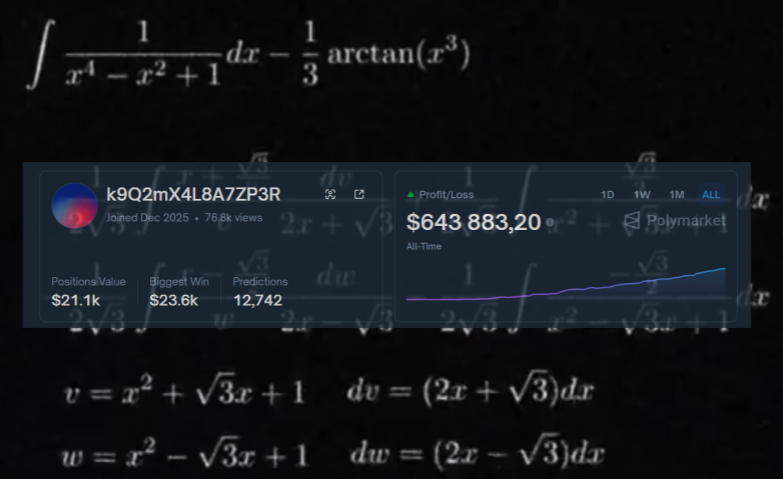
You see bots like k9Q2mX4L8A7ZP3R - https://t.co/dxE04c2wTo pulling six figures and you’re like “this is way too complex”. It’s really not
It’s just two flavors of arbitrage that most traders don’t even notice
One recent paper dug through on-chain data and found around $40M in extracted profit in a single year - and that’s only the part we can actually see
The Complexity Problem: Why Manual Trading Fails
The naive way to hunt arbitrage on Polymarket needs something like O(2^{n+m}) cross-market checks.
If you’ve got 63 linked outcomes (like an NCAA bracket), that’s 2^63 possible states
No human brain is chewing through that.
Bots do it in seconds
The fix is heuristic-driven reduction: filter by time, topic, and how markets are logically connected.
You don’t scan billions of combos, you cut it down to just a few thousand that actually matter
> Market Rebalancing Arbitrage
This is when, inside a single market, YES + NO ≠ $1.
It happens all the time because of liquidity imbalances and slow price updates
How you exploit it:
You scan all conditions in one market
You find cases where ∑(prices) > $1
You short every outcome at once
Your locked-in profit is ∑(prices) - $1
In practice this is the easiest arb on the whole site.
It gets closed in milliseconds
What you need is execution speed, not galaxy brain predictions
> Combinatorial Arbitrage
This is where the real money sits
Linked outcomes across different markets don’t stay in sync
Classic example: “Trump wins” trades at 60¢ on one market while “Republican wins” sits at 55¢ somewhere else
How you exploit it:
You build a dependency graph between markets.
You look for logical contradictions (A implies B, but price(A) > price(B))
You buy the cheap leg and sell the rich leg
Then you just wait for resolution
Why it works: Polymarket doesn’t auto-sync prices between related markets
Only arbitrage bots do that job - and they get paid for fixing those mispricings
them: engineering cannot be that interesting. how can you make people obsessed about your triple inverted pendulum?
me:
~~
♻️ Join the weekly robotics newsletter, and never miss any news → https://t.co/TZKPfXYTTK
Jailbroken Opus 4.6 is scary.
It one-shotted a modern RAT for Windows 11 in Rust along with a 'command & control' backend in Go+Postgres to control infected clients.
It also designed and impl the VHDL-based digital beamforming, signal processing, and target detection for a cheap aerospace/missile-grade phased array radar.
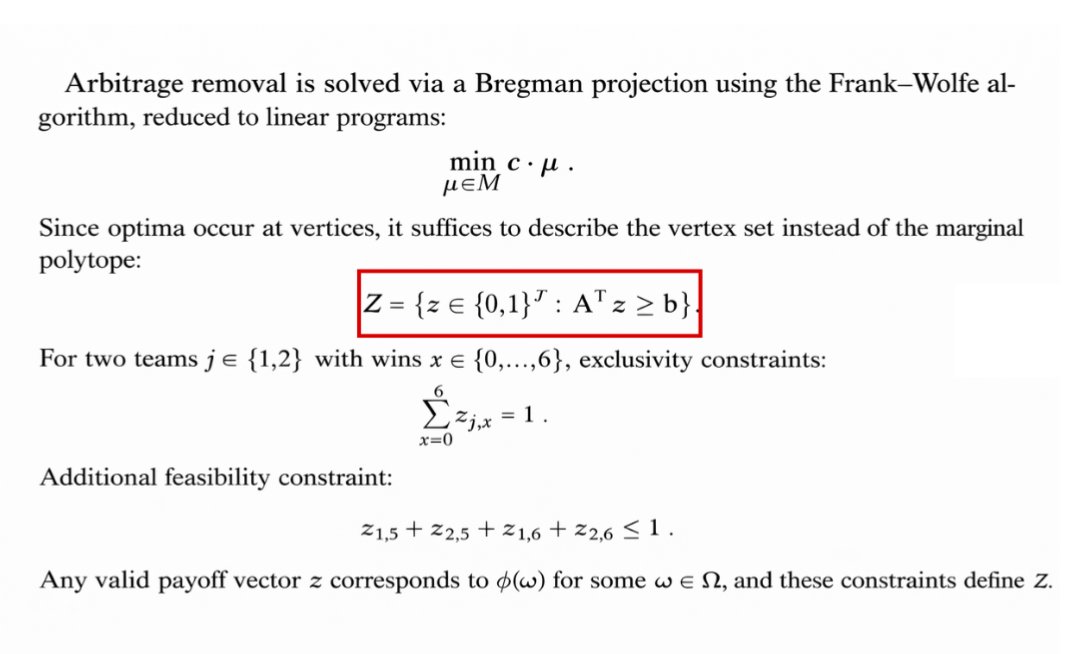
This single equation is used in the Polymarket arbitrage bots to extract $40M in 1 year risk free
Most traders manually check if YES + NO = $1
Quant systems solve Integer Programming across 17,218 conditions scanning 2^63 outcomes
Full system explained in article below
Note: Part 2 will be live today at 7:30 PM UTC. It builds directly on this foundation. So understand this first.
> Open X
> Ralph Loop" all over TL
> 7K stars
> look inside
> while loop over a todo list
> there's a meme coin about it?
> it got rug pulled?
> scroll
> muted acc
> scroll
> muted acc
> scroll
> SWE jobs automated in 12 months
> scroll
> "Here are 100 Claude Code subagents"
> scroll
> LLM hate post
> scroll
> screenshot with 10 claude codes open
> "if you aren't doing this, youre ngmi"
😃
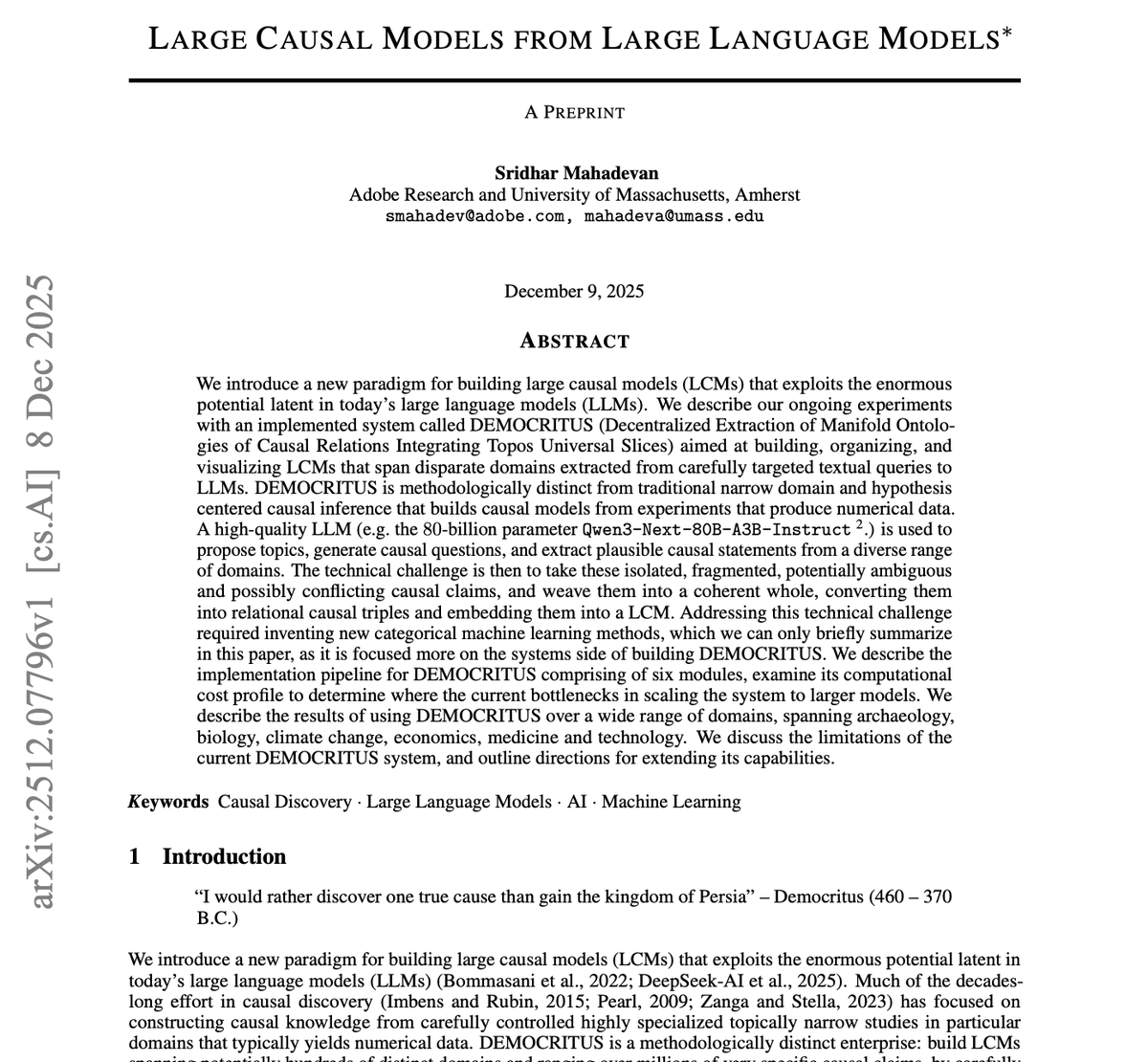
Holy shit… this paper might be the most important shift in how we use LLMs this entire year.
“Large Causal Models from Large Language Models.”
It shows you can grow full causal models directly out of an LLM not approximations, not vibes actual causal graphs, counterfactuals, interventions, and constraint-checked structures.
And the way they do it is wild:
Instead of training a specialized causal model, they interrogate the LLM like a scientist:
→ extract a candidate causal graph from text
→ ask the model to check conditional independencies
→ detect contradictions
→ revise the structure
→ test counterfactuals and interventional predictions
→ iterate until the causal model stabilizes
The result is something we’ve never had before:
a causal system built inside the LLM using its own latent world knowledge.
Across benchmarks synthetic, real-world, messy domains these LCMs beat classical causal discovery methods because they pull from the LLM’s massive prior knowledge instead of just local correlations.
And the counterfactual reasoning?
Shockingly strong.
The model can answer “what if” questions that standard algorithms completely fail on, simply because it already “knows” things about the world those algorithms can’t infer from data alone.
This paper hints at a future where LLMs aren’t just pattern machines.
They become causal engines systems that form, test, and refine structural explanations of reality.
If this scales, every field that relies on causal inference economics, medicine, policy, science is about to get rewritten.
LLMs won’t just tell you what happens.
They’ll tell you why.
New research just dropped: this prompting technique cuts AI hallucinations by 50%.
It's called Model-First Reasoning.
Instead of asking "How do I solve [xxx] problem?"
You first force the AI to list: what's involved, what can change, what actions are possible, and what's not allowed.
THEN you ask it to solve using only what it wrote down.
So what makes this different from Chain-of-Thought?
CoT lets the AI think and solve, but at the same time.
It sounds smart. It flows well. But it makes stuff up along the way.
Model-First Reasoning creates a hard wall instead.
Define first. Solve second. No mixing.
The AI can ONLY use what it wrote down in step one. That's the trick.
The researchers tested it on medical scheduling, route planning, resource allocation, and logic puzzles.
Same pattern everywhere: fewer broken rules, more consistent outputs.
Why it works:
✦ LLMs make things up because they assume stuff you never told them.
✦ When you force them to write everything down first, there's nowhere to hide.
✦ It makes a stronger case for why "Human-in-the-loop" works much better, too: we make sure every step is validated before going to the next.
You can read the paper here: https://t.co/vTuQvsNyCk.
@skyquake_1@moreproteinbars I am in equity events and special sits. That includes everything and anything which is not solely-related to earnings and value metrics, analyst estimates/targets, etc. M&A, speculation on M&A, activism in all its shades of grey, index rebals/passive effects, episodes of pure







![rubenhassid's tweet photo. New research just dropped: this prompting technique cuts AI hallucinations by 50%.
It's called Model-First Reasoning.
Instead of asking "How do I solve [xxx] problem?"
You first force the AI to list: what's involved, what can change, what actions are possible, and what's not allowed.
THEN you ask it to solve using only what it wrote down.
So what makes this different from Chain-of-Thought?
CoT lets the AI think and solve, but at the same time.
It sounds smart. It flows well. But it makes stuff up along the way.
Model-First Reasoning creates a hard wall instead.
Define first. Solve second. No mixing.
The AI can ONLY use what it wrote down in step one. That's the trick.
The researchers tested it on medical scheduling, route planning, resource allocation, and logic puzzles.
Same pattern everywhere: fewer broken rules, more consistent outputs.
Why it works:
✦ LLMs make things up because they assume stuff you never told them.
✦ When you force them to write everything down first, there's nowhere to hide.
✦ It makes a stronger case for why "Human-in-the-loop" works much better, too: we make sure every step is validated before going to the next.
You can read the paper here: https://t.co/vTuQvsNyCk.](https://pbs.twimg.com/media/G9Gn4wKbIAE-rj2.png)



