GPT-style chat is cool.
But agentic execution is the real battleground now.
Ring-2.6-1T looks engineered for exactly that:
orchestration, routing, coding, planning, and reliable long workflows ⚡
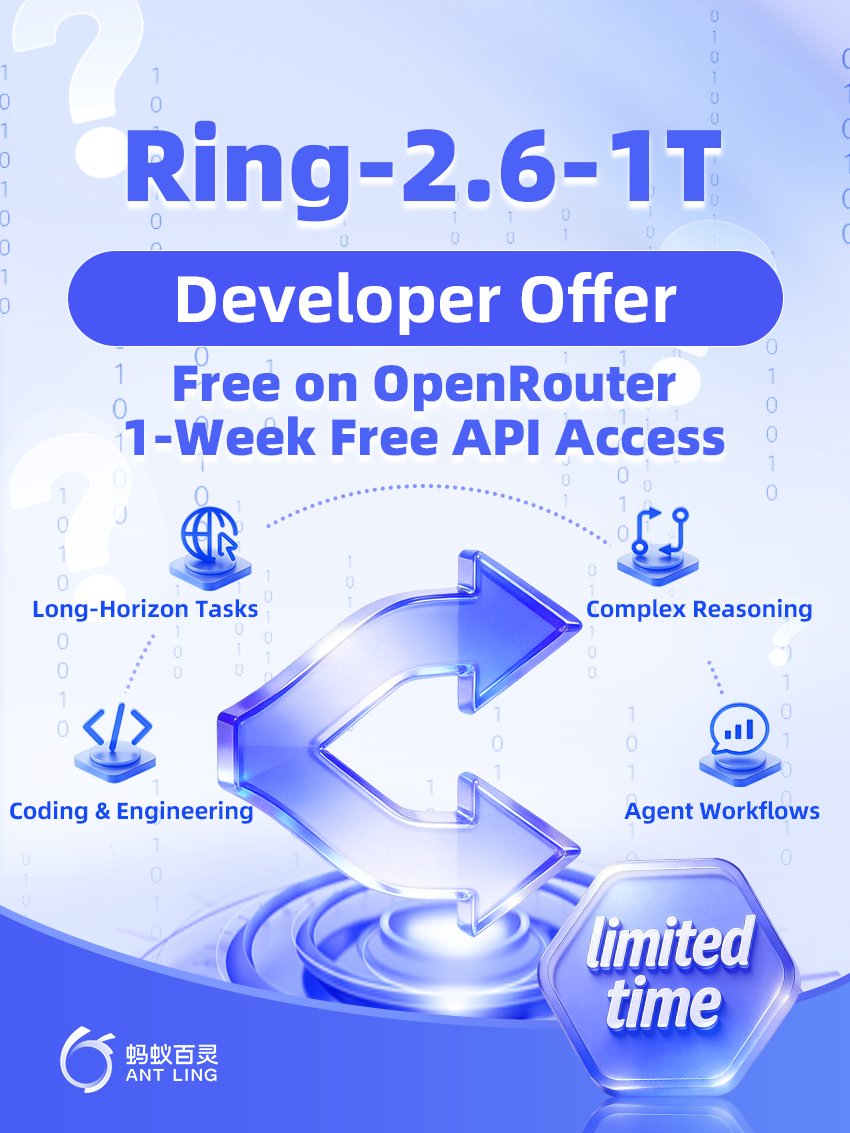
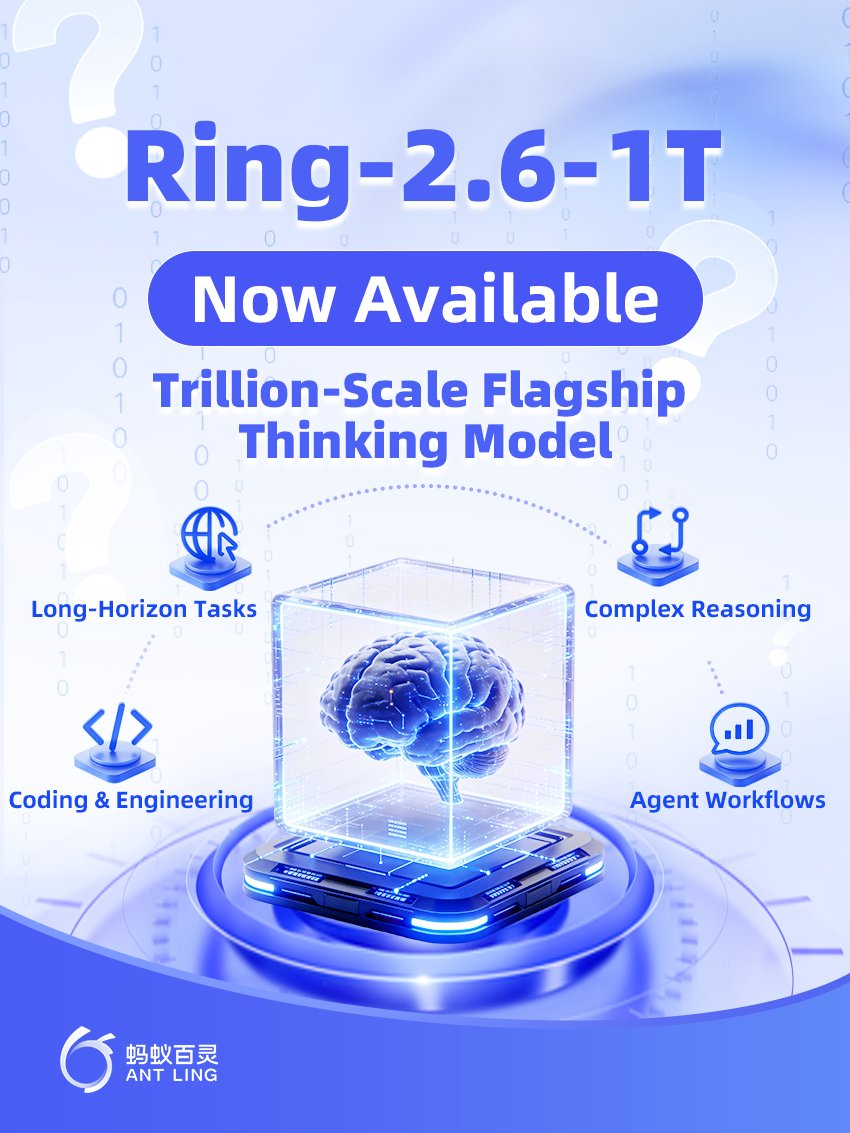
We are launching Ring-2.6-1T, a trillion-parameter flagship thinking model engineered for real-world complex tasks and production env: 🚀
- Adjustable Thinking Effort: dynamic compute mechanism to flexibly balance cognitive depth, token cost, and execution speed;
- Agent-Optimized: Built for high-frequency workflows, delivering rapid multi-step execution and tool orchestration with SOTA stability;
- Deep Thinking: Unlocks the model's maximum capability ceiling for rigorous mathematical logic and scientific research;
ai is getting smarter, but your personal ai should know you.
linger remembers your preferences and past decisions, connects your approved files and apps, and coordinates agents like claude code, codex, and pi.
plus 12 local open models and zero local token fees.
In the 1960s, computing was centralized until the PC put power into everyone's hands. Now Al is trained in datacenters and rented back to you token by token.
Today we open source Linger (@HeyLingerAl), your personal agent living on your own computer.
We believe intelligence should be distributed. Your context, your data, and the intelligence that powers them should be owned entirely by you.
Github: https://t.co/CS1Rj8H8yJ Homepage: https://t.co/R7clDJdc6i
AI winners won’t just build better models—they’ll build better infrastructure.
One interface for image, video, 3D, and audio lets teams test and ship faster, without constantly rewriting integrations.
That edge is bigger than it looks.
Comfy Router is live
One API for frontier image, video, 3D, and audio models.
Same model string. Same arguments. No new SDK, no new key, no redeploy.
What Comfy Router gives you:
→ Explicit routing. You name the provider, we call that provider. It's down? The request fails there. No silent fallback.
→ Every job returns the provider that ran it. Log it, bill it, debug it.
→ Async. submit() returns a request ID immediately. The queue retries 429s and transient errors until a slot opens. subscribe() submits and polls to completion.
→ Batch-friendly. Queue a few hundred jobs, hold the IDs, pull results as they land. Nothing blocking on a 5-min video render.
→ 24h retention on inputs and outputs, then deleted.
→ Comfy credits. No sub, no Router fee.
Providers at launch: Comfy. Runware, Wavespeed, Fal, Higgsfield. Multi-provider where the model supports it.
Get Your API Key with the link below. ⬇️
We raised $21M to help small businesses beat the giants
We're giving $1M of it back to you today
Today we're launching Runable Grow: world's first agent that runs your entire go-to-market. 24/7
The last few months have been unreal.
Millions of users came to @runable_hq and built their entire business on it, websites, databases, payments, analytics, pitch decks, product videos & scheduled work.
Every single one of them asked the same question:
"How do I grow it?"
So we built the answer.
Runable Grow handles GTM end-to-end:
→ Runs ads on Meta, Google, and ChatGPT without any account, fully managed by Runable
→ Cold calls + cold emails from a real phone number and your business inbox
→ Generates and qualifies leads
→ Social listening
→ SEO + AEO optimization
Not a dashboard. Not a "copilot."
An agent that does the work.
It's a world-class media buyer, SDR, SEO lead, brand analyst working for your business while you sleep.
Don't believe me? Prove me wrong.
Your first $100 on Grow is on us. Every paid user. No catch.
Go break it 👇 https://t.co/92GPjhRyQA
Today, we're launching Monaco into General Availability.
We onboarded several hundred hypergrowth startups during our beta. The results are staggering:
The average customer added 16 percentage points to their month-over-month revenue growth rate.
The average customer tripled their monthly meeting volume.
With today's release, Monaco is now the most advanced AI sales platform in the world.
Monaco customers have an unfair competitive advantage.
We raised $22.5M to fix both halves of the custom medical device supply chain: the paperwork that blocks them and the manufacturing that slows them.
In America 🇺🇸, it's easier to prescribe a patient opioids than to get them custom insoles to prevent amputation. Three generations of my family watched that up close and couldn't fix it. Here's what we've built @HikeMedAI :
397B Isn't the Headline
397B parameters gets attention.
Self-improvement gets mine.
Ornith-1.5 can generate tasks, build scaffolds, create solution rollouts, and use them for reinforcement learning.
The future of scaling may be about more than parameters.
Aloha! 🌺Introducing Ornith-1.5, a family of open-source LLMs spanning 9B Dense, 35B MoE, and 397B MoE, trained with self-improving strategies.
It achieves state-of-the-art performance among open-source models of comparable size and delivers performance comparable to Claude Opus 4.8 across reasoning, agentic, and coding tasks:
✅Terminal-Bench 2.1 (86.1)
✅SWE-Bench (86 on verified, 65.1 on pro, 79.6 on Multilingual)
✅DeepSWE (56)
✅HLE (44.6)
✅ClawEval (81.4)
✅Tool Decathlon (71.2)
Ornith-1.5 takes a major step toward training foundation models through end-to-end self-improvement, extending the self-scaffolding strategies introduced in Ornith-1.0 into a more complete self-improvement loop: the model proposes new tasks, generates task-specific scaffolds, and produces solution rollouts for reinforcement learning, continuously creating new learning experiences from which it can improve.
All models, along with their quantized versions (FP8, GGUF, MLX, and NVFP4), have been released under the MIT License, enabling unrestricted commercial and research use.
📘Tech Blog: https://t.co/OZ63scRWLB
🤗Huggingface: https://t.co/mGJLwhrQOM
The wild part isn’t 28B.
It’s 28B + 10M context + strong agentic performance + single-GPU deployment.
That combination makes Pokee-Isaac 28B seriously hard to ignore.
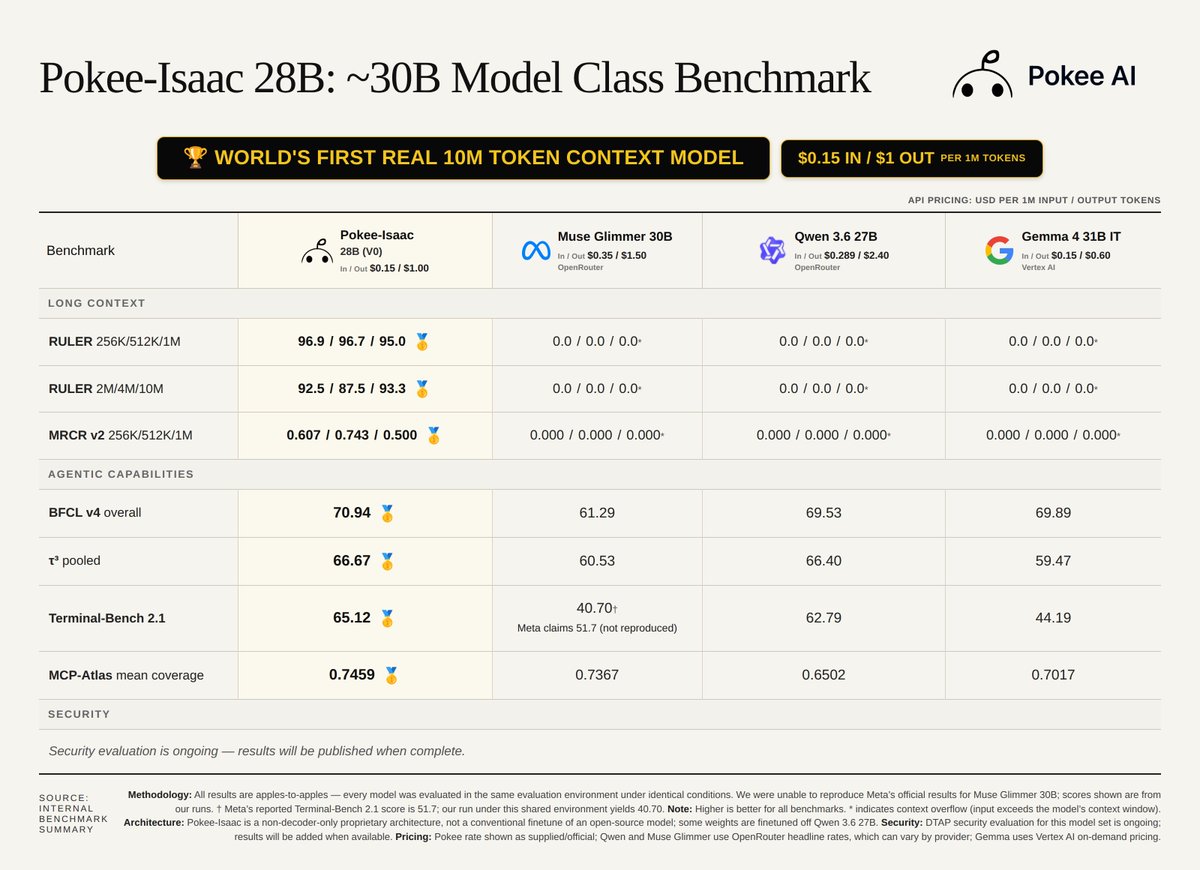
Meta just released Muse Glimmer 30B. So we put it side-by-side with Pokee-Isaac 28B, Qwen3.6 27B, and Gemma 4 31B.
Same ~30B weight class. Same evaluation environment.
Pokee-Isaac leads across every agentic benchmark we tested:
BFCL v4: 70.94
τ³-bench: 66.67
Terminal-Bench 2.1: 65.12
MCP-Atlas: 74.59%
And then there’s Pokee-Isaac's unique long-context capabilities:
93.3% RULER at 10M context
0.5 MRCR v2 at 1M token context
where all other models score 0!
All in a 28B model deployable on a single GPU.
The ~30B local frontier is getting very interesting.
Bigger isn't always better. Ling 3.0 Tiny proves you can get serious reasoning, local inference, and tool use from a model that activates just
1.3B parameters per token. Efficient AI is becoming the new competitive advantage.
Today, we’re releasing Ling-3.0-tiny: 7.9B total parameters, with only 1.3B active per token.
A native hybrid reasoning model built for real-world tasks, math, instruction following, and resource-sensitive deployment.
More intelligence with less compute. 🧵
Long-context AI only matters if it can actually reason across that context.
Leading benchmarks like BFCL v4 and τ³-bench, combined with a 93.3% RULER score at 10M tokens, suggest Pokee-Isaac 28B isn't just remembering more—it's using that information effectively.
Releasing Pokee-Isaac 28B — the world’s first real 10M-token context frontier-class agentic model, deployable on a single GPU (starting from RTX 4090 or equivalent).
New proprietary non-decoder-only architecture:
• 93.3% RULER at 10M tokens
• Up to 137K tokens/s prefill on one B200 with 10M-token context
• Leads BFCL v4 and τ³-bench in our evaluation
• Lowest combined attack success rate among evaluated models on DTAP security red-teaming benchmark
Pricing and deployment:
💰 $0.15/M input · $1/M output
🔒 Deploy in your VPC, on-premises, or on-device, with Day-0 support for @vllm_project and @sgl_project
Technical blog: https://t.co/nFqaYBlcQP
Technical report: https://t.co/XDOoZxpgJx
API: https://t.co/KYj8fOOjNS
Video Podcast is live.
Turn any doc, link, or idea into a two-host video show with studio scenes, multi-cam cuts, and B-roll. Ready in minutes.
Everyone else stops at audio. This is a show you can publish.
Try it: https://t.co/mwV67pFCDT
A model built for production scale agents and free to use until August 3.
That's the kind of launch more AI teams should be doing. Lower the barrier and let the community decide.
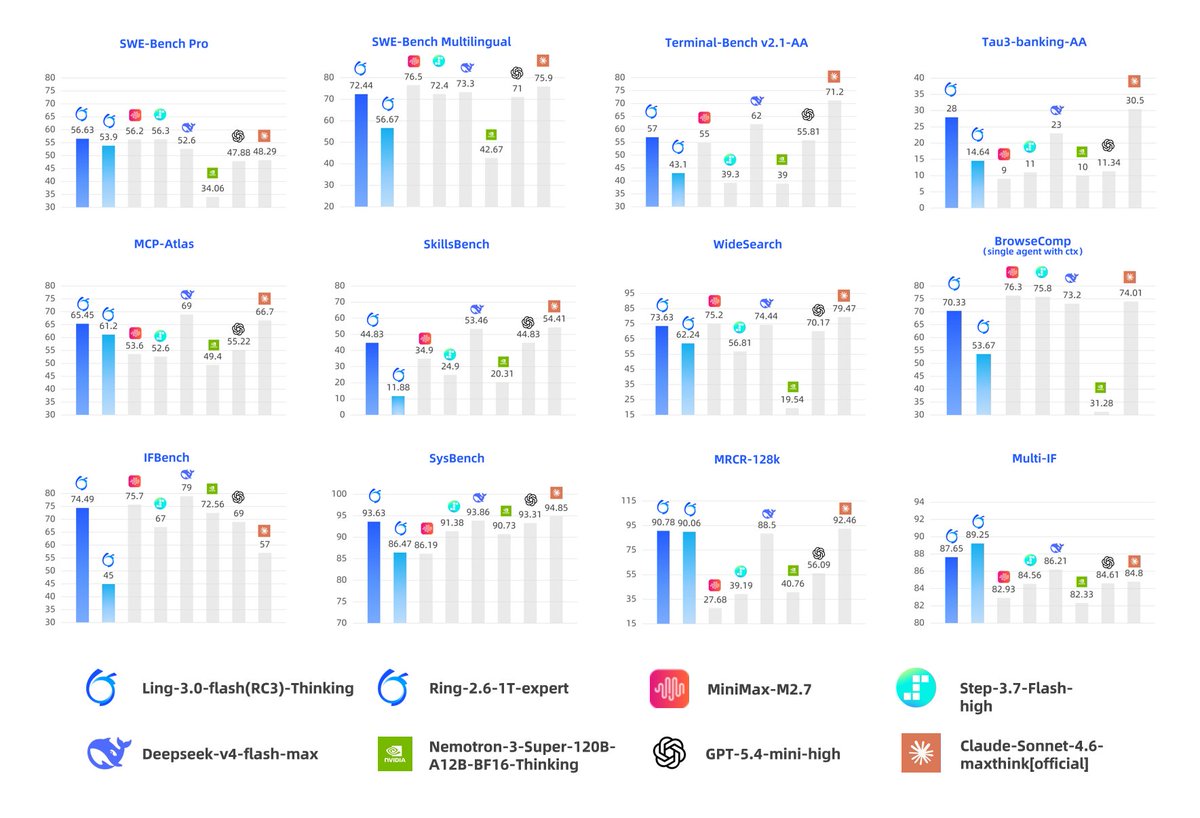
Today, we’re releasing Ling-3.0-flash—a hybrid-reasoning MoE model built for production-scale agents.
124B parameters. Just 5.1B active per token.
With 1/8 of the total and 1/12 of the active parameters, it matches or beats our 1T flagship model on most benchmarks shown.
The future of business is borderless.
Your financial platform should be too.
Flex Global is built for companies that think beyond one market and plan for worldwide growth.
We conquered the US over the last 3 years.
Flex grew to a $1.2B+ valuation and $10B+ in annualized payment volume.
Today, we’re bringing that same experience to businesses all around the world.
Introducing Flex Global:
170+ countries
32 currencies
2% cashback
24 products
🏆 $10,000+ in prizes
🔥 The hottest AI developer tools — all in one place.
🌟 100+ AI engineers from top AI Labs
🚀 The BIGGEST AI Hackathon of the Summer is here.
Shanghai AI Lab just published a 58-page position paper trying to settle what "world model" actually means. Their definition quietly demotes Sora-style video generation from main event to side effect. Worth breaking down.
Nobody tweets demos of policy evaluation, but this is the part of world models where the money is.
The real bottleneck in robotics right now: policies improve faster than anyone can physically test them. 324k simulated rollouts to grade policies attacks exactly that. The one number I'd want before trusting it, though, is the correlation between world-model score and real-world success rate. Policies exploit simulator errors. A great score inside the model can just mean the policy found the blind spots. The old model-based RL crowd had a name for this: hallucinating value.
Generation gets the demos. Evaluation gets the deployment.