ALPHEUS is a €5m project funded by the European Union’s Horizon 2020 program. This project receives funding from the @EU_H2020 Research & Innovation.
Programme.
The team aims to discover whether low-head PHS is a feasible technology in the North Sea to cope with the problem of large-scale renewable energy storage.
https://t.co/DJQMtngHOW
#H2020#NationalHydropowerDay#HydroDay
Work Package 3 has the aim to develop a power take-off (PTO) powertrain architecture with multidimensional machine-side control to maximize efficiency and minimize mode switching time of the turbine.
https://t.co/6LwQWUtSC2
#ALPHEUS#H2020#workpackage
Since the 2021 Newsletter, the work of the Consortium has well advanced, and we would like to thank all members of the Consortium and their collaborators for the enormous research work they have done.
Enjoy the reading on https://t.co/shv1X2HktO
#ALPHEUS#H2020
It is our pleasure to introduce the second Newsletter of the #ALPHEUS research project to you. #H2020
It presents the recent research results and gives you an insight view from the design of the turbines to the dam design and the discussion on finding suitable sites.
Work Package 2 has the aim to develop propeller type and positive displacement runners and casings that operate efficiently in both pump and turbine modes with application of laboratory and numerical methods.
https://t.co/D4ZauCdk5V #ALPHEUS
7 work packages have been created for the #ALPHEUS project - a tangible work-plan to achieve the project objectives and suggested concept.
Each work package break down the different tasks, deliverables, and milestones of the project.
The Pumped Hydro Storage (PHS) is used for this purpose in mountainous regions such as Norway and the Alps, but low countries do not have the natural topography needed for PHS.
This is why the #ALPHEUS project has been created.
#H2020
Renewable energy is essential for our global efforts to decarbonize and slow the rate of global warming.
The consumption of energy by industries and individuals often does not coincide in time with the generation of energy by the win or sun.
Energy storage is then needed.
ALPHEUS project team members are working hard, even during the summer period!
Jonathan Fahlbeck, PhD student, and Prof. Håkan Nilsson were at the IAHR 2022 - 31st Symposium on Hydraulic Machinery and Systems.
#IAHR2022#OpenFOAM#ALPHEUS#H2020
In the ALPHEUS project, Reversible Pump-Turbine (RPT) technologies are developed that can augment grid stability in regions with a flat topography.
Read more on https://t.co/Urhr4DcOvm
Conference paper: https://t.co/IMqq0dmtYg
#ALPHEUS#H2020
The implementation of large civil structures can face opposition from the public.
#ALPHEUS developed a stakeholder questionnaire to gather general stakeholder concerns respecting the low-head PHS technology.
Learn more about the analysis on https://t.co/3yIbPIsGFo
At Ghent University, a dry emulation test-setup is developed to validate the machine-side control architectures that control the different low-head reversible pump-turbines (RPT).
Read more on https://t.co/fvFwsKjo9u
#ALPHEUS#H2020#energytransition
To analyse the impact of providing grid-supporting FCR on the fatigue life of the counter-rotating Reversible Pump-Turbine (RPT), three different partners within the ALPHEUS project joined forces.
Read more on https://t.co/VsJLtQG2GU
#ALPHEUS#H2020#energytransition
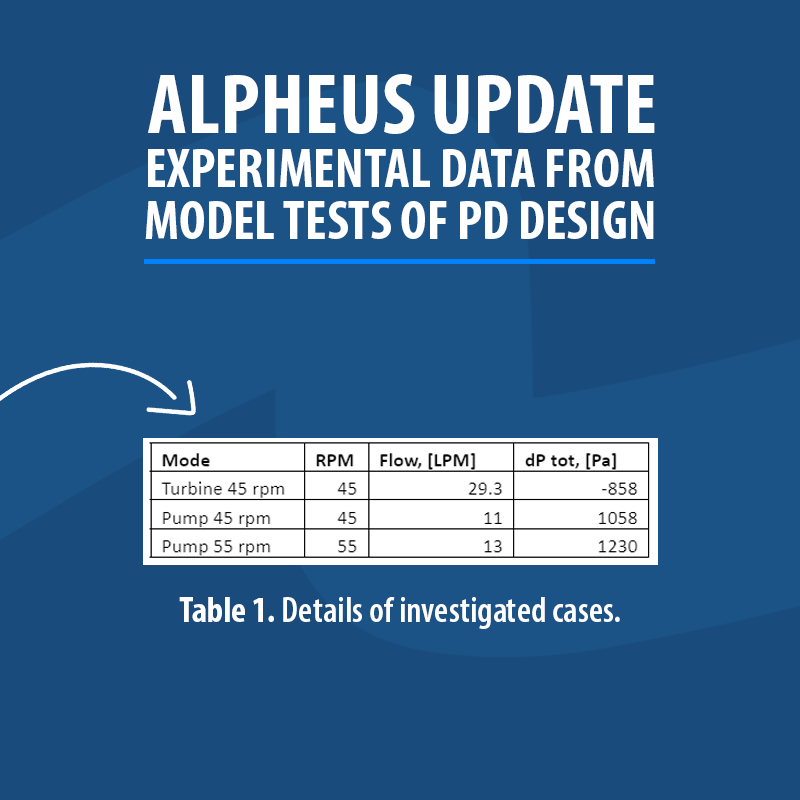
Experiments were run in both turbine and pump mode, the latter at two different rotational speeds.
The details on global parameters for the cases are seen in Table 1.
#ALPHEUS#H2020
Update on deliverable 2.5: Experimental data from model tests of PD design.
PIV experiments of a positive displacement pump of the ALPHEUS project has been performed at Chalmers University. The test section CAD geometry can be seen in Fig. 1.
#ALPHEUS#H2020
To shift the operating range of PSH into the low-head region, ALPHEUS proposes a novel system comprised of several newly developed components.
Learn more on https://t.co/RAs6nJlUU5 written by Antonio Jarquin Laguna and Justus Hoffstädt
#ALPHEUS#H2020