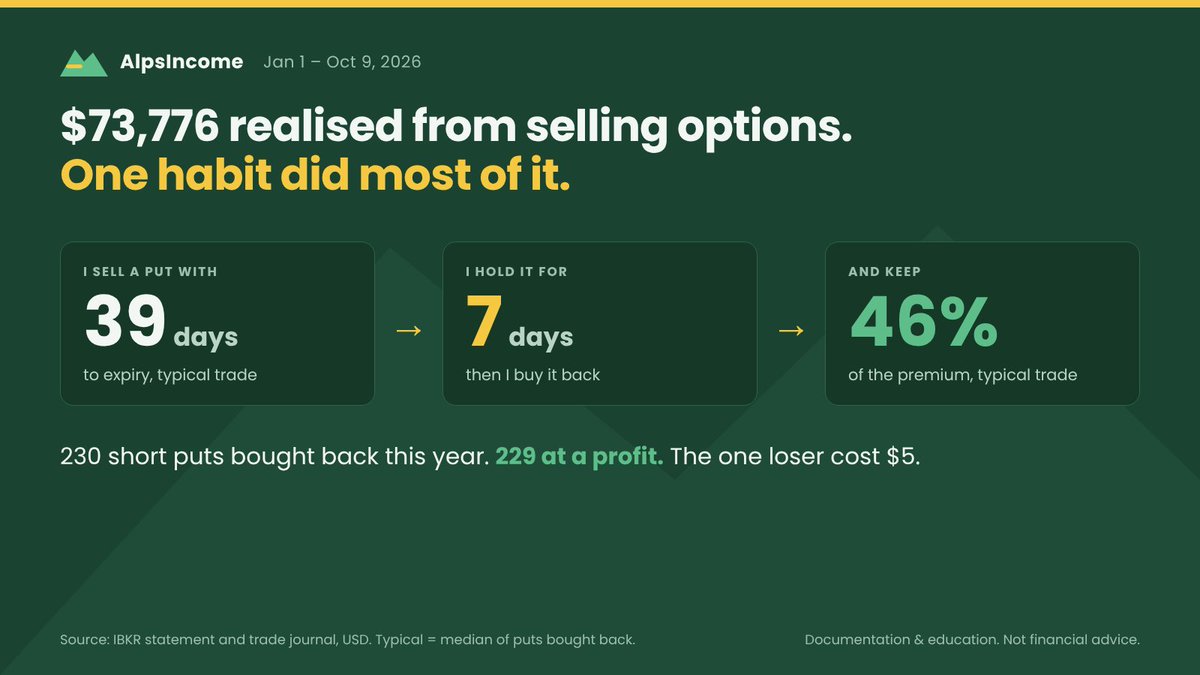
$73,776 realised from selling options this year.
One habit did most of it.
My typical put has 39 days to expiry when I sell it. I hold it for 7.
By then about half the premium is gone, so I buy it back and sell the next one. I don’t wait for the last dollars. They take the longest and carry the most risk.
230 puts closed this way in 2026. 229 at a profit. The one loser cost me $5.
Small wins, taken early, repeated. That’s the whole engine.
When do you take profits: at a fixed percentage, or at expiry?
Documentation and education, not financial advice.
Expiration Friday. S&P down 7 days in a row, VIX near 30.
What I did:
• Took assignment on $META, $GOOGL, $AMAT. Shares are paid in cash, no margin.
• Sold Jan calls above net cost: META 680C, GOOGL 315C, SPCX 165C = $1,386 premium
• Closed two Dec calls early: +$416 realized
• Bought my first hedge: 3x $QQQ Feb 610/550 put spreads for $4,132, max payout $18,000. Covers about half my tech risk.
• Zero new puts. S&P is below its 200-day, so the brakes stay on.
What I did not do: sell shares at the lows.
The account is deep red on paper. The plan is unchanged: collect premium, keep the insurance, wait for the trend to turn.
Education & documentation, not financial advice.
Red tape, green premium.
S&P below its 200-day, VIX term structure inverted. My rule on days like this: no new puts. The premium comes from what I already own.
Today:
• Bought back 4 covered calls at 36–71% profit
• Sold new ones further out, every strike at or above my cost basis
• Closed a PANW put after earnings for +$165 instead of taking delivery at $360
Realized today: ~$1,250
New call premium collected: $1,291
When the market won't pay you to take new risk, get paid on the risk you already hold.
Education & documentation, not financial advice.
#options #wheelstrategy #coveredcalls
My filter cost me $85 last night. I’m keeping it anyway, but I’m fixing it.
Yesterday I said $TGT would get a final check at 9:30pm CET. Tight spread or no trade.
The check:
Spread 4.4% ✅
Open interest 2,016 ✅
Strike 12% below price ✅
Size on the bid: 12 contracts ❌ (my rule says 25)
So I passed.
This morning Target beat ($2.65 vs $2.05 expected) and raised guidance. Implied vol collapsed from 114% to 35%. The $140 put I would have sold for $0.89 traded at $0.04.
That’s 96% of the premium. About $85 per contract, overnight.
Was the rule wrong? Not exactly. A depth minimum protects you when you size up. But I trade 1–2 contracts on earnings. 12 on the bid is plenty for that.
So the rule changes from “25 contracts” to “5x my own size.”
That’s the real edge in options selling. Not the trade you take. The rules you write down, test, and fix when the data says so.
Same night, my automated shadow log tracked 4 other earnings names. Only one would have been a real winner. It was the one I skipped. 😅
Do you have a hard rule that’s ever cost you a winner?
Education and documentation of my own trades. Not financial advice.
The market is red. My process isn’t.
Today in my options book:
✅ $DIS earnings: sold the $110 put the night before for $0.89. Bought it back this morning for $0.20. +$67 overnight, 78% of the premium kept. Textbook IV crush.
❌ $NVDA earnings tonight: passed. Clean chain, fat premium. But too much noise around the name, and I already carry enough AI exposure. A trade you skip can’t hurt you.
⏳ $TGT: final check at 9:30pm CET. Tight spread or no trade. Nothing forced.
The honest part: the S&P is ~6.5% off its high, the Nasdaq is in correction, and four of my puts expire in the money on Friday. I’ll take the shares and start selling calls Monday. That’s the wheel. Assignment isn’t the end of the trade, it’s the next step.
Lesson I’m writing down today: my AI cluster was too big. The warning was in my own journal when I opened the trades. The flag worked. I didn’t act on it.
Patience pays in this game. Panic doesn’t.
Education and documentation of my own trades. Not financial advice.
The market dropped today. I collected $1,380 in fresh premium anyway.
Here’s what a red day looks like when you run the Wheel on purpose 🧵
The S&P slipped below its 50-day average. Almost every stock I own was red. My account had its ugliest daily P&L in weeks.
So what did I do?
1. Took profits that were already on the table
→ $MRK put: bought back at 1.10, +$230
→ $MS calls: closed at 0.51, +$189
→ $CAT call: closed at 2.11, +$245
→ $IREN call: closed at 0.07, +$13
Realized today: $678. A falling market makes short options cheaper to buy back. That’s the moment to close them.
2. Sold new premium right away
→ $MS Dec 195 calls ×2: $692
→ $CAT Feb 760 call: $643
→ $IREN Feb 38 call: $45
Every stock I hold now has a covered call on it. 9 positions, 9 calls. No share sits idle.
3. Said no to the obvious trade
$NVDA is down 30% in 3 months, with an RSI of 24 and earnings tomorrow. The premium looks juicy. But my system says: trend broken, momentum gone, event risk overnight. That’s not a discount. That’s a falling knife.
Discipline isn’t about the trades you take. It’s mostly about the ones you skip.
4. Planned the next step before it happens
4 of my puts will likely be assigned on Friday. That’s not a disaster. That’s the Wheel working as designed:
Sell put → get assigned → sell calls above your net cost → repeat.
The rule I never break: never sell a call below my net cost basis (unless I’ve decided to exit the position).
Red days don’t stop the income. They just change where it comes from.
—
Education and documentation of my own trading. Not financial advice.
🔁 Repost if this helps someone stay calm on a red day.
@StocInsights Higher vol improves the put credit but I still refuse the trade if the strike is not an ownership price I want. The cash set-aside remains the ticket limit. How do you filter quality names when vol spikes?
@InvestwithColby Once I own the shares I write the covered call off the reduced basis, not the old entry. The 50 percent close decision on the call stays separate from the share basis. Do you set the call strike before or after you see the new basis?
@eddyluxe_ Early assignment is rare but it forces the basis update immediately. I log the shares at strike minus premium and decide the next covered call from there. Do you have a fixed rule for accepting the early fill versus rolling?
@BlueDiamond2077 Assignment locks the put premium into the share basis right away. I only write the next covered call once that basis is in the ticket. Did the McDonalds exit change how you size the next put?
@mintedtrading I set the cash aside as the hard ticket size before I even check the premium. If the strike is not a price I would hold anyway I skip it. Do you lock the ownership rule first or let the credit size the trade?
@mrtoptick After the put fills the only number I care about is strike minus premium. That becomes the basis for any later covered call. Do you rewrite the call rule off the new basis or keep the original plan?
Next Friday, 4 of my cash-secured puts get assigned: AMAT, GOOGL, META, PANW.
Most traders see that as a loss.
I see it as step two of the wheel.
Here’s what those shares can earn the moment they land, with every call strike at or above my net cost basis (Jan ‘27 calls, today’s quotes):
• META 680C → ~$2,290
• PANW 360C → ~$1,675
• AMAT 430C → ~$1,120
• GOOGL 315C → ~$865
≈ $5,950 in premium over ~2 months, on stocks I picked because I’d be happy to own them.
Two rules make this work:
Never sell a call below your net cost basis. If the stock gets called away, you exit with a profit plus the premium.
Know when to stop. My margin sits above my 32% limit today, so: zero new puts. The system decides, not the itch to trade.
Assignment isn’t the end of the trade. It’s the next paycheck.
Education and documentation of my own trading — not financial advice.
#Options #WheelStrategy #CoveredCalls #CashSecuredPuts
@858silver Selling puts into the move. I only take the ones where I already want the shares at that strike. Did the premium cover the risk you actually took today?
@the_PA_trader89 Rolling for a net credit on the CSP. I only roll if the new basis still looks like a buy I want. Did the roll keep your effective basis inside the range you set?
@3PeaksTrading Premium on those June 27 150s moved that fast. I usually check the bid-ask width before I scale in. Was the fill quality still tight when it dropped to 14?
@SuperMariossss I write the call off the current basis, not the original entry. Do you lock the strike rule before the stock moves or wait for the open?
@ceddiexilin I keep the put premium out of the blended average until assignment actually hits. Do you treat the direct lot and the put lot as one number right away or keep them separate until the put fills?
Caterpillar was put to me at $770.
Today it trades at $605.
Most people panic here. I sold a call instead.
→ Sold 1x $CAT Jan 15 $760 call for $4.58 = $458 cash today
→ 64 days, delta 0.10 – roughly 90% odds it expires worthless and I keep shares + premium
→ Strike sits above my net cost basis, so even if CAT gets called away, I close green
My net basis drops to $750.25. Next call, it drops again.
That's the wheel:
The stock doesn't have to climb back to $770.
The premium walks the cost basis down to the stock.
November so far: $3,880 realized premium. Month is 40% done.
Education and documentation of my own account. Not financial advice.
#options #wheelstrategy #coveredcalls
@JayThetaIQ Sitting on the shares with a known basis I only sell the call if the credit improves the exit enough. Earnings IV can look fat but the gap risk is real. Do you wait for the print or take the premium now?
@OptionEdgeHQ I keep a fixed cash buffer so assignment never forces a sale. The size of that buffer decides how many puts I can run. What fraction do you leave free?