Join our sister team! @HumaneSociety is hiring a science advisor to provide scientific advice on programs aiming to replace the use of animals in testing and research through regulatory, legislative, and corporate reforms!
More info/apply 👉 https://t.co/cPmDcHw7x0
Attending #2022SOT in San Diego? Check out our satellite session with @jhucaat, “21st Century Toxicology: Updates on Relevant Domestic and International Activities” Thursday, March 31, 12:30-4:30 PM.
More info (click on Thursday, March 31) 👉 https://t.co/caXJLuTbc2
📣 Registration is now open for our 4 new preview #webinars! The 1st module, #ConsumerExposure, will cover in-use scenarios & how subsequent local & systemic #exposuremetrics can inform the amount of data needed to support a #riskassessment.
Register: https://t.co/S74LUCtNoX
Students & early career scientists: Are you worried about the costs of attending @PCRM’s Summer School on Innovative Approaches? Do you have a strong interest in non-animal methods? Check out #ASCCT's travel awards! → https://t.co/K0Qvox6Xvp
Funding call! @jhucaat's 2023-2024 Alan and Helene Goldberg in vitro toxicology grants are accepting pre-proposal submissions! Submit your best non-animal ideas before April 15! 👉🏽https://t.co/AwIplgO0QP
📣 To mark the 9th “banniversary” of EU becoming world’s largest #crueltyfree cosmetics market, @AFSAcollab is excited to announce our new initiative to help the 🌎 transition to a modern, #animalfree approach to cosmetics #safety assessment. Countdown is on - details coming Mon!
Are you a UK-based life science student who is interested in human-relevant research? Check out these summer studentships from @AFRUKScience, which offer funding for consumables & a stipend to carry out your animal-free project!
Apply by March 29 → https://t.co/NCtjMzMHzR
.@OECD will discuss @EU_sciencehub’s report ‘Addressing evidence needs in chemicals policy and regulation’ at their upcoming webinar next Wednesday (March 16) at 1pm CEST. Register👇
https://t.co/gjEfVgrOMs
Coffee break reading! This informative piece from @ScienceLine explores how combining organ-chip technology with #AI could revolutionise drug development. https://t.co/cNRaiQcn4T
Watch this charming and informative video from @EFSA_EU explaining how the “weight of evidence” approach can be used to justify accepting the fish embryo toxicity test to predict toxicity.
https://t.co/7Qw19MqIjH
The latest paper from @NKleinstreuer & colleagues describes the development of a computational approach to predict drug-induced cardiotoxicity.
Read all about it!👇
https://t.co/rS66NBTgWm
"Ultimately, I want to build a heart for a sick kid."
Check out these beauties created by the ever-inventive Kit Parker from @hseas & @wyssinstitute. These robofish are modeled on zebrafish, but human heart cells are contracting to move them!
https://t.co/op9tORWjXB
This exciting new paper explores the concept of "clinical outcome pathways"—the practice of applying the AOP framework to the clinic to accelerate drug discovery and enable effective drug repurposing.
https://t.co/xeWhu1BNmW
Check out @aic_cphms' new webinar series focused on computational systems & predictive biology! Tune in on Saturday at 11am IST to hear Dr. Nagasuma Chandra from @iiscbangalore answer the question "can biology be a predictive science?"
Register → https://t.co/8Zoz87XkQt
Have you published a paper that has or could have major impacts on the replacement, reduction or refinement of the use of animals in research? You could be eligible for the @NC3Rs International 3Rs Prize! Apply by April 6.
https://t.co/DTPWjkIcp2
Funding news! @theNCI is offering grants to support the development and characterization of state-of-the-art biomimetic tissue-engineered technologies for cancer research.
More info → https://t.co/Rft8WkTRq6
This report from @EU_ScienceHub explores what is needed for current and future chemical safety regulation, taking into account recent advances in toxicology methods & the requirements of the Chemicals Strategy for Sustainability.
👉https://t.co/He4XzpWW4d
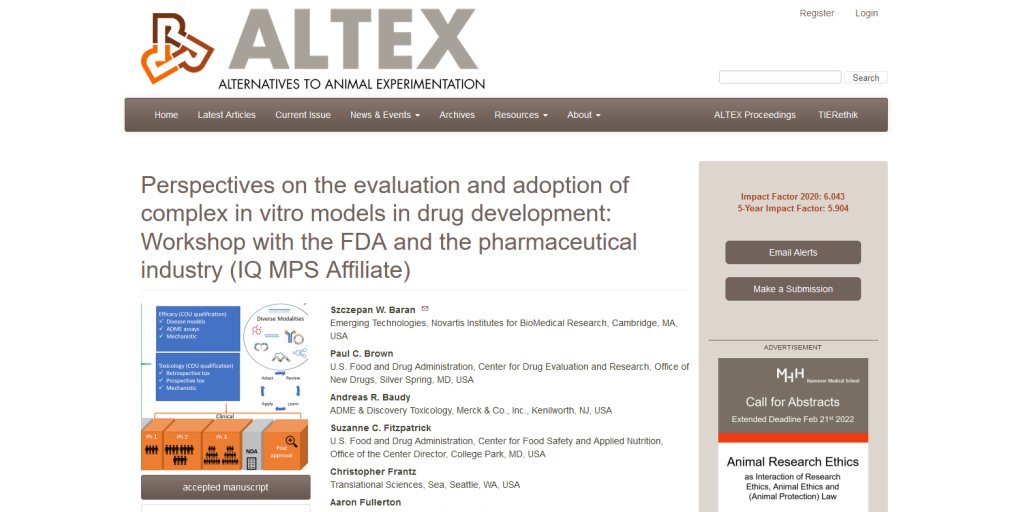
Great workshop report about the industry perspective on what is required to promote the use of complex in vitro models for regulatory purposes for drug development.→ https://t.co/yRYv9Xv7LT
Congratulations to @BarrileR, whose exciting new project (made possible by a @jhucaat Alan and Helen Goldberg In Vitro Toxicology grant) aims to use blood vessel chips to develop a validated translational platform for de-risking vaccine development! https://t.co/a8SJhP2mzC
This is a great summary of @Herophilus_SF’s work to develop and screen patient-derived brain organoids by applying functional genomics to reveal novel validated targets and ultimately identify novel therapeutics for brain diseases.
@neurotheory
https://t.co/AjGO2vdbBk